
Your novel is ready for readers. The final chapter is finished, the manuscript has been revised, and you're wondering where the story should go next.
Amazon Kindle? Other ebook stores? Or a platform where readers follow the novel chapter by chapter?
All three can work, but they are not the same kind of publishing.
One turns your finished novel into a book customers can buy. Another makes it available across several retailers. The third lets readers experience the story as an ongoing release, often before the complete novel becomes a book.
Choosing between them affects your publishing rights, earnings, file preparation, release schedule, and future options.
At Amazon KDP Experts, the publishing process starts with a practical question: what stage has the manuscript reached, and what does the author want the finished book to achieve?
That question matters here, too. Before opening a publishing account, you need to decide what kind of publication you're actually planning.
Key Takeaways
- Amazon KDP is a practical starting point for authors who want to sell a completed novel as a Kindle ebook, paperback, or hardcover.
- Wide distribution lets authors offer eligible ebooks through multiple retailers rather than relying on one store.
- Serial fiction publishes a story in installments, which suits authors prepared to release chapters consistently.
- KDP Select is optional. Its exclusivity applies to the enrolled Kindle ebook, not the novel's print editions.
How Do You Publish a Novel Online?
To publish a novel online, finish and prepare your manuscript, choose a publishing model, check your rights, format the content, create a suitable cover, enter your book information, and submit it through your chosen platform. You can publish a complete novel through Amazon KDP or wider ebook retailers, or release it chapter by chapter through a serial-fiction platform.
The first decision is whether you're publishing a finished book or an ongoing story.
A completed novel usually needs editing, a cover, book metadata, pricing, distribution settings, and a reader-ready ebook file.
A serialized novel needs an opening that works episode by episode, reliable chapter divisions, and a publishing schedule you can maintain.
Both require care. They simply ask for different kinds of preparation.
Which Online Publishing Route Is Right for Your Novel?
Before comparing websites, compare what each publishing model gives you.
| Publishing route | What readers receive | Main advantage | Main consideration |
|---|---|---|---|
| Amazon KDP | A complete Kindle ebook or printed book | Direct Amazon publishing and print-on-demand | Amazon-focused retail reach; optional ebook exclusivity through KDP Select |
| Wide ebook distribution | A complete ebook available through selected retailers | Broader retailer and geographic choice | Multiple store requirements, reporting and distribution settings |
| Serial fiction | Chapters or episodes released over time | Allows readers to follow a story as it develops | Ongoing publishing commitment and platform-specific rights |
| Combination strategy | Different editions or titles through different routes | Flexibility across formats and books | Requires careful rights, ISBN and distribution planning |
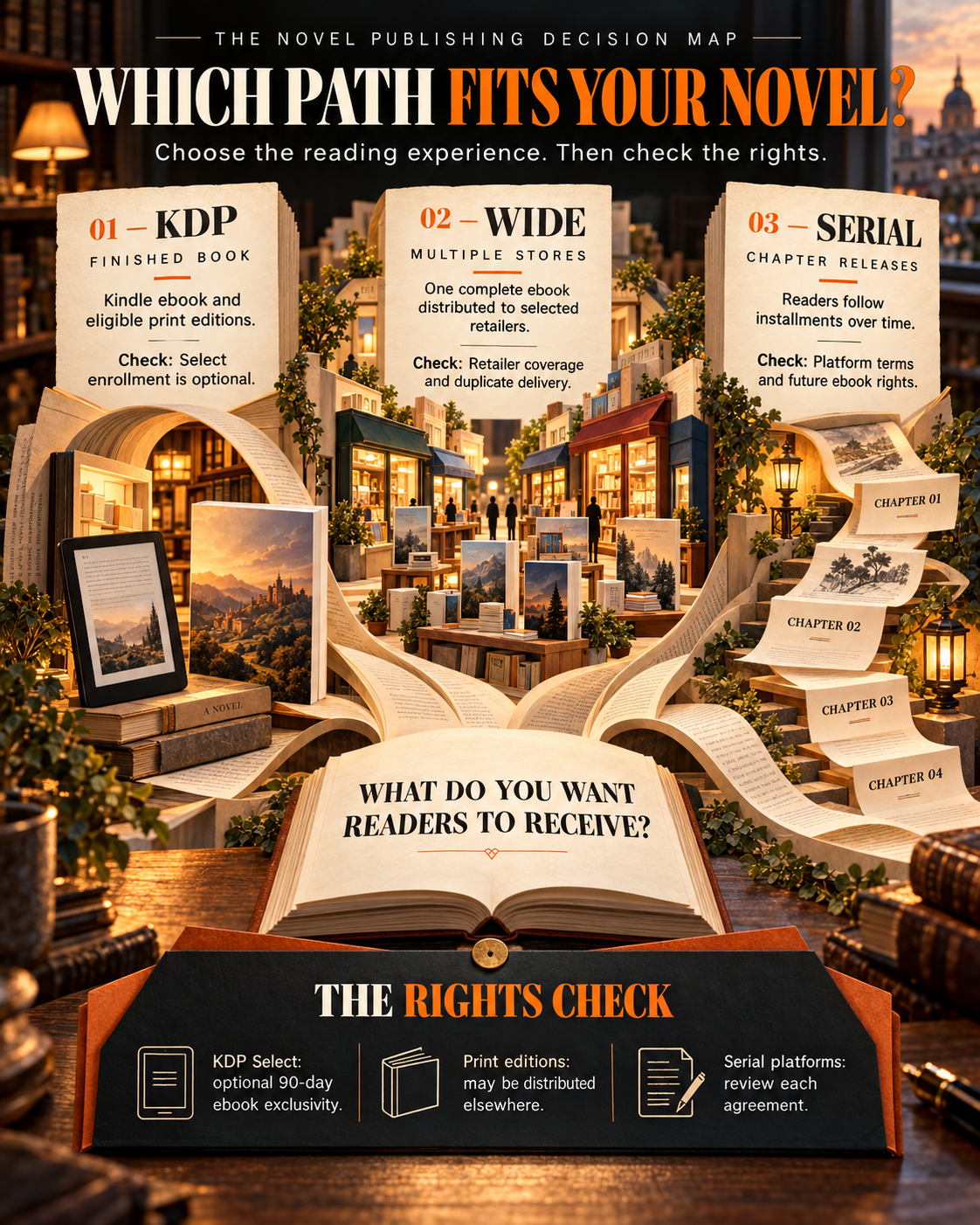
A single novel can eventually move through more than one of these models.
For example, you may serialize a fantasy story before preparing a revised ebook edition. Or you may publish a Kindle ebook through KDP while making that same ebook available through other retailers without enrolling it in KDP Select.
The order matters, particularly when exclusivity is involved.
Option 1: Publish Your Novel on Amazon KDP
Amazon Kindle Direct Publishing, commonly called KDP, lets independent authors publish ebooks and eligible print editions without paying an upfront platform publishing fee.
You do not need a traditional publishing contract to use it. You do need the necessary publishing rights and files that meet the platform's requirements.
What You Need Before Uploading
Prepare the following:
- Final edited and proofread manuscript
- Kindle-ready ebook interior
- Cover image that fits the book's genre
- Book title, subtitle if applicable, and author name
- Description written for prospective readers
- Relevant categories and search keywords
- Publishing rights and territory information
- Pricing decision
- Paperback or hardcover files if you also want print editions
For a standard text-based novel, a reflowable ebook usually provides the most suitable reading experience. The text adapts to different screen sizes and reader settings rather than remaining locked into printed pages.
If your manuscript is still a Word document full of manual page breaks, inconsistent headings, or fixed page numbers, it may need more work before upload.
The existing KDP formatting requirements checklist explains how Kindle ebooks, paperbacks, and hardcovers need different production settings.
How the KDP Publishing Process Works
Step 1: Create Your Account
Set up your KDP account and complete the required identity, payment, and tax information.
Keep control of your own login and payment details.
Step 2: Create a New Title
Choose the ebook or print format, then enter the book's title, author, series information where applicable, description, language, and other requested details.
Step 3: Upload and Preview
Upload the manuscript and cover, then inspect the preview.
Check chapter openings, scene breaks, italic text, the table of contents, paragraph spacing, and any special characters.
Step 4: Set Rights and Pricing
Confirm where you have the rights to publish, choose your list price, and review the available royalty options.
Step 5: Submit the Book
Review the final information and submit the edition for Amazon's checks.
Submission does not mean immediate approval or guaranteed sales. Amazon controls the review process and publication status.
Should You Enroll in KDP Select?
KDP Select is an optional program for Kindle ebooks. Enrollment makes the eligible ebook available through Kindle Unlimited and provides access to certain Amazon promotional features.
In return, the ebook becomes subject to exclusivity restrictions.
Amazon's current guidance states:
“KDP Select is for Kindle eBooks only.”
The official KDP Select enrollment requirements explain that an enrolled ebook must remain exclusive to the Kindle Store during its 90-day term, with the stated public-library exception. Authors may still distribute other formats, including print editions, elsewhere.
Amazon also allows a limited sample of the ebook's content on other websites under its current rules.
This is particularly important if you've already published chapters online.
Do not enroll a previously serialized novel in KDP Select without checking whether the full text is still publicly available elsewhere.
KDP Select renews automatically unless you turn renewal off. Ending automatic renewal does not end the current participation term early.
For authors who want to sell the same ebook across several retailers from the start, publishing through ordinary KDP without Select is often the more suitable Amazon setup.
Option 2: Publish Your Novel Through Wide Distribution
Suppose someone wants to read your novel but does not use Kindle.
They may prefer Kobo, Apple Books, Barnes & Noble's NOOK store, or another supported ebook retailer.
Wide distribution gives you a way to serve readers across multiple stores.
Instead of making the finished ebook exclusive to one retailer, you make it available through selected distribution channels.
How Wide Ebook Publishing Works
You can publish directly with individual retailers where their systems accept your title, or use a distribution service to manage several stores.
A service such as Draft2Digital can help authors deliver eligible ebooks to participating retailers from one publishing workflow.
However, there is an important qualification.
Draft2Digital does not automatically distribute every book to Amazon.
Its current Amazon distribution policy states that Amazon distribution is available by invitation only and subject to eligibility requirements.
For most authors who want broad coverage including Kindle, a practical arrangement to consider is:
KDP directly for Amazon + a wide distributor for selected non-Amazon retailers.
Make sure the distributor is not also sending the same edition to Amazon unless that arrangement is deliberate and permitted.
Why Some Authors Prefer Going Wide
More Retailer Choice
Readers can choose from several stores rather than buying through one marketplace.
More Geographic Flexibility
Different ebook retailers serve different countries and reading markets. Availability still depends on the distributor's supported territories and retailer arrangements.
Less Dependence on One Store
Your ebook is not tied entirely to a single retailer's discovery system or account.
That does not remove all platform risk, but it spreads your distribution across more than one channel.
Does Wide Distribution Guarantee Better Sales?
No.
Placing a novel in more stores creates more places where it can sell. It does not automatically create demand.
A book still needs accurate metadata, a suitable cover, a compelling description, competitive positioning, and a clear audience.
Your royalty also depends on the retailer, distributor, price, territory, and relevant fees. Avoid comparing platforms using one assumed percentage.
A useful distribution decision looks at net earnings, reader availability, reporting, control, and administrative work together.
What Does Current Publishing Data Tell Novelists?
The market for fiction remains substantial, but that does not mean every online publishing route works equally well.
According to the Association of American Publishers' 2025 annual StatShot report, released in August 2026, estimated U.S. adult-fiction publishing revenue reached $7.1 billion in 2025.
That figure covers a broad publishing market. It is not an estimate of self-published novel sales, Kindle Unlimited earnings, or serial-fiction revenue.
What it tells us is that adult fiction remains a significant consumer-book category.
What it cannot tell us is where your particular novel will find its strongest readership.
A fast-moving progression fantasy may fit a different online reading environment from a standalone literary novel. Format, genre, reader habits, and the author's ability to maintain a publishing schedule still matter.
Option 3: Publish Your Novel as Serial Fiction
Not every novel needs to arrive online as one finished ebook.
Some stories suit installment publishing.
Serial fiction means releasing the novel in chapters or episodes over time. Readers can begin the story while later installments are still being written, edited, or prepared.
Platforms associated with this model include Wattpad, Royal Road, Inkitt, and other web-fiction reading services.
They should not be treated as identical.
Which Serial Fiction Platform Fits Your Genre?
Wattpad is worth investigating for character-driven fiction, romance, and young-adult storytelling.
Royal Road is worth investigating for fantasy, progression fantasy, LitRPG, and other stories written around ongoing plot development.
Inkitt is another fiction-reading and publishing environment authors can evaluate, including its content rules and any optional commercial agreements.
These are starting points, not promises about readership or income. Check each platform's current genre categories, discovery features, moderation rules, monetization terms, and publishing agreement before uploading.
How to Prepare a Web Novel
Serial publishing rewards clear structure.
Readers may encounter chapters separately, sometimes with several days between releases. Each installment should deliver enough movement to justify continuing.
Focus on the following:
A Strong Opening
Introduce the central conflict quickly enough for readers to understand what kind of story they're entering.
Useful Chapter Boundaries
Choose chapter endings that create natural anticipation without manufacturing a dramatic cliffhanger every time.
Consistent Continuity
Maintain a record of character details, locations, timelines, unresolved conflicts, and major story events.
A Sustainable Release Plan
Build a reserve of edited chapters where possible so the schedule does not depend entirely on how much you write that morning.
Clean Online Presentation
Check paragraph spacing, scene separators, dialogue formatting, and how the chapter appears on a smaller screen.
Can You Earn Money From Serialized Fiction?
Sometimes, but publishing on a serial platform does not automatically mean the platform pays you.
Monetization depends on the service, your eligibility, contractual terms, available programs, and how readers access paid content.
Some authors later release completed or revised serials as ebooks or printed novels.
That transition requires planning because the publicly available serial, a distributor's contract, and ebook exclusivity rules may not allow the same content to remain everywhere at once.
KDP Select vs Wide Distribution vs Serial Fiction: The Rights Issue
This is where an attractive publishing idea can become complicated.
Your copyright ownership, the platform license, and distribution exclusivity are separate questions.
Copyright Ownership
You may retain ownership of your original novel while granting a platform permission to host or distribute it.
Check exactly what license you grant, how long it lasts, and whether you can remove the content.
Retail Exclusivity
KDP Select is an ebook distribution commitment.
An ebook enrolled in Select generally cannot be distributed as the same digital book through other retailers during the active term, subject to Amazon's stated exceptions.
Serial Publishing Agreements
A serial platform may have general hosting terms as well as separate agreements for selected publishing or monetization programs.
Do not assume that all programs are nonexclusive.
Prior Online Publication
If you hope to query literary agents or pursue traditional publishing later, public serialization may affect how some recipients view the manuscript's previous publication history.
Policies vary. Publicly posting a manuscript is not the same thing as privately submitting it to an editor or agent.
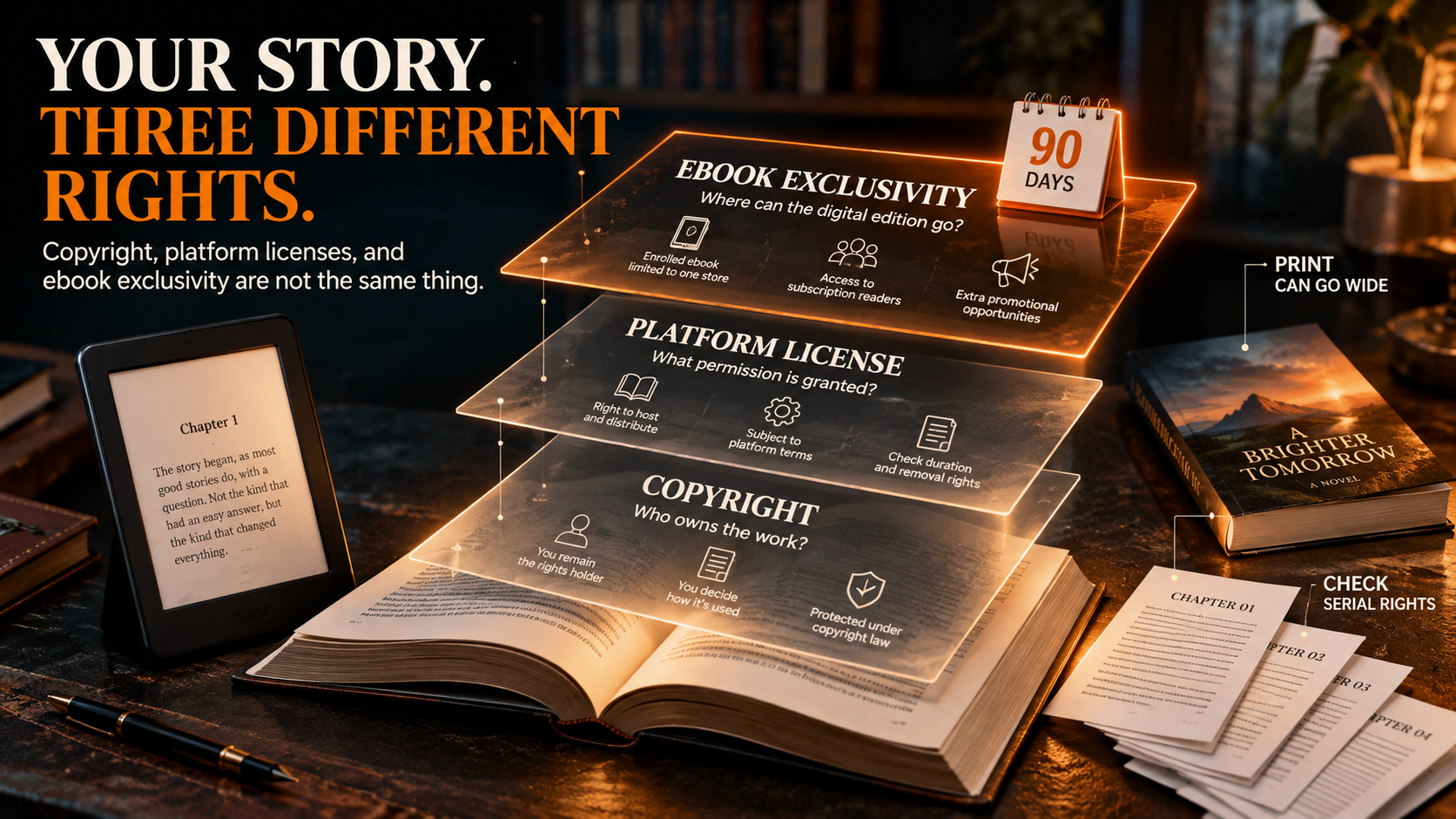
The safest approach is to decide which rights you may need later before uploading the complete story publicly.
Can You Publish a Web Novel First and Sell It as an Ebook Later?
Yes, that can be a possible publishing path, provided you own the necessary rights and comply with the applicable agreements.
But it requires more planning than simply exporting the chapters to EPUB.
Consider this example.
A fantasy author begins releasing chapters of an original novel on a web-fiction platform. After completing the story, the author wants to publish a revised Kindle edition.
The author should first review the web platform's agreement, confirm which content remains public, and decide whether the ebook will be exclusive or wide.
If the ebook will enter KDP Select, public access to the same full digital content must be addressed before enrollment.
If the author prefers wide distribution, the ebook may be available through several retailers, provided the licensing arrangements allow it.
The serial edition and the final ebook may also need different editing and structural decisions. Repeated chapter reminders that worked during serialized reading can feel unnecessary in a continuously read novel.
Finishing a serial is not always the same as finishing the final book edition.
How Much Does It Cost to Publish a Novel Online?
Publishing-platform fees and professional book-production expenses are not the same thing.
KDP allows eligible authors to upload and publish without paying an upfront platform publishing fee.
Other platforms may have their own commission, distribution, service, or paid-program terms.
But making a book available online is only part of the process.
Potential production costs include editing, proofreading, cover design, ebook formatting, print preparation, ISBNs where needed, proof copies, and optional professional support.
| Expense | Complete ebook | Serial fiction | Print edition |
|---|---|---|---|
| Editing and proofreading | Recommended | Recommended before releases | Recommended |
| Cover | Retail-focused | Platform-appropriate | Format-specific full cover |
| Interior formatting | EPUB or supported equivalent | Chapter text for online display | Print-ready interior |
| ISBN | Depends on platform and edition | Usually not needed for ordinary chapter posting | Required for supported print editions |
| Physical proof | Not applicable | Not applicable | Recommended |
| Distribution costs | Platform dependent | Platform/program dependent | Printing and distribution dependent |
Do not assume that an ISBN is necessary for every digital publication. For example, a Kindle ebook does not require you to supply an ISBN through KDP.
Likewise, do not buy several professional services before confirming which ones the manuscript actually needs.
How to Publish a Novel Online: A Practical Six-Step Plan
The exact upload screens vary, but a reliable process follows the same general order.
Step 1: Decide What You Want Readers to Receive
Choose between:
- A complete ebook
- An ebook and print edition
- A chapter-by-chapter story
- Different formats through different permitted channels
This choice controls much of the work that follows.
Step 2: Finish the Right Level of Editing
For a complete ebook, the manuscript should be ready for publication.
For serial fiction, build a realistic chapter plan and prepare enough edited material to release consistently.
A rough draft should not automatically become the public version simply because a platform accepts the upload.
Step 3: Prepare the Appropriate Files
A completed novel being sold as an ebook will usually need an accessible, reflowable file with working chapter navigation.
A printed novel needs separate production decisions such as trim size, margins, pagination, and cover dimensions.
If those distinctions are difficult to manage, professional book formatting services can help prepare approved text for the selected editions.
Step 4: Check Publishing Rights and Distribution
Confirm who owns the manuscript, whether any previous agreement limits distribution, and whether the selected platform requires exclusivity.
For an ebook published wide, decide which service handles each retailer to avoid accidental duplicate distribution.
Step 5: Prepare Your Book Listing or Serial Page
For a retail ebook, check the cover, book description, author information, categories, keywords, series order, pricing, and territorial rights.
For a serialized story, prepare the story description, genre tags, content notices where required, chapter structure, and release schedule.
Step 6: Preview Before Publishing
Inspect the ebook on different screen sizes or review the uploaded serial chapters as a reader would.
Check links, punctuation, chapter order, missing scenes, special characters, and the cover's readability at smaller sizes.
Only submit once the material and relevant publishing details are ready.
What Do First-Time Novelists Commonly Get Wrong?
Mistake 1: Assuming Amazon KDP Requires Exclusivity
Ordinary KDP ebook publishing does not automatically enroll the title in KDP Select.
Do this: decide deliberately whether the ebook should enter Select.
Not that: assume every Kindle ebook must be exclusive to Amazon.
Mistake 2: Sending the Same Ebook to Amazon Twice
If you upload directly through KDP, check that a wide distributor is not also sending the same edition to Amazon.
Duplicated listings and overlapping distribution arrangements can create problems with availability and book data.
Mistake 3: Publishing Every Chapter Before Checking Future Rights
A public web novel may be compatible with your long-term plan—or it may interfere with a later exclusive ebook arrangement or particular submission requirements.
Check first.
Mistake 4: Treating Formatting as an Optional Final Detail
An ebook can upload successfully and still contain broken navigation, poor paragraph spacing, or inconsistent chapters.
Uploading is not proof that readers will receive a good file.
Mistake 5: Choosing Based on Someone Else's Genre
A particular author may earn more through Kindle Unlimited. Another may prefer wider retail distribution. A serial writer may enjoy releasing chapters over time.
None of those outcomes proves which route is best for a different novel.
What If Your Novel Is Finished but Not Publication-Ready?
A complete manuscript may still need proofreading, edition-specific formatting, a cover, metadata, or decisions about rights and distribution.
Those are not necessarily reasons to buy a full publishing package.
For a finished novel headed toward Amazon, book publishing support can help organise KDP title setup, metadata, formats, uploaded files, previews, and author-approved publishing decisions.
Amazon KDP Experts is an independent publishing-support provider, not Amazon or Kindle Direct Publishing itself. Platform acceptance, retail placement, and sales remain outside the service provider's control.
If you're comparing whether Amazon publication is the only route for your book, the existing guide Can You Sell Self-Published Books on Amazon Without KDP? explains alternative Amazon retail and print-distribution arrangements in more detail.
The main goal is to complete the right work for the route you choose, without paying twice for the same stage.
Final Thoughts: Publish the Novel in the Format Your Story Needs
Publishing your novel online does not have to mean following the same path as every other author.
Amazon KDP may be right when you have a completed novel ready for Kindle and print readers. Wide distribution may be a better fit when you want the ebook available through several retailers. Serial fiction may work when the story is structured for installments and you can maintain the release.
The right decision is not simply where to upload your novel. It is how you want readers to experience it and which publishing rights you want to preserve.
Start there. Then prepare the manuscript, files, and distribution settings to match.
Ready to Turn Your Manuscript Into a Published Novel?
Your next step may be final formatting, a publishing-readiness check, or help preparing the ebook and print editions.
Amazon KDP Experts can help you identify the work needed before submission, while keeping your copyright, account control, royalties, and final approval in your hands.