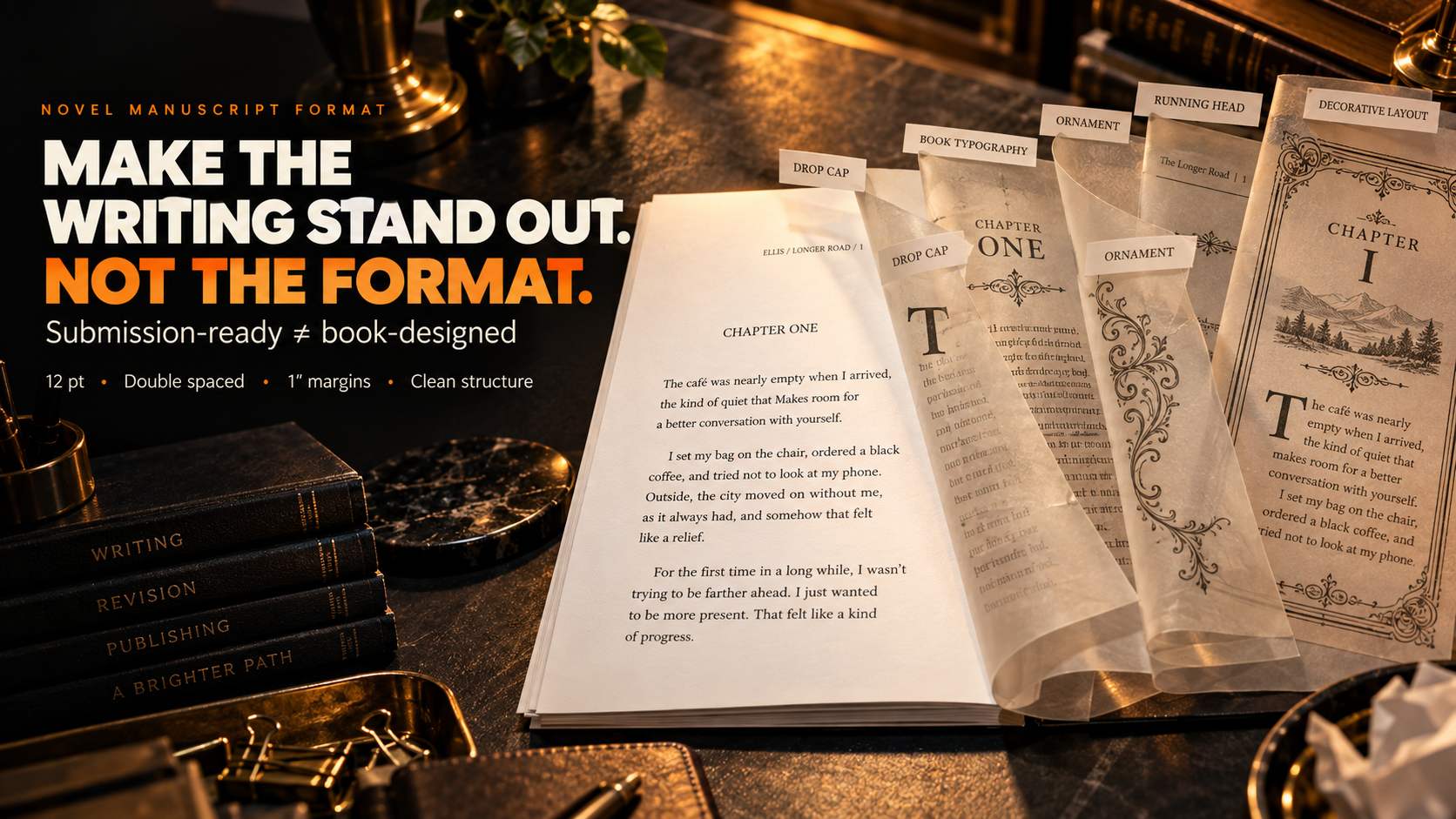
Your novel is finished. The chapters are in order, the ending finally works, and you are ready to send it to an agent or publisher.
Then a surprisingly basic question appears: What is the correct novel manuscript format?
That question matters because a submission manuscript has a different job from a finished paperback or Kindle book. Agents and editors need a document that is easy to read, review, annotate, search, and move through. Fancy typography and book-style page design usually work against that goal.
For authors working toward publication, Amazon KDP Experts treats manuscript preparation, editing, final book formatting, and publishing as separate stages. Keeping those stages separate can save a lot of unnecessary rework later.
Key Takeaways
- Standard novel manuscript format is deliberately plain: readable 12-point type, double spacing, generous margins, consistent indents, clear chapters, and page identification.
- The recipient's instructions always come first. An agent or publisher's stated submission rules override any general formatting standard.
- Submission formatting is not book formatting. Your Word manuscript should not imitate the interior of a finished paperback.
- Clean structure matters more than visual style. Agents should notice the writing, not the document setup.
What Is the Standard Novel Manuscript Format?
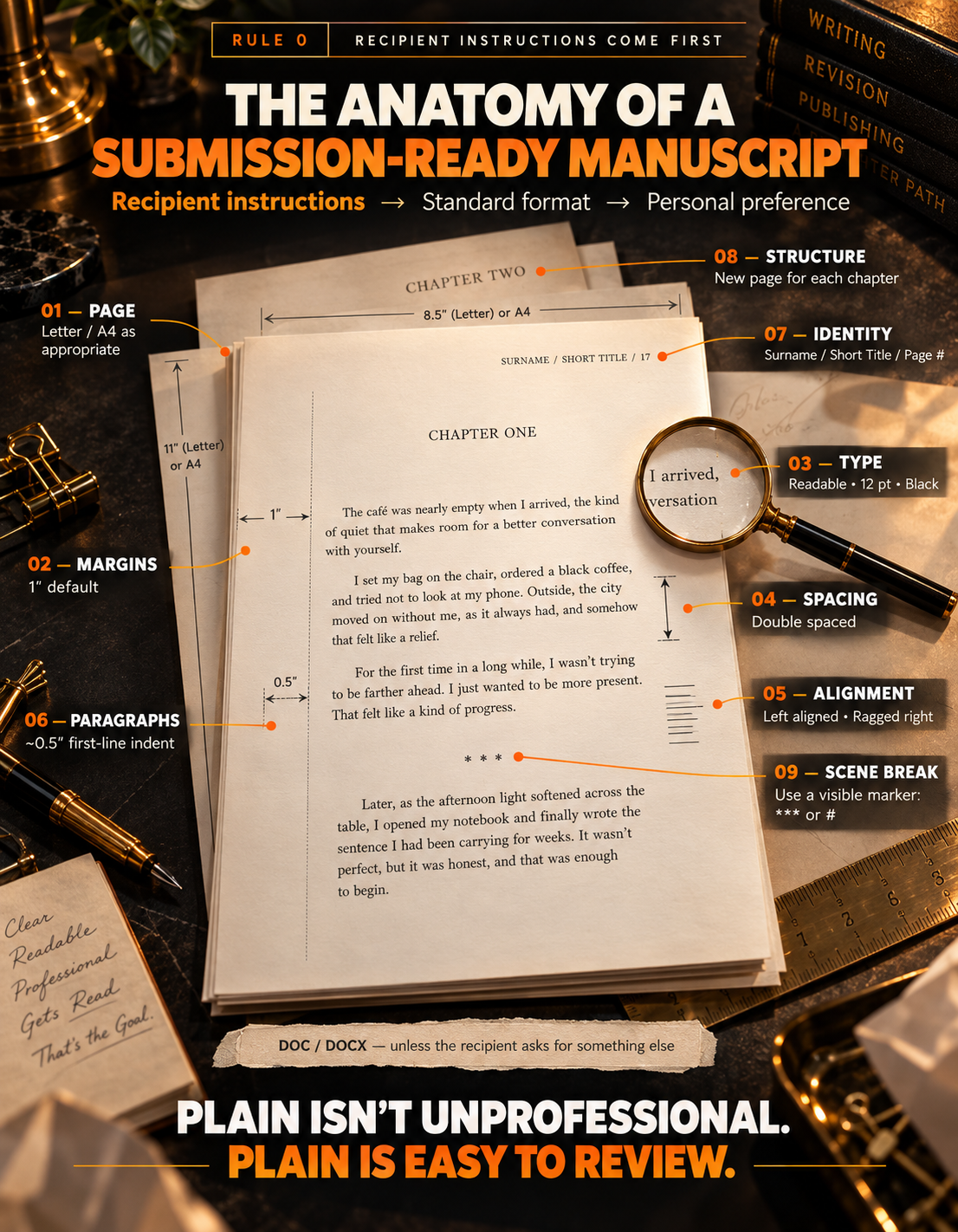
Standard novel manuscript format usually means a clean Word document using a readable 12-point font such as Times New Roman, one-inch margins, double-spaced body text, approximately half-inch first-line paragraph indents, left-aligned text, page numbers, a simple identifying header, a title page, and clear chapter and scene breaks.
That is the useful default, not an unbreakable law.
The current Reedsy manuscript-format guide recommends Letter size for the U.S. and Canada or A4 in many other markets, along with one-inch margins, 12-point Times New Roman or similar type, double spacing, and 0.5-inch paragraph indents.
The word default matters.
Before changing a single margin, check where the manuscript is actually going.
Which Rule Matters Most Before You Submit?
Follow the agent's or publisher's own instructions first.
Standard manuscript formatting gives you a safe starting point when no detailed instructions are provided. It should never be used to overrule a recipient who has told you exactly what to send.
That difference is more important than debating whether one particular header style is “correct.”
For example, P.S. The Literary Agency currently asks writers in several fiction categories to paste the first ten pages into the body of the email. Its guidance is very direct:
“Do not send attachments.”
See the current P.S. Literary Agency submission guidelines.
So use this rule:
Recipient instructions → standard manuscript format → personal preference
Never reverse that order.
What Should a Novel Manuscript Actually Look Like?
Here is a practical default checklist for a first-time novelist.
Document and File Setup
Use an editable document unless the recipient requests something else.
A professional starting point is:
- File: DOC or DOCX
- Page size: Letter, 8.5 × 11 inches, for most U.S./Canadian submissions
- Alternative page size: A4 when appropriate for the territory
- Margins: 1 inch on every side
- Document background: white
- Text: black
- File name: something searchable such as Lastname_SHORTTITLE.docx
Do not send a PDF simply because it appears more “finished.” Some agents want Word files because they are easier to annotate. Others use submission forms or request pasted sample pages.
Check first.
Font, Alignment, and Spacing
Keep the body visually quiet.
A dependable setup is:
- Font: Times New Roman or another conventional readable font
- Size: 12 point
- Line spacing: double
- Alignment: left aligned
- Right edge: ragged rather than fully justified
- Paragraph spacing: no automatic blank line after every paragraph
- Sentence spacing: one space after punctuation
Your submission is a working reading document, not a typography portfolio.
Paragraph Indents
Use a first-line paragraph setting of approximately 0.5 inch for ordinary paragraphs.
Set that through the paragraph controls in Word or Google Docs rather than pressing the spacebar repeatedly.
Tabs and manually inserted spaces can create inconsistent formatting when the manuscript moves between programs or is later prepared for publication.
What About the First Paragraph of a Chapter or Scene?
Conventions vary.
Some manuscript guides indent every narrative paragraph for consistency. Others leave the opening paragraph after a chapter or scene break flush left.
This is a good example of a small detail that should not become more important than the recipient's instructions.
Consistency matters more than decorative experimentation.
What Goes on the Manuscript Title Page?
The title page should answer the practical questions an agent or editor needs answered without searching through the document.
A common fiction title page includes:
Top Left
- Legal Name
- Email Address
- Phone Number
- Other Contact Information When Requested
If you already have representation, follow your agent's instructions about contact information.
Top Right
Include the approximate manuscript word count.
For a full-length novel, rounding to the nearest thousand is common.
Center
Place:
YOUR NOVEL TITLE
followed by:
Your Author Name
Your author name may be a pen name, but your legal/contact information should remain clear where required.
Lower Section
Genre or category may be included when appropriate.
Keep the page restrained. Logos, borders, cover artwork, decorative fonts, mock book covers, and promotional copy normally do not belong on a novel submission title page.
How Should Headers and Page Numbers Be Formatted?
Your manuscript should remain identifiable if pages are separated or printed.
A practical header can contain:
SURNAME / SHORT TITLE / PAGE NUMBER
For a long title, shorten it to a recognisable keyword or phrase.
You do not need to turn the header into a design feature. It exists for identification.
Page numbers should update automatically through your word processor rather than being typed manually.
The title page is commonly treated separately from the numbered manuscript body.
How Should Chapters Be Formatted?
Every new chapter should begin on a fresh page.
Use an actual page break, not fifteen presses of the Enter key.
A simple chapter opening works well:
CHAPTER ONE
or
CHAPTER 1
If the chapter has a title:
CHAPTER ONE
The Long Way Home
Keep the style consistent through the whole manuscript.
Some traditional manuscript conventions start the chapter heading partway down the page. Exact vertical placement matters less than clarity and consistency unless specific submission instructions say otherwise.
Do You Need Decorative Chapter Openers?
No.
Your submission does not need:
- Drop Caps
- Ornamental Dividers
- Designed Chapter Numbers
- Special Fonts
- Illustrated Chapter Headings
- Print-Style Running Heads
Those decisions belong much later in book production.
How Should Scene Breaks Appear?
Never rely only on extra vertical whitespace to communicate an important scene transition.
Blank space can disappear when text is copied, converted, reformatted, or displayed in another system.
Use a visible and consistent marker such as:
***
or
#
The point is not to choose the prettiest symbol.
The point is to make the transition unmistakable.
Novel Manuscript Format vs Published Book Format
This distinction causes more confusion than almost anything else in manuscript preparation.
| Element | Submission Manuscript | Published Novel Interior |
|---|---|---|
| Main purpose | Reading and editorial review | Final reader experience |
| Line spacing | Usually double | Usually much tighter |
| Font | Plain, conventional | Selected for final book design |
| Margins | Simple review-friendly margins | Built around trim size and binding |
| Page size | Letter or A4 commonly used | Final book trim size |
| Paragraph treatment | Submission convention | Typesetting convention |
| Chapter design | Minimal | Can include designed openings |
| Headers | Identification | Running heads where appropriate |
| File | Often DOC/DOCX | EPUB/KPF or print-ready PDF |
| Decorative elements | Minimal | Added when appropriate |
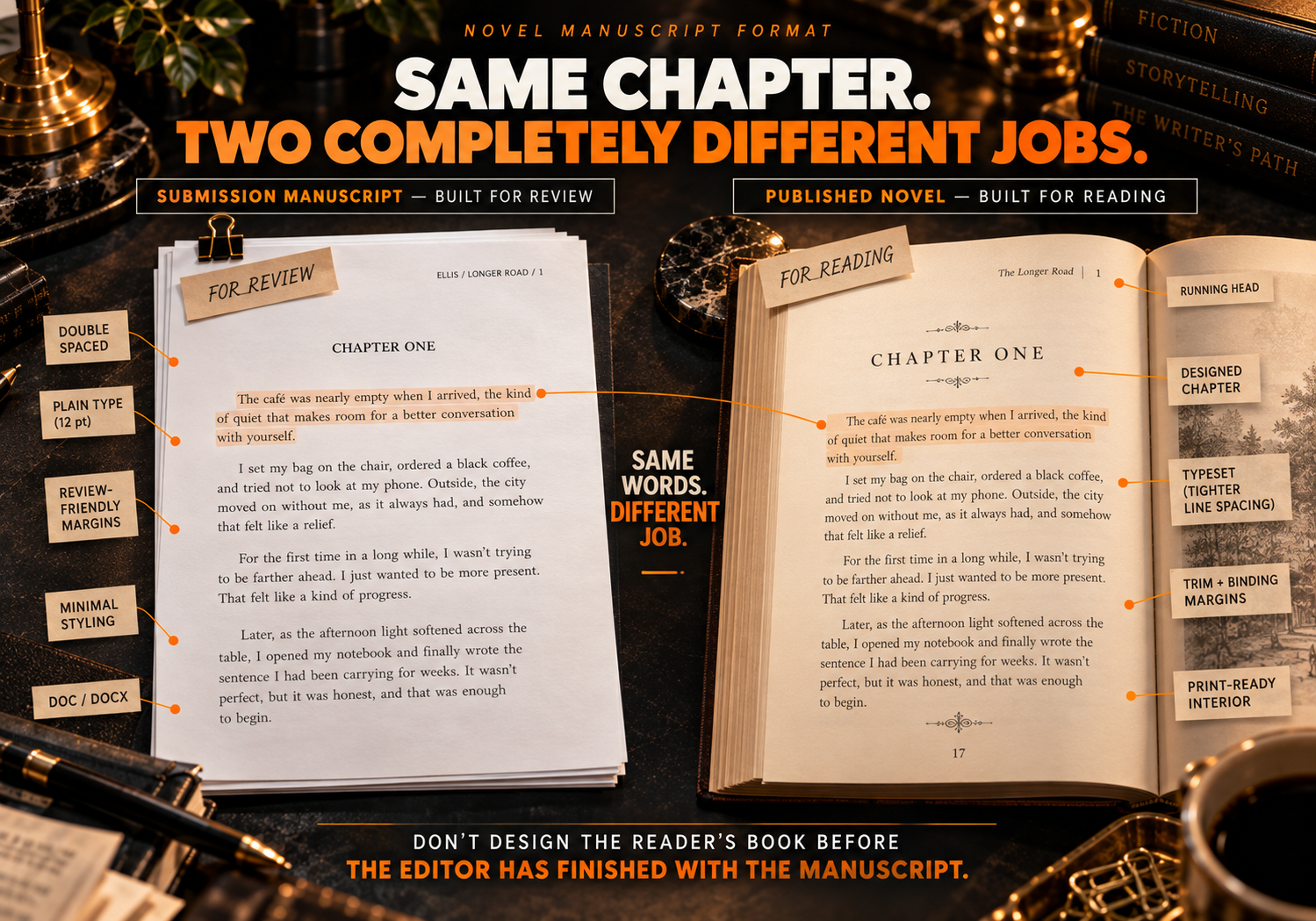
This is why trying to make a manuscript “look like a real book” before querying is usually the wrong goal.
Once the text has been approved and the book is moving toward production, professional book formatting services deal with typography, print margins, trim size, chapter styling, pagination, ebook navigation, and final publication files. Those are different decisions from manuscript submission formatting.
The existing guide to KDP formatting requirements for Kindle, paperback, and hardcover shows the next-stage difference in more detail: Kindle, paperback, and hardcover versions should not be treated as one interchangeable production file.
How Do You Format a Novel Manuscript Step by Step?
Use this order rather than fixing isolated details randomly.
1. Read the Submission Instructions
Check:
- Requested Pages Or Chapters
- Attachment Rules
- Accepted File Types
- Synopsis Requirements
- Naming Conventions
- Whether Material Belongs In An Email, Form, Or Uploaded File
Do this before formatting around assumptions.
2. Set the Page Basics
Choose the requested page size and set one-inch margins unless another specification is given.
Then establish your base body style.
3. Standardise the Body Text
Apply the same font, size, alignment, double spacing, and paragraph indentation across the manuscript.
Using styles is cleaner than correcting every paragraph individually.
4. Clean the Structural Elements
Check:
- Title Page
- Headers
- Page Numbers
- Chapter Breaks
- Chapter Headings
- Scene Breaks
Every structural marker should behave consistently.
5. Remove Drafting Debris
Search for:
- Comments
- Track Changes
- Highlighted Notes
- Placeholder Text
- Inconsistent Fonts
- Duplicate Spaces
- Accidental Blank Pages
- Manual Tabs And Spacing
- Unfinished Chapter Labels
6. Save a Submission Copy
Keep your working manuscript separate.
Save a clean version specifically for the submission so later edits do not accidentally alter the file you already sent.
What Do First-Time Authors Most Often Get Wrong?
Mistake 1: Designing the Manuscript Like a Paperback
Decorative typography can feel more professional to the writer while making the file less practical for the person reviewing it.
Do this: make the manuscript easy to read and assess.
Not that: imitate the final typeset novel.
Mistake 2: Using Spaces to Create Layout
Repeated spaces and Enter-key presses are fragile.
Use paragraph settings, page breaks, indents, headers, and styles instead.
Mistake 3: Treating “Standard Format” as More Important Than Instructions
P.S. Literary's current no-attachment requirement is a good example of why this fails.
The correct format for that submission is the format they asked for.
Mistake 4: Formatting Before the Manuscript Is Really Finished
Layout cleanup will not fix weak pacing, contradictory character details, unclear scenes, repetition, or grammar problems.
If the text itself still needs work, deal with that before worrying about a perfect submission presentation.
Professional book editing services for self-published and independent authors address structure, clarity, consistency, language, and editorial concerns before final book production begins.
If you are considering automated editing before submission, the guide Can AI Edit My Book? What It Fixes, Misses and Can Make Worse explains where automated cleanup can help and where decisions still depend on voice, subtext, context, and author intent.
What Does a Submission-Ready Manuscript Look Like in Practice?
Picture a first-time novelist who has finished an 82,000-word thriller.
The draft was written in Google Docs. Chapter titles use several font sizes. Some paragraphs start with tabs; others use spaces. Scene breaks are represented only by blank lines.
The story may be ready, but the file is not.
The author does not need a redesign.
They need a cleanup:
- Check the target agent's submission instructions.
- Create a separate submission copy.
- Standardise body text.
- Apply proper paragraph indents.
- Replace manual chapter spacing with page breaks.
- Turn invisible scene gaps into consistent scene markers.
- Add the required identifying information.
- Remove comments and drafting notes.
The writing has not changed.
The document has become easier to review.
That is what good manuscript formatting should accomplish.
Can You Format the Manuscript Yourself?
For a straightforward text-only novel, usually yes.
You can probably handle submission formatting yourself when:
- The manuscript structure is simple
- You understand Word or Google Docs styles
- Chapters and scenes are already organised
- The file has no major consistency problems
- The recipient's guidelines are clear
Professional review becomes more useful when the file contains years of accumulated formatting, inconsistent styles, unusual text structures, complex notes, imported content, extensive tracked revisions, or uncertainty about whether editing is actually complete.
The goal is not to make a plain manuscript complicated.
It is to remove the things that get between the reader and the writing.
Submission-Ready Novel Manuscript Checklist
Before sending the file, check each item once.
Document
- Correct file type for this recipient
- Professional file name
- Correct Letter or A4 page size
- One-inch margins unless instructed otherwise
Body Text
- Readable 12-point font
- Black text
- Double spacing
- Left alignment
- Consistent paragraph indents
- No unnecessary blank lines between ordinary paragraphs
Structure
- Clean title page
- Approximate word count included where appropriate
- Headers are consistent
- Page numbers work automatically
- Every chapter begins on a fresh page
- Scene breaks are visibly marked
Final File Check
- No Track Changes
- No unresolved comments
- No highlighted drafting notes
- No accidental font changes
- No placeholder text
- No unexplained blank pages
- Recipient's current submission instructions checked again
Final Thoughts: Make the Writing Easy to Read, Not the File Easy to Notice
Good novel manuscript format is intentionally quiet.
The file should help an agent or editor move through your story without wondering why one chapter uses different spacing, why page numbers disappear halfway through, or whether a blank line represents a scene change.
Start with standard manuscript formatting when no special instructions exist. Then check the recipient's requirements and change whatever they ask you to change.
Most importantly, do not confuse a submission manuscript with the finished book readers will eventually buy. Submission formatting prepares the writing for professional review. Editing strengthens the text. Book formatting comes later, when the approved manuscript is being turned into an actual ebook or print interior.
Keep those stages in the right order and the process becomes much easier to manage.
Ready to Send the Manuscript?
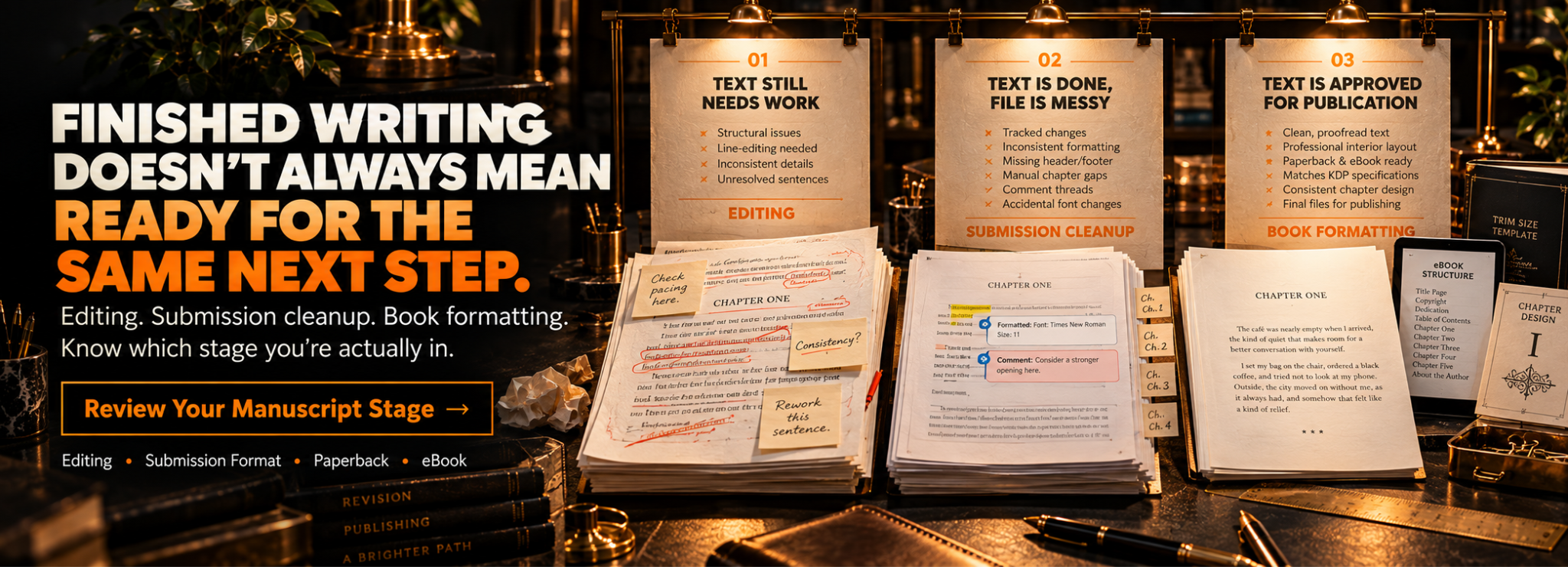
If the novel is finished but you are still unsure whether the text needs editing, submission cleanup, or final publication formatting, identify that stage before paying for the next service.
Amazon KDP Experts can review where the manuscript currently stands and help separate editorial work from the formatting needed later for ebook, paperback, or hardcover production, while the manuscript and final decisions remain yours.