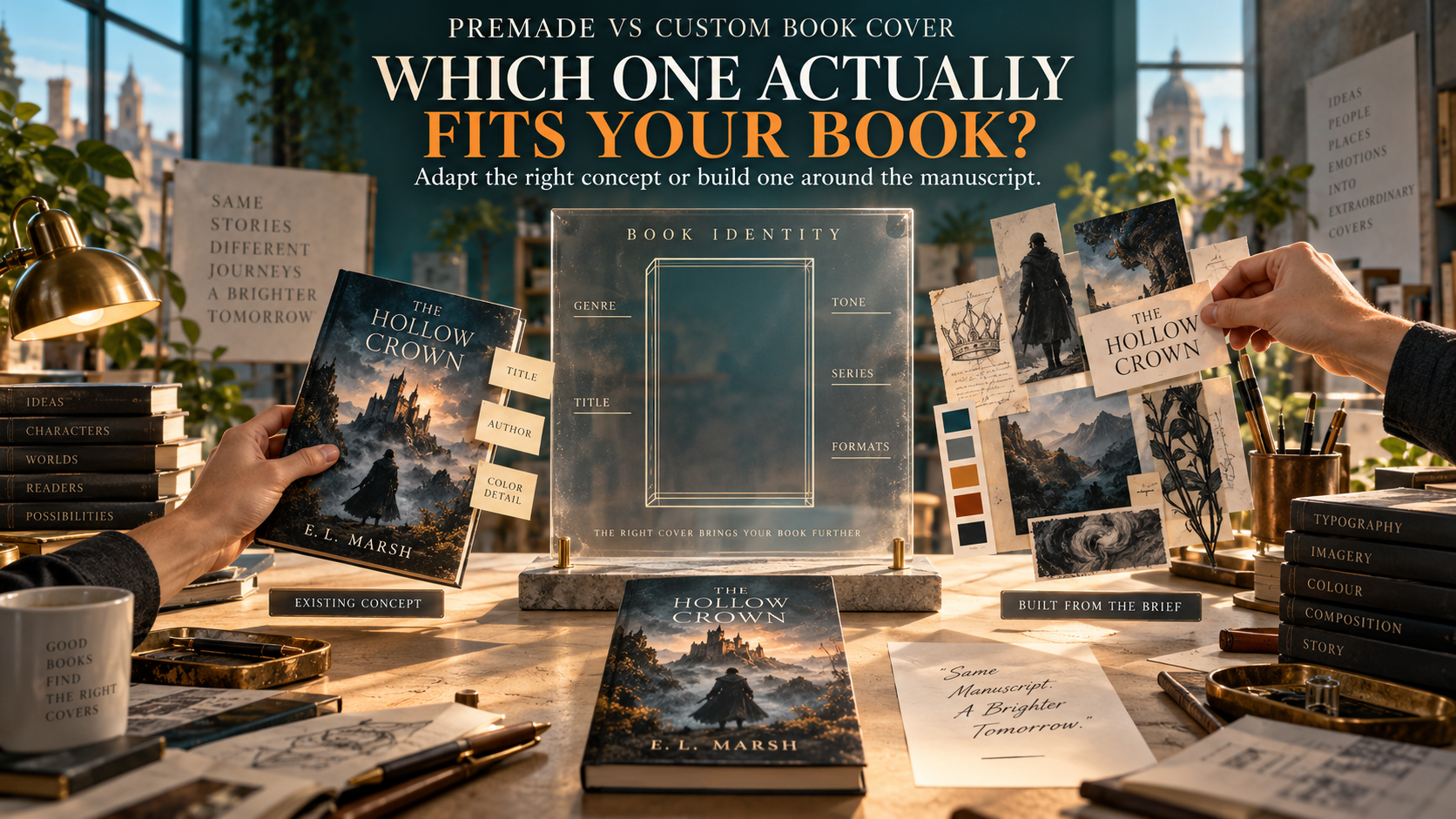
You find a premade cover that looks almost perfect.
The mood fits. The typography feels right. The price leaves room in your publishing budget, and the designer can replace the title and author name quickly.
Then you remember this is Book One of a planned trilogy.
Can the designer create Book Two in the same visual language? Are the images exclusive? Will you receive a paperback wrap as well as the eBook front? What happens if the next book needs a character or setting that the original artwork cannot support?
That is where the premade vs custom book cover decision becomes more complicated than price.
Both can produce professional work.
The better option is the one that fits the book's genre, series plan, visual specificity, rights requirements, formats, budget, and publication schedule.
At Amazon KDP Experts, cover design is treated as part of the book's positioning and production process rather than decoration added at the end. The current service direction considers genre, audience, typography, imagery, formats, and author review together.
Choose a premade cover when you find an existing design that already fits your genre, tone, title, and future plans. Choose custom when the book needs specific imagery, stronger series architecture, unusual genre positioning, or art built around the manuscript rather than adapted to it.
Key Takeaways
- Premade does not mean poor quality, and custom does not automatically mean better.
- Series plans should influence the cover decision before Book One is finalized.
- “Sold once” does not necessarily mean every image on a premade cover is exclusively licensed.
- Custom design can also contain licensed stock assets, so rights should be discussed in either model.
- KDP file requirements and AI-image disclosure still apply regardless of how the cover was purchased.
What Is the Difference Between a Premade and Custom Book Cover?
Premade covers are designed before a specific author's book is commissioned.
The designer creates a finished concept, offers it for sale, and then changes agreed details such as the title, subtitle, author name, typography, or minor color elements after purchase.
Many specialist premade stores retire each finished design after one author buys it. That policy is common, but it is not universal, so check before paying. Current stores such as DesignDusk and Earthly Charms explicitly describe their premades as one-sale designs.
Custom cover design begins after the designer receives your project brief.
The concept can be developed around your genre, plot, theme, author brand, character details, visual references, publishing formats, and series plans.
The difference is therefore not simply:
cheap versus expensive.
It is:
adapt an existing concept versus develop the concept around the book.
When Does a Premade Cover Make More Sense?
Premade is strongest when the available design already communicates what the book needs to communicate.
Your Genre Has Clear Visual Signals
Romance, thriller, mystery, cozy mystery, paranormal fiction, horror, and some fantasy subgenres often contain familiar visual patterns.
That does not mean every cover should look identical.
It means readers should be able to make a reasonably accurate guess about the kind of book they are looking at.
Premade designers often work inside those established signals because the design has to attract an author before the designer knows which manuscript will buy it.
That can actually be an advantage for a straightforward genre title.
You Find the Right Cover Rather Than “Almost” the Right Cover
The word almost causes trouble.
If you need to replace the main character, change the setting, move the composition, alter the central object, rebuild the lighting, and change the typography, you are no longer making small premade adjustments.
You are trying to turn one concept into another.
At that point, custom design may be the cleaner decision.
You Are Testing a New Pen Name or Genre
Authors sometimes want to test reader response in a new category without committing a large part of the production budget to one title.
A well-chosen premade can make sense here because the initial creative direction already exists.
The important condition is fit.
Buying an inexpensive cover that sends the wrong genre signal does not become a good publishing decision because it cost less.
When Is a Custom Book Cover the Better Choice?
Custom design becomes more useful as the number of project-specific requirements increases.
Your Story Depends on Specific Visual Details
Suppose your fantasy novel centers on a city built into a red cliff, a protagonist with a recognizable physical feature, and a symbolic object that matters throughout the trilogy.
Finding that exact combination in a premade library may be difficult.
Custom work gives the designer room to solve the actual visual problem.
Your Book Crosses Genres
Cross-genre books are harder to fit into existing premade categories.
A romantic fantasy thriller, literary speculative memoir, or business book with an unconventional creative concept may need design choices that balance more than one visual expectation.
Custom work gives the designer the brief before the concept exists.
That matters.
Your Author Brand Already Has a Visual System
Established authors may already have typography, colors, title treatment, symbols, or visual patterns readers associate with their work.
The cover then has two jobs:
sell this book and still look like it belongs to this author.
Custom design is usually easier to control when that brand relationship matters.
Premade vs Custom Book Cover for a Series: Which Is Safer?
Series planning is where the decision becomes much more important.
One good cover is not automatically a good series system.
A series needs design elements that can change enough to distinguish each volume while remaining consistent enough to look related.
That can include:
- typography
- title placement
- author-name treatment
- color structure
- framing
- symbols
- character style
- illustration style
- image treatment
- spine architecture
Some premade designers can extend an existing cover into later titles. Current premade providers even advertise series extensions.
But confirm this before purchasing Book One.
Ask whether the designer can create future covers in the same style, whether the underlying assets can be sourced again, and what happens if the designer stops offering that design line.
The Series Problem Most Authors Notice Too Late
Imagine buying a striking premade for Book One.
Six months later, Book Two is complete.
The original designer is available, but the main stock model used on Book One cannot be licensed for the new composition you need. Another model looks noticeably different.
Now the series has a choice:
change visual direction after one book or redesign Book One.
Neither option is impossible.
Both could have been discussed earlier.

How Should Genre Affect the Decision?
The best route often depends less on whether the book is fiction or nonfiction and more on how specific the visual promise needs to be.
This is not a fixed rule.
Genre gets you into the right visual neighborhood.
The manuscript still decides the house.
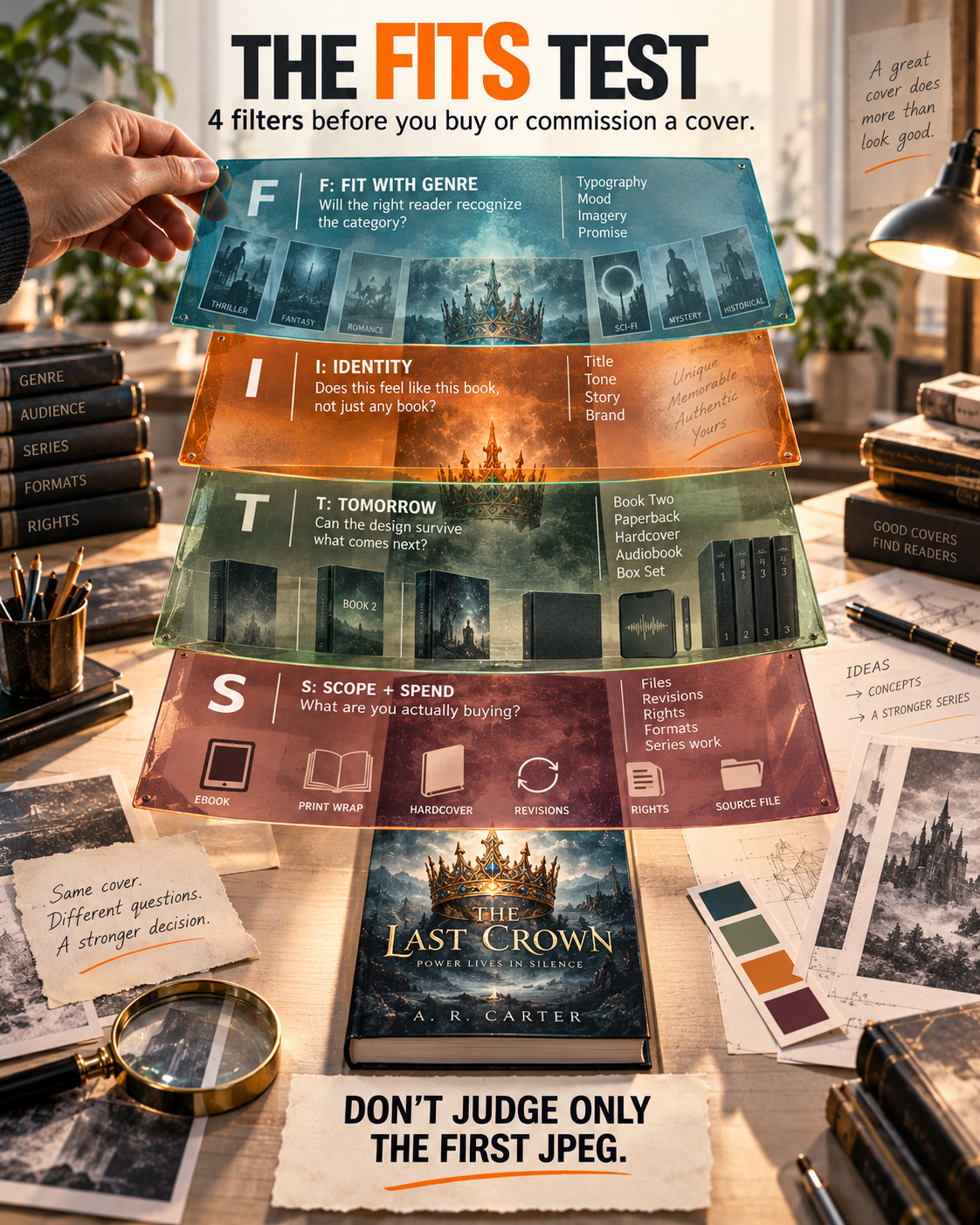
Use the FITS Test Before Buying Either Option
F: Fit With Genre
Would the intended reader understand the broad type of book before reading the description?
Genre recognition matters more than copying whatever happens to be popular.
KDP's current metadata rules specifically warn against covers that misleadingly resemble another book's layout, fonts, colors, or imagery too closely.
I: Identity of the Book
Does the design reflect something meaningful about this particular manuscript?
That does not mean literal illustration.
Sometimes the right typography, mood, composition, and visual metaphor communicate more than a scene from Chapter Seven.
T: Tomorrow's Editions
What happens next?
Think about:
Book Two. Paperback. Hardcover. Audiobook. Revised edition. Box set.
Do not evaluate only the first JPEG.
S: Scope and Spend
Compare what you actually receive.
An inexpensive eBook front and a full custom package containing print wraps, additional formats, several concepts, and revision rounds are not equivalent deliverables.
Budget against the files and rights you need, not the label “premade” or “custom.”
How Much More Does Custom Cover Design Cost?
Custom design normally costs more because the designer is developing creative direction for a specific project rather than selling an existing concept.
For a current market benchmark, Reedsy's 2026 analysis reports an average professional book-cover design cost of $880.
That is the single external market statistic used in this article.
It should not be treated as a required budget.
Quotes vary based on illustration, designer experience, genre, revisions, number of formats, print-wrap requirements, series development, typography, and other project details.
Premades normally cost less because much of the concept work has already been completed before the author arrives.
Compare the Full Cost
Before choosing, ask whether the quoted amount includes:
eBook front cover, paperback wrap, hardcover version, typography changes, revisions, stock licensing, illustration rights, future series adaptation, source files, and additional format conversions.
The cheapest checkout price can become less attractive once every missing deliverable is added later.
Who Owns the Artwork on a Premade Cover?
This deserves more attention than it usually gets.
“Sold once” can mean that the finished composition will not be resold to another author.
It does not automatically mean every image inside that composition exists nowhere else.
Many designers legally license stock photography, textures, fonts, or other design assets.
Those underlying assets may also be available to other license holders.
The same issue can apply to custom covers.
Custom does not automatically mean every visual element was created exclusively for your book.
Ask the designer what was created from scratch, what is licensed, what usage rights you receive, whether any restrictions apply, and whether the designer retains portfolio rights.
KDP puts the responsibility on the publisher. Its eBook cover guidance tells authors to:
“make sure you have all rights necessary for the content of your cover image.”
That question belongs in the project conversation before publication.
What About AI-Generated Cover Art in 2026?
Ask.
Do not assume.
KDP currently requires authors to disclose AI-generated images, and that explicitly includes cover artwork. AI-assisted work does not require the same disclosure when a human created the actual image and AI only helped refine it.
This applies whether the design is premade or custom.
Before approving the final cover, ask the designer:
Was generative AI used to create any actual image or artwork incorporated into this cover?
You need an answer because the KDP account holder is responsible for the disclosure during publication.
Heavy human editing afterward does not automatically change AI-generated artwork into AI-assisted artwork under KDP's current definition.
That is a 2026 cover-design question every author should be asking.
What Files Should You Receive?
The design can look beautiful and still be incomplete for publication.
Kindle eBook
KDP's current eBook guidance recommends an ideal marketing-cover size of 2,560 × 1,600 pixels, with JPEG or TIFF accepted on its cover-upload page and RGB color space required.
Paperback
A paperback cover is not just the front artwork.
KDP requires the print cover as one PDF containing the:
back cover + spine + front cover
KDP also requires bleed around the outside edges, and spine dimensions depend on the final page count and paper choice.
Hardcover
KDP hardcover uses a different cover construction from paperback because it is case laminate and includes wrap and hinge areas.
Do not simply enlarge the paperback file. (Amazon Kindle Direct Publishing)
This is why the design contract should identify the formats being delivered.
What Most Authors Get Wrong
Mistake 1: Buying the Artwork Before Locking the Title
Typography can completely change the balance of an existing premade.
A three-word thriller title and a twelve-word nonfiction title do not occupy the same visual space.
Do this: test your real title.
Not that: imagine that any title can be dropped into any design.
Mistake 2: Choosing by Beauty Instead of Positioning
You are not buying wall art.
Ask whether the cover feels right for the reader you want, not just whether you personally like the colors.
Mistake 3: Assuming Premade Means Nonexclusive
Some premade covers are retired after one purchase.
Check the policy.
Mistake 4: Assuming Custom Means Fully Exclusive
Custom work may still contain licensed stock elements.
Check the agreement.
Mistake 5: Forgetting Future Books
Series continuity becomes much harder to solve after the first design is already locked.
Mistake 6: Approving at Full Screen Only
Shrink the cover.
The title, author name, primary shape, and genre impression should still hold together when the artwork is small.
Five Steps to Choose Without Regretting the Cover Later
1. Define the Reader Before the Artwork
Write one sentence describing who should recognize this book.
Genre comes first.
Personal taste comes second.
2. Collect Comparable Covers
Study current books aimed at the same reader.
Look for patterns in typography, composition, color, character treatment, and imagery.
Do not ask the designer to copy them.
Use them to understand the visual language of the category.
3. Decide Whether the Book Needs Adaptation or Creation
If an existing premade already solves the visual problem, adaptation may be enough.
If you keep asking to rebuild the concept, commission custom.
4. Check Rights, Formats, and Series Terms
Before paying, confirm:
- commercial usage
- stock-image licensing
- AI-generated artwork
- revision scope
- eBook file
- paperback file
- hardcover file if needed
- future series extensions
- source-file policy
- designer portfolio rights
5. Test the Final Design in Its Real Environment
Check the eBook thumbnail.
Check the Amazon product-page view.
Check the complete paperback wrap.
If publishing hardcover, check the hardcover template separately.
Then confirm that the cover title, subtitle, author name, and series information match your KDP metadata. KDP requires those details to stay consistent.
An Illustrative Decision
Picture two fantasy authors with the same cover budget.
The first has a standalone dark fantasy novel. They find a premade with the exact tone, strong typography, suitable imagery, and no planned sequel.
Premade may be the sensible choice.
The second author has a five-book fantasy series built around one protagonist, one invented city, and changing magical symbols that matter across the entire story.
Book One might still fit a premade.
But the real design problem is not Book One.
It is Books One through Five.
Custom series development now has a stronger case because the author needs a visual system rather than one attractive composition.
Same genre.
Similar budget.
Different production decision.
When Does Professional Custom Cover Design Make Sense?
Custom cover work is most useful when your project needs more than a ready-made concept can reasonably provide.
That may include cross-genre positioning, series planning, custom illustration, character-specific artwork, branded nonfiction, complex typography, several publication formats, or a cover that needs to coordinate closely with the rest of the publishing project.
Amazon KDP Experts currently describes cover work around concept development, typography, imagery, genre, audience, eBook artwork, paperback wraps, and publishing-ready files.
You can review the broader book cover design support available through Amazon KDP Experts before deciding whether the project needs an existing concept or a fully developed custom direction.
Once the design is approved, Amazon KDP publishing support can address the technical next stage, including edition setup, full-wrap files, previews, metadata, pricing, and author-approved submission preparation.
Authors approaching their first upload may also benefit from the related guide to common self-publishing mistakes on Amazon KDP.
Final Thoughts: Buy the Cover Your Book Actually Needs
The premade vs custom book cover question does not have one winner.
Premade can be the smarter choice when the right concept already exists, the genre signal is clear, the budget is tight, and future design needs are limited.
Custom becomes more valuable when the book asks for visual decisions that do not already exist: specific characters, cross-genre positioning, branded nonfiction, original illustration, or a series system that has to survive several releases.
Neither option excuses weak rights documentation or incomplete KDP files.
Before spending money, ask four things:
Does it fit the genre? Does it fit this book? Can it support what comes next? Do I know exactly what rights and files I am buying?
If those answers are clear, the label on the design process matters far less.
Decide the Cover Brief Before You Pay for the Artwork
If the manuscript is nearly ready but you are still deciding between an existing cover and a custom concept, define the reader, genre, formats, series plan, and rights requirements first.
Review Amazon KDP Experts publishing and cover-design services to discuss what the project actually needs before the artwork is finalized.