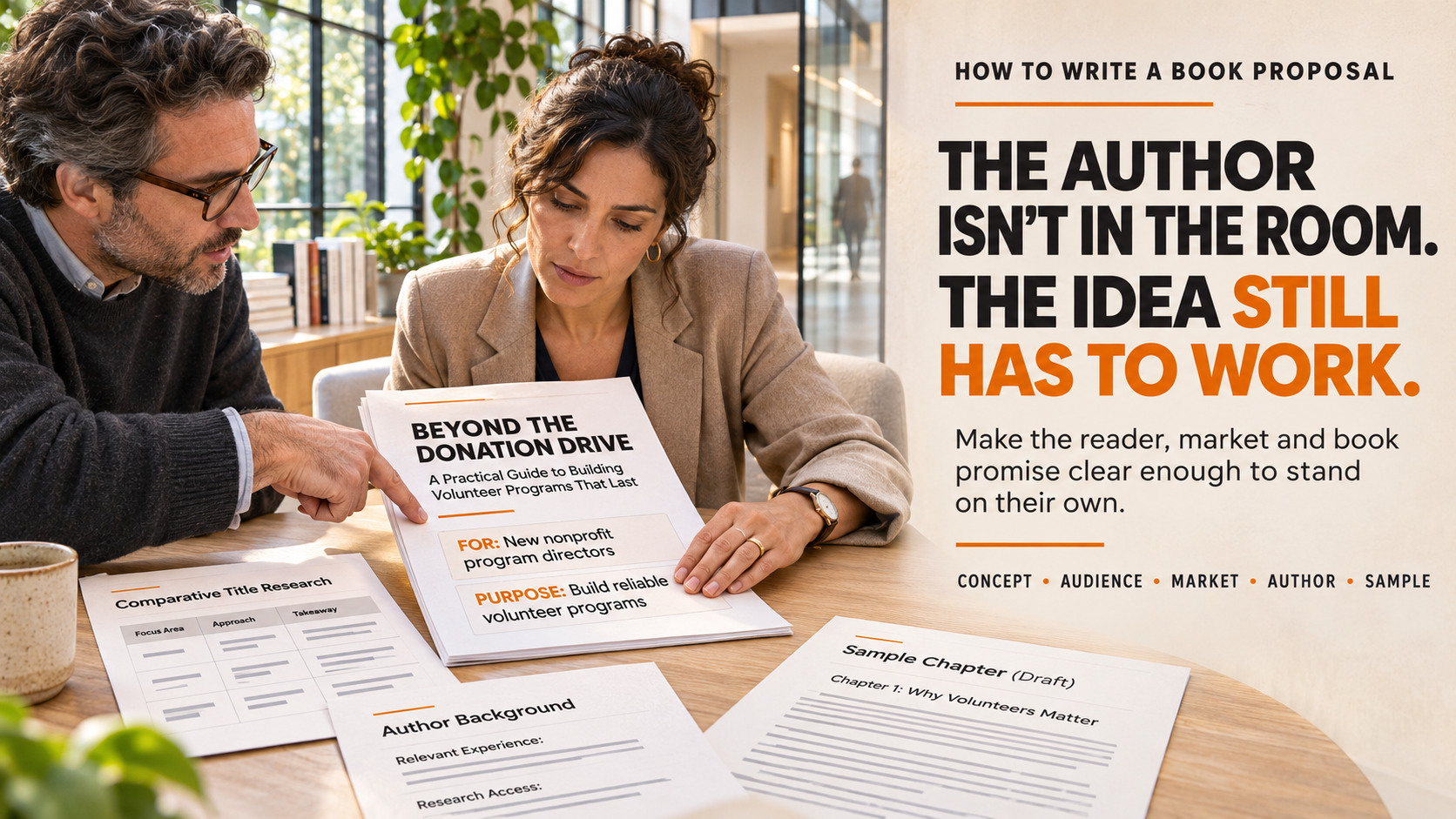
You have a nonfiction book idea you believe in.
You know the subject. You may have spent years researching it, teaching it, working in the field, or living through the experience you want to write about.
But then you try to explain the book to a literary agent.
What exactly is the book about? Who will buy it? What makes it different from the books already available? Why are you the right person to write it?
Suddenly, the idea that felt so clear in your head becomes difficult to explain on the page.
That's the problem a nonfiction book proposal is designed to solve.
A proposal isn't simply a summary of a book you hope to write. It's a convincing explanation of what the book will deliver, who needs it, why the market has room for it, and whether you can bring it to completion.
Learning how to write a book proposal is therefore as much about making better publishing decisions as it is about preparing a professional submission.
At Amazon KDP Experts, we encourage authors to clarify the reader, manuscript direction, and work still required before committing to writing or publishing services. Those same decisions are essential when preparing a proposal for traditional publication.
In this guide, you'll learn what literary agents and acquisitions editors expect, how to research your audience and comparable books, and how to turn your idea into a credible publishing pitch, without exaggerating your platform or inventing evidence of demand.
Key Takeaways
- A nonfiction book proposal makes the business and editorial case for a book. It explains the concept, readership, market position, author's credentials, and proposed manuscript.
- Research your audience before polishing the pitch. A compelling idea still needs a recognizable reader and a reason to exist alongside competing books.
- Use evidence, not promotional claims. Comparable titles, verifiable expertise, existing audience relationships, and strong sample writing make your case more credible.
- Follow the recipient's guidelines. Proposal length, chapter requirements, and submission procedures vary among agents and publishers.
- Make every section support the same promise. The overview, chapter outline, author bio, and sample chapters should describe one coherent book.
What Is a Nonfiction Book Proposal?
A nonfiction book proposal is a document used to pitch a book project to a literary agent or publisher, often before the complete manuscript has been written.
It presents the book's central idea, target readers, market position, author qualifications, promotional opportunities, planned chapters, and sample writing.
The purpose is to help a publishing professional evaluate whether the project is worth acquiring and whether the author can deliver it.
A strong proposal answers four questions:
- What is the book? Its subject, argument, approach, and reader promise.
- Who will buy it? The identifiable audience and evidence that readers are interested in the subject.
- Why this book and this author? What distinguishes the project and qualifies the writer.
- Can it be delivered and promoted? Whether the structure, sample writing, research plan, and audience access are credible.
Think of the proposal as the place where an interesting subject becomes a clearly defined publishing project.
Do All Nonfiction Authors Need a Book Proposal?
No.
The answer depends on the kind of nonfiction you're writing and the publishing route you're pursuing.
| Project Type | Typical Proposal Consideration |
|---|---|
| Practical nonfiction or self-help | A proposal and sample material may be used to pursue a traditional deal before the manuscript is complete |
| Business or professional nonfiction | Publishers often evaluate the concept, author expertise, identifiable market, and platform |
| Narrative nonfiction | Strong storytelling, research access, narrative structure, and sample writing can be especially important |
| Memoir | Some agents and publishers expect a completed manuscript, particularly from debut authors without an established platform |
| Academic nonfiction | University presses may require a specialized proposal, scholarly contribution, and different supporting materials |
| Self-published nonfiction | No traditional acquisition proposal is required, although proposal-style planning can clarify the project |
A traditional publishing proposal and an independently published book's production plan serve different purposes.
If you're planning to publish independently, our guide on how to write a nonfiction book covers the broader process of developing, researching, writing, and revising the complete manuscript.
Here, we're concentrating on how to make a nonfiction book project convincing to someone evaluating it for publication.
What Should a Nonfiction Book Proposal Include?
Most substantive trade nonfiction proposals cover a similar collection of information, even when the section order varies.
| Section | What It Must Establish | Common Weakness |
|---|---|---|
| Book overview | The concept, promise, relevance, and distinct angle | Describing the subject without explaining the book |
| Target audience | Exactly which readers would buy and benefit from it | Claiming the book is for everyone |
| Author bio and platform | Credibility, experience, access, and existing reach | Inflated credentials or irrelevant biography |
| Comparable titles | An identifiable readership and meaningful market position | No relevant books or unrealistic comparisons |
| Marketing plan | Credible ways the author can help reach readers | Promising media appearances without connections |
| Chapter outline | A coherent, sufficiently developed book | Chapters that repeat the same idea |
| Sample chapters | The ability to deliver compelling, credible prose | Sending preliminary or unrepresentative writing |
| Manuscript specifications | The project's size, remaining work, and practical requirements | Unrealistic delivery promises or missing permissions |
These aren't just administrative sections.
Each serves as evidence for a particular part of the publishing decision.
For that reason, the smartest way to develop a proposal isn't necessarily to write its sections in the order they'll eventually appear.
Start by finding out what you can genuinely support.
How to Write a Book Proposal: Build the Evidence Before the Pitch
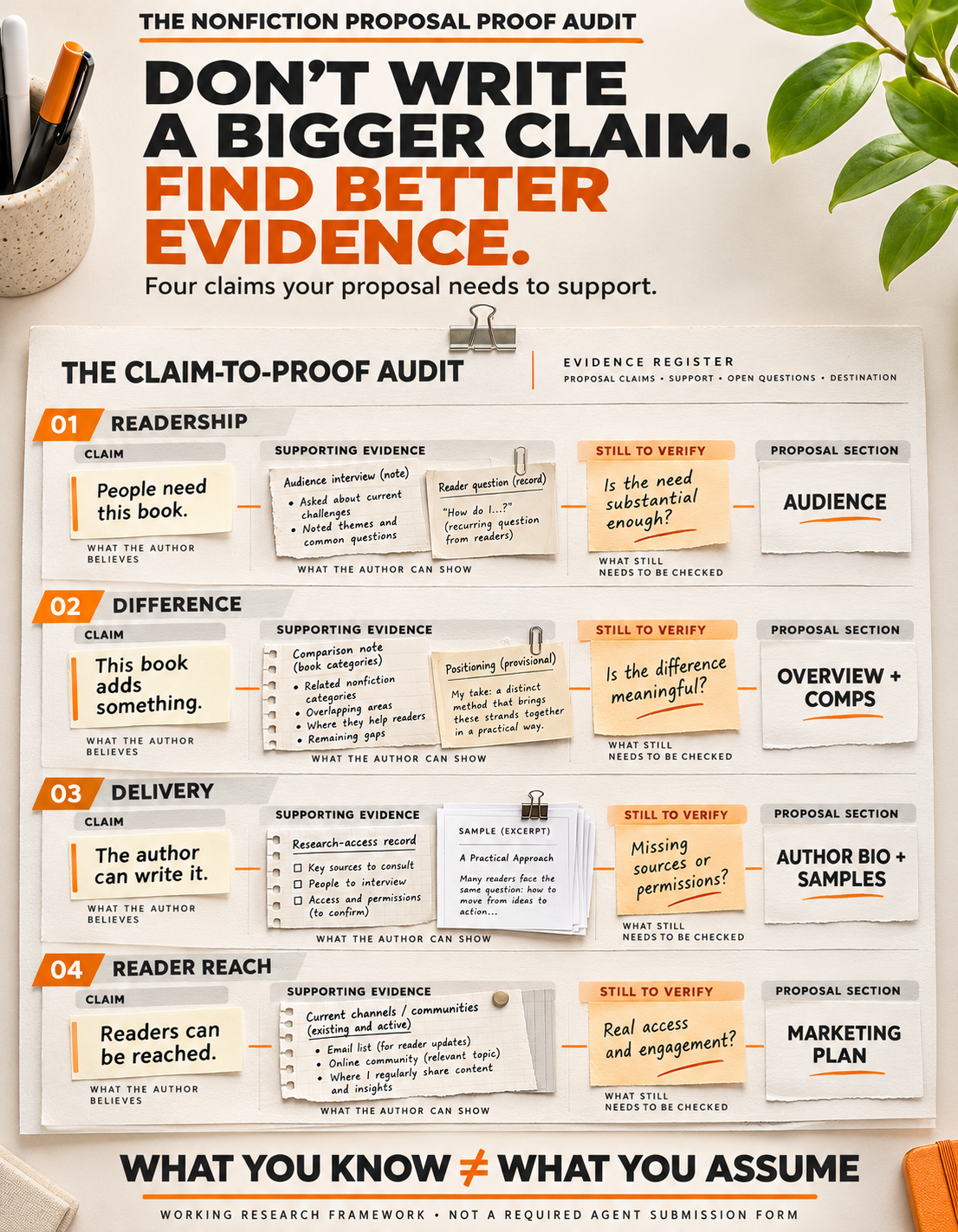
Before writing the polished overview, create a working document for the facts, assumptions, and unanswered questions behind your project.
This is especially useful when you have plenty of knowledge about the subject but haven't yet tested whether it can support a distinct commercial book.
The Proposal Proof Ledger
Use four columns:
| Proposal Claim | Evidence You Have | What Still Needs Checking | Where It Belongs |
|---|---|---|---|
| A defined readership needs this book | Relevant reader conversations, existing books, professional experience | Whether the problem is important enough for a full book | Audience |
| The book adds something distinctive | Comparison of current books and your approach | Whether the proposed difference is meaningful | Overview and comps |
| The author can deliver the material | Professional experience, original research, archives, interviews | Permissions, missing expertise, research gaps | Author bio and sample chapters |
| The author can help reach readers | Existing newsletter, professional community, speaking history | Actual access, engagement, and promotional commitments | Marketing plan |
This is a planning framework, not a form required by literary agents.
Its purpose is simple: separate what you know from what you hope is true.
For example, an author may believe thousands of people would benefit from a leadership book.
That is a belief.
Evidence might include recurring questions from a defined professional audience, relevant current titles, paid workshops, or an established newsletter.
The proposal should distinguish those things rather than presenting the first claim as a demonstrated market fact.
Step 1: Write a Book Overview That Explains Why the Project Matters
The overview introduces the concept to an agent or acquisitions editor.
It should help them understand the book quickly without requiring them to read the entire chapter outline first.
A useful overview establishes:
- The central subject or argument.
- The audience the book is intended to serve.
- The problem, question, or story that gives the book significance.
- The distinctive approach or insight.
- Why does this book belong in the current publishing market?
- Why the proposed author is suited to the work.
Start With the Book, Not Your Biography
Imagine a consultant proposing a book about leadership.
A weak opening might say:
Leadership is one of the most important skills in today's workplace. Many people struggle to become effective leaders, and this book will help them succeed.
The statement is broadly agreeable.
But it gives a publishing professional little reason to remember this particular book.
A stronger proposal begins with a more specific problem:
The first difficult conversation a new manager has with an employee often arrives before anyone has taught that manager how to lead one. This book shows newly promoted managers how to prepare for conversations about missed expectations, disagreement, and performance without relying on vague advice about simply being more confident.
That version defines a recognizable reader, a recurring situation, and a practical purpose.
It suggests what the book will actually contain.
Add the Distinctive Angle
Now answer the question an editor is likely to ask:
What will readers get here that isn't adequately delivered by the books they already own?
Your difference might come from original research, unusual professional access, a particular reader group, a new synthesis of established ideas, or an especially useful method.
It shouldn't depend on casually dismissing competing authors.
Write the Overview Last, Even Though It Appears First
You can draft a provisional overview early.
But don't finalize it until you've researched comparable books, tested your audience assumptions, and created a credible chapter structure.
By then, you'll know whether the book you initially imagined is the same project you're now proposing.
Pro Tip: Remove the book's working title from your overview and ask someone unfamiliar with the project to describe its intended reader and main promise. If they can't, the explanation is probably still too broad.
Step 2: Identify the Readers Who Would Actually Buy the Book
A nonfiction proposal needs more than a description of people who might find the topic interesting.
An agent or publisher wants to understand who is likely to seek out the book and why the subject deserves a sustained reading experience.
Separate the Primary Reader From Secondary Audiences
Imagine a proposed book about rebuilding volunteer programs at small nonprofits.
Potential audiences include:
| Audience | Why They Might Read It | Role in the Proposal |
|---|---|---|
| First-time nonprofit program directors | They need a working system for recruiting and retaining volunteers | Primary |
| Experienced volunteer coordinators | They want to improve existing processes | Secondary |
| Community organization boards | They make decisions about staffing and program design | Secondary |
| General readers interested in community service | They may appreciate the subject but aren't necessarily looking for an operational guide | Peripheral |
The proposal becomes clearer when it names one central reader.
It doesn't need to exclude every other possible audience.
Find Evidence of Reader Demand
Look beyond broad demographic labels.
Study the places where the intended readers already discuss their problems or purchase relevant resources.
That might include:
- Existing nonfiction books and their intended audiences.
- Professional associations and educational programs.
- Relevant conferences, courses, and recurring workshops.
- Reader communities and subject-specific publications.
- Questions that appear repeatedly in your own professional work.
- Feedback from previous writing, teaching, or public presentations.
Explain what the evidence shows and what it doesn't.
A popular online discussion may demonstrate interest in a topic, but it does not establish how many people will purchase a book.
Likewise, a large professional association doesn't mean its entire membership is a prospective readership.
The Reader-Purchase Test
Ask yourself:
What would make this person choose a book about this problem instead of a free article, video, workshop, or shorter guide?
Your answer might involve the need for a complete framework, a coherent narrative, original research, practical exercises, or a resource readers can use repeatedly.
If the idea can be fully addressed in a short article, you may need to broaden its intellectual depth, or consider whether it should become a book at all.
Step 3: Research Comparable Titles Without Pretending You Have No Competition
Comparable titles, often called comp titles, help agents and editors understand the publishing market in which your book belongs.
They provide context for the prospective readership, positioning, content, format, and commercial expectations.
They aren't a list of books you intend to defeat.
How to Choose Useful Comp Titles
Look for books that your intended reader might reasonably consider alongside yours.
Prioritize titles that are:
- Recent enough to reflect the current market where possible.
- Relevant to the same reader or closely related need.
- Comparable in category, scope, tone, or intended use.
- Published through channels relevant to the market you're approaching.
- Substantive enough to support an informed comparison.
Established category classics can provide useful background, but relying only on famous books may misrepresent the market for a new author.
The Comparable-Title Research Method
For each candidate book, record the title, author, publisher, publication year, intended reader, central promise, and distinctive approach.
Then answer:
What does this book already deliver well, and what legitimate reason would its readers have to consider mine?
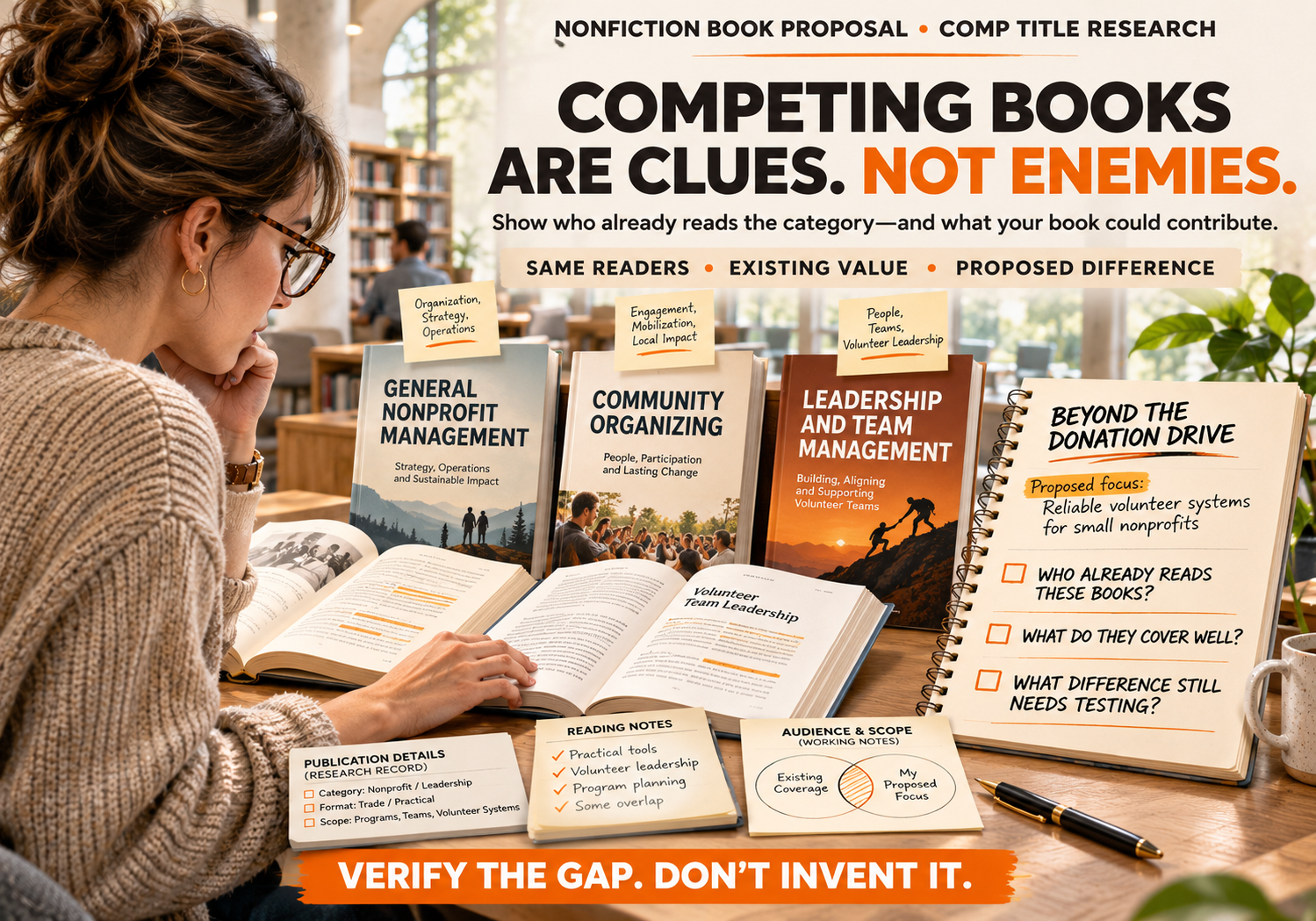
Here is how the analysis might work for the hypothetical nonprofit leadership book.
| Existing Book Category | What It Already Provides | Potential Distinction for the New Book |
|---|---|---|
| General nonprofit management guide | Broad organizational management principles | A narrower focus on volunteer operations |
| Community-organizing book | Mobilization, engagement, and social action | A practical system for running ongoing volunteer programs |
| Leadership handbook | Communication and team management | Processes designed for teams with unpaid contributors |
These are illustrative categories, not invented published titles or proof of an unoccupied market.
The author would still need to research actual books and demonstrate that the distinction holds up.
Don't Misuse Amazon Rankings and Reviews
A retailer's bestseller rank isn't a verified lifetime sales figure.
Customer reviews can offer useful clues about reader expectations, but they aren't a representative survey of the market.
Use the available information responsibly rather than presenting assumptions as measured sales performance.
Literary agent guidance on developing a nonfiction book proposal emphasizes that comparable titles should demonstrate both the existence of an audience and a meaningful distinction for the proposed work.
Pro Tip: If your comp analysis could apply unchanged to almost any book in the category, you haven't explained your market position clearly enough.
Step 4: Write an Author Bio That Establishes Credibility
Your author biography isn't a complete professional history.
It's an argument for why you're qualified to produce this particular book and, where relevant, help it reach readers.
A convincing bio may include:
- Relevant professional experience.
- Specialized training or credentials.
- Previous books or substantial published work.
- Original research, field experience, or primary-source access.
- Teaching, speaking, or media experience.
- Long-standing participation in the subject community.
- An existing audience you can reach directly.
The most relevant credentials depend on the book.
A researcher writing narrative history may need to demonstrate investigative skill and access to archives.
A clinician writing professional health nonfiction should establish relevant qualifications and appropriate evidence standards.
A memoirist may need to establish why the story matters beyond personal experience and demonstrate the ability to tell it compellingly.
Credentials and Author Platform Aren't the Same Thing
Your credentials support the credibility of the work.
Your platform describes your ability to reach people who may be interested in that work.
They can reinforce each other, but one doesn't replace the other.
An author may have extraordinary expertise and little public audience.
Another may have substantial social reach but lack the qualifications needed for a technical nonfiction project.
Address the gap honestly.
What if You Don't Have a Large Following?
Don't invent one.
Explain the relevant reach you do have and the professional relationships that are genuinely available.
You may have a specialized newsletter, teaching role, professional association involvement, recurring speaking invitations, or access to an identifiable community.
If your audience access is currently limited, your proposal can acknowledge that.
But also recognize that a weak author platform can be a significant commercial obstacle in some trade nonfiction categories.
Strong writing alone will not erase every market concern.
Step 5: Build a Marketing Plan Based on Actions You Can Actually Take
A proposal's marketing section should explain how you can help readers discover the book.
It isn't a request for the publisher to handle every aspect of promotion.
Nor is it a page of ambitious claims about becoming a bestseller.
Separate Existing Resources From Future Possibilities
Use this distinction:
| Credible Marketing Evidence | Unsupported Promotional Claim |
|---|---|
| An active newsletter reaching a relevant professional audience | A plan to build a huge newsletter before release |
| Previous speaking invitations in the book's subject area | A promise to secure major conference keynotes |
| Regular contributions to an established publication | An assumption that national newspapers will cover the book |
| A documented relationship with an organization that serves the target reader | An expectation that every member of that organization will buy it |
| Existing teaching or workshop activity | A speculative nationwide book tour |
Future plans can be included.
Just distinguish intentions from confirmed opportunities.
Build the Marketing Plan Around Reader Access
A useful plan answers:
- Where does the intended readership already spend time?
- Which of those channels can the author genuinely access?
- What relevant material could the author share before or after publication?
- Which organizations, publications, or professional communities might reasonably be interested?
- What activity can the author commit to without relying on an unconfirmed third party?
A narrow, credible plan can be more persuasive than a long list of unlikely promotional possibilities.
Don't Confuse Visibility With Book Sales
A podcast invitation, social media post, or speaking engagement can generate awareness.
That doesn't establish how many books will sell.
Publishers make commercial judgments using information beyond what most authors can access.
Your responsibility is to provide accurate evidence of your reach and explain how it relates to the proposed readership.
Step 6: Create a Chapter Outline That Proves the Book Can Deliver
A book proposal outline is more detailed than a list of appealing chapter titles.
It should show what the book will actually contain and why the sections belong in their proposed order.
For each chapter, describe:
- The main subject or reader problem.
- The chapter's central argument or purpose.
- The examples, stories, research, or evidence it will use.
- The insight or progression it contributes to the larger book.
Example: From Vague Chapters to a Coherent Book
Suppose our hypothetical nonprofit book has these proposed chapters:
| Weak Chapter Title | Stronger Chapter Direction |
|---|---|
| Understanding Volunteers | Why volunteer programs break down when responsibilities remain informal |
| Recruiting People | How to define useful roles before asking people to join |
| Keeping Volunteers Happy | How to create feedback, recognition, and scheduling systems |
| Growing Your Organization | How to expand participation without overloading the same dependable people |
The revised chapters form a progression.
The reader moves from understanding an operational problem to establishing a more reliable system.
Write a Meaningful Chapter Summary
A weak summary:
Chapter Three will discuss ways to communicate better with volunteers.
A stronger summary:
Chapter Three explains why volunteer communication fails when important decisions are scattered across personal messages, informal conversations, and multiple coordinators. It introduces a practical communication structure, examines where information is lost during handoffs, and shows how program directors can create consistent expectations without introducing unnecessary administration.
The second version provides enough substance for an editor to evaluate the proposed chapter.
It also tells the author what research and writing remain.
Account for the Book's Type
A prescriptive business guide should demonstrate a useful progression of ideas.
Narrative nonfiction should show the development of the story, including the significance of major events and how the narrative resolves.
A memoir proposal should not read like a collection of disconnected life episodes.
If a narrative book depends on a compelling ending, the outline should generally reveal that ending rather than concealing it like advertising copy.
Step 7: Choose Sample Chapters That Demonstrate Your Ability
A polished proposal cannot compensate for sample writing that fails to deliver on its promise.
Sample chapters give a literary agent or editor evidence of the author's voice, subject knowledge, structure, and ability to sustain the work.
Which Chapter Should You Submit?
That depends on the manuscript and the recipient.
For practical nonfiction, a substantial chapter that clearly demonstrates your central method may be a good choice.
For narrative nonfiction or memoir, opening chapters may be more important because the reader needs to experience how the story begins and develops.
Some agents specifically ask for the first chapters.
Others provide more flexible requirements.
Always follow the actual submission guidelines.
Don't choose a different sample solely because it feels stronger if the recipient has requested particular pages.
The Sample Chapter Quality Test
Before including a chapter, ask:
- Does it sound like the book described in the overview?
- Does it deliver a meaningful idea rather than merely introduce one?
- Are factual statements adequately supported?
- Does the chapter contain specific details or examples?
- Does the writing establish confidence in the author's ability?
- Is the structure clear without requiring extensive explanation from the proposal?
- Has the material received appropriate revision and proofreading?
A strong sample should make the proposed book feel real.
What if You Have Research but Can't Yet Write the Chapters?
You may need help determining whether the obstacle is the manuscript structure, your writing process, or the absence of essential material.
Professional book ghostwriting services can support nonfiction manuscript development through interviews, research organization, outlining, collaborative drafting, and author review, depending on the agreed scope.
If you're considering that route, our guide to hiring a ghostwriter without losing your voice or rights explains how to evaluate writing samples, contracts, collaboration, and deliverables.
When the goal is a traditional publishing proposal, confirm specifically whether the professional has relevant proposal-development experience. General book-writing experience isn't automatically expertise in pitching trade nonfiction.
Step 8: Document the Manuscript's Scope and Practical Requirements
A proposal also needs to show that the project is achievable.
Include information relevant to the manuscript's production, such as:
- Estimated completed manuscript length.
- Current writing and research status.
- Realistic time needed for delivery.
- Special photographs, illustrations, charts, or tables.
- Primary interviews or archives still needed.
- Permissions and licensing issues.
- Contributors, co-authors, or specialist reviewers where relevant.
- Other features affecting editorial or production work.
The purpose isn't to predict every detail with perfect accuracy.
It's to demonstrate that you've considered what completing the book actually requires.
Be Specific About Unresolved Dependencies
For example:
The proposed manuscript will draw on original interviews with community organization leaders. Interview access and permission for substantial quotations will need to be confirmed during the research stage.
That is more useful than implying interviews have already been secured.
Likewise, if a project depends on photographs or archival records, establish whether the material exists and what rights may be required.
Don't promise a delivery date that assumes every source, interview, contributor, and revision will arrive without complications.
A Worked Nonfiction Book Proposal Example
The following is a fictional demonstration created for this article. It is not a real publishing submission, client case study, or evidence of market demand.
Its purpose is to show how the proposal sections can support one coherent book.
Fictional Book Concept
Working Title: Beyond the Donation Drive
Subtitle: A Practical Guide to Building Volunteer Programs That Last
Proposed Category: Practical nonprofit management
Primary Reader: New program directors and volunteer coordinators at small community organizations
Example Proposal Overview
Small community organizations often depend on people who give their time willingly, yet the processes supporting those people may be less developed than the programs they are expected to run.
Beyond the Donation Drive is a practical guide for nonprofit leaders who need to build reliable volunteer operations without creating a complicated management system. The book begins with the problems caused by unclear roles and informal communication, then develops a method for recruiting, onboarding, coordinating, and retaining volunteers around manageable responsibilities.
Designed for new program directors and coordinators, the book combines operational explanations, decision tools, and practical examples. Its central argument is that sustainable volunteer participation depends less on continuously recruiting new people and more on making participation clear, useful, and manageable for those already involved.
This is an illustrative editorial concept. Its market fit, originality, and claims would still require research.
Example Audience Statement
Primary audience: People who manage volunteer programs at small nonprofits and community organizations.
Reader need: A practical operating framework for organizing volunteers, setting expectations, and improving continuity.
Secondary audiences: Organization leaders and board members involved in volunteer program oversight.
Evidence still required: Actual comparable-title research, relevant community feedback, and validation that the proposed readership seeks this kind of complete book.
Example Comparable-Title Positioning
Rather than claiming the project has no competitors, the author would identify existing nonprofit management, community-organizing, and volunteer coordination books.
The comparison would explain which topics those books already address, where their audiences overlap, and whether the proposed guide offers a meaningfully distinct approach.
Unverified gap: The author must demonstrate that the proposed emphasis on small-organization operating systems is not already adequately served by relevant recent publications.
Example Author Bio
This section should not invent an impressive professional background.
A real author would replace the following planning prompts with verifiable details:
- Relevant experience managing or researching volunteer programs.
- Actual organizational responsibilities.
- Relevant publications or training experience.
- Original research or professional access.
- Existing audience relationships and promotional channels.
If those details are insufficient, the project may require more research, collaboration, or a different positioning strategy.
Example Chapter Progression
| Proposed Chapter | Core Purpose |
|---|---|
| The Hidden Cost of Informal Systems | Explain why unclear responsibilities undermine volunteer programs |
| Define the Work Before Recruiting | Show how to describe roles and expectations |
| Make Onboarding Repeatable | Develop a practical introduction process |
| Build Reliable Communication | Establish coordination and handoff procedures |
| Recognize Contributions Without Burning People Out | Address sustainable participation |
| Review What Actually Works | Introduce an ongoing improvement process |
Example Marketing Plan
The author would identify any relevant workshops, organizational partnerships, professional writing, conferences, or reader communities already available.
Unconfirmed speaking invitations or endorsement relationships would remain explicitly labeled as possibilities, not commitments.
Why This Example Is More Useful Than a Generic Template
Every section points toward the same proposed book.
The overview defines the problem.
The audience section identifies who needs the solution.
The comparable-title analysis tests the market.
The author bio establishes who can credibly provide it.
The chapters demonstrate how the manuscript would deliver.
And the marketing plan addresses how those readers might discover the book.
That's what makes a proposal coherent.
How Long Should a Nonfiction Book Proposal Be?
There is no universal page count that every literary agent and publisher requires.
Some proposals are comparatively compact. Others become substantial documents once detailed chapter summaries, supporting materials, and sample chapters are included.
Length depends on the nonfiction category, project complexity, and submission requirements.
A detailed literary-agent proposal outline may ask for material different from what a particular academic press or independent publisher requests.
For example, publishing expert Jane Friedman explains that proposal length varies considerably and emphasizes that authors should understand their market and build a compelling business case rather than merely satisfy a page-count target.
Her book proposal guide and template offer further context for preparing trade nonfiction proposals.
What Matters More Than Length?
An agent should be able to understand:
- What makes the book compelling.
- Who is likely to read it.
- What supports the market argument.
- What qualifications the author brings.
- How the chapters will work.
- Whether the sample writing delivers.
Do not extend the document simply to reach a presumed standard.
And don't cut essential research to make it look brief.
Book Proposal vs Query Letter vs Synopsis: What's the Difference?
These documents are related, but they serve different purposes.
| Document | Main Purpose | Typical Content |
|---|---|---|
| Book proposal | Present the nonfiction project and its publishing case | Concept, audience, comps, credentials, marketing, chapters, samples |
| Query letter | Introduce the project and seek interest or representation | Concise pitch, relevant author information, requested materials |
| Synopsis | Explain the book's content or narrative progression | Main argument or story, important developments, resolution where relevant |
| Manuscript | Deliver the actual book | Complete prose, research, stories, explanations, and supporting material |
A query letter isn't simply a condensed chapter outline.
It should introduce the project in a way appropriate to the recipient.
Similarly, a synopsis cannot replace the market and author-platform analysis usually needed in a trade nonfiction proposal.
Should You Send the Complete Proposal With Your First Query?
Only when the agent or publisher's instructions call for it.
Some recipients request an initial query, sample pages, or a brief description.
Others invite a complete proposal.
Follow their stated requirements, preferred file types, word limits, and submission procedures.
Sending a large unsolicited attachment may work against you if the agency requests a different process.
Mistakes That Weaken Otherwise Promising Book Proposals
Mistake 1: Calling the Book Important Without Showing Why
Statements about a topic's importance aren't enough.
Define the reader and demonstrate why the subject deserves the book-length treatment you're proposing.
Mistake 2: Claiming Everyone Is a Potential Reader
A vague audience makes positioning, comparable-title research, and marketing less credible.
Identify the primary reader first.
Mistake 3: Treating Comparable Books as Enemies
Your competition analysis should demonstrate market understanding, not dismiss other authors.
Mistake 4: Using Followers as Proof of Sales
An audience metric can show reach, but it doesn't automatically prove purchases.
Explain who the audience is, how it was built, and how relevant it is to this book.
Mistake 5: Filling the Marketing Section With Unconfirmed Promises
Potential endorsements, media opportunities, and speaking events should not be presented as secured arrangements.
Mistake 6: Writing Chapters That Don't Deliver the Overview
If the proposal promises a practical method but the outline contains only general reflections, the book's structure needs more development.
Mistake 7: Sending an Unfinished Sample Chapter
A rough chapter doesn't establish that you can deliver a publishable manuscript.
Revise the sample until it represents the quality and approach of the proposed book.
Mistake 8: Ignoring the Requirements of the Intended Publisher
A generic template cannot replace the actual recipient's instructions.
Different agents, trade imprints, and academic presses may expect different materials.
Mistake 9: Confusing Proposal Writing With Manuscript Writing
A finished manuscript may still need a proposal if a traditional publisher requests one.
Conversely, an excellent proposal doesn't mean the author has completed the book.
Mistake 10: Making the Pitch Sound More Certain Than the Evidence
Overstated credentials, fabricated sales forecasts, or unsupported market claims can undermine confidence in the rest of the proposal.
Specific, defensible evidence is more persuasive.
Should You Use AI to Write a Book Proposal?
AI tools can assist with organizing notes, comparing draft structures, identifying repeated ideas, and improving clarity.
But using AI to generate a confident-sounding market argument does not make that argument true.
Be particularly careful when asking tools to produce:
- Comparable titles and bibliographic details.
- Market-size estimates.
- Book sales projections.
- Author credentials.
- Research findings.
- Testimonials or endorsements.
- Literary-agent submission requirements.
Verify such information against appropriate sources.
A useful AI-assisted workflow is to provide your own research notes and ask for a gap analysis:
Review this draft nonfiction proposal. Identify claims without evidence, contradictions between the overview and chapter outline, unsupported audience assumptions, and promotional statements that appear more certain than the supplied information. Do not invent missing facts or book titles.
Use the feedback as an editorial review, not as proof that the proposal is ready to submit.
If the project needs substantial structural development or a more polished presentation, professional book editing services may help with clarity, coherence, and writing quality, subject to the provider's expertise and agreed scope.
Before hiring, confirm whether the editor specifically has experience with nonfiction proposals and traditional publishing submissions.
Your Final Book Proposal Submission Checklist
Use this checklist before approaching literary agents or publishers.
| Question | Ready When... |
|---|---|
| Is the central concept clear? | You can explain the book's argument or promise in a concise paragraph |
| Is the intended reader specific? | The audience can be recognized and meaningfully researched |
| Is the market argument credible? | Relevant comparable books and supporting information are accurately represented |
| Is the author's authority established? | Credentials and experience are real, relevant, and verifiable |
| Is the platform described honestly? | Existing reach is distinguished from future promotional plans |
| Is the chapter structure complete? | Each chapter advances the book's purpose rather than repeating it |
| Are sample chapters strong? | They demonstrate the voice, substance, and quality of the proposed manuscript |
| Is the production plan realistic? | Research, permissions, delivery needs, and outstanding work have been considered |
| Is the document internally consistent? | Overview, outline, audience, and samples describe the same project |
| Does the submission follow instructions? | The recipient's required materials and procedure have been checked |
Don't treat this as a way to guarantee an agent's interest.
Use it to identify preventable weaknesses before someone else evaluates your work.
Final Thoughts: A Strong Book Proposal Makes the Book Easier to Believe In
A nonfiction proposal should leave the reader with a clear sense of the book that could exist.
Not just the subject.
Not just the author's enthusiasm.
The actual book, its reader, its argument, its distinctive contribution, and the evidence that the author can deliver it.
That is the purpose behind learning how to write a book proposal.
Research the audience before claiming demand. Study comparable titles before describing your idea as original. Connect your credentials to the book's subject. Write sample chapters that deliver on the promise.
Most importantly, allow the process to change your thinking.
You may discover that your first concept is too broad, that a different readership is better suited to the material, or that the chapter structure needs to change.
Those discoveries are not failures.
They are the work of turning an interesting idea into a more convincing publishing project.
A good proposal doesn't make uncertainty disappear. It makes the book, and the decisions still required, much clearer.
Your Nonfiction Idea Deserves a Clear Next Step
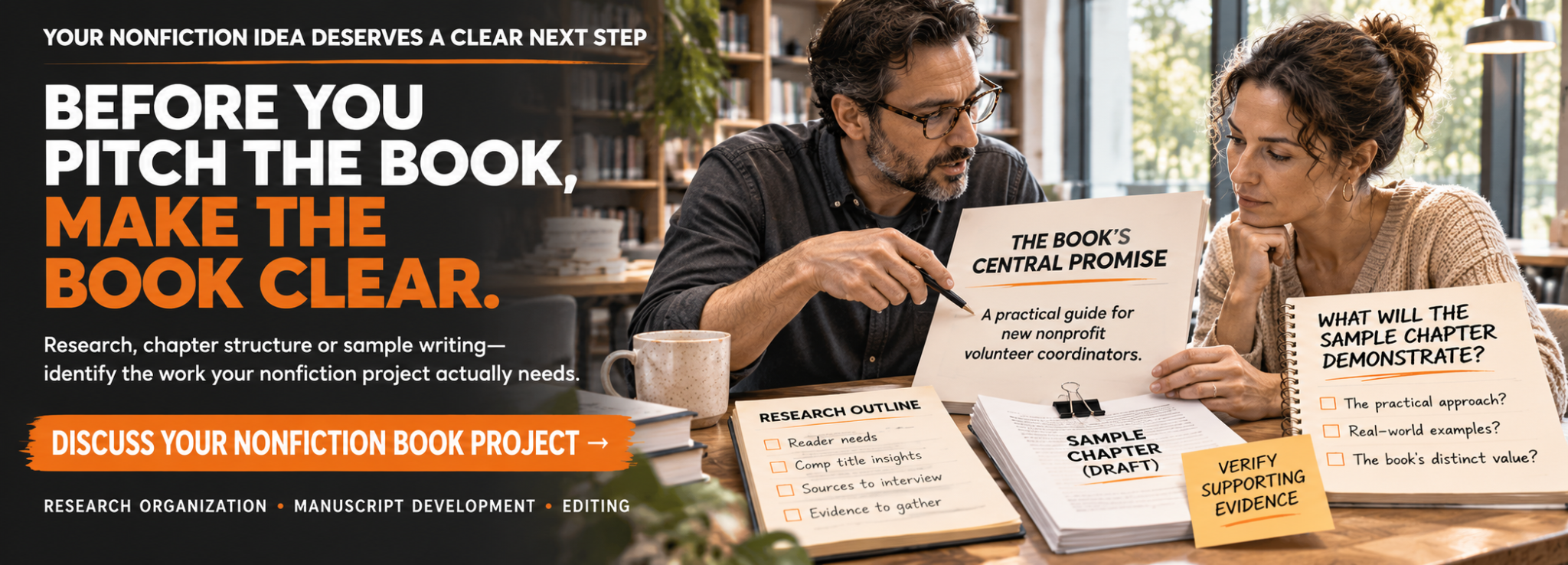
You may have a strong concept but need help organizing research, developing sample chapters, or preparing a manuscript for the publishing path you choose.
Amazon KDP Experts provides independent writing, editing, and publishing-support services. We do not act as a literary agency or guarantee traditional publishing representation or acquisition.
Tell us what you have already written, which decisions remain unresolved, and what kind of professional support you're considering.