
You have enough knowledge to fill a book. The problem is figuring out which parts belong in it.
Maybe you've spent years helping clients solve the same problem. Perhaps you have research, recorded interviews, presentation slides, or a collection of ideas you've wanted to turn into something meaningful.
You sit down to write. The introduction sounds promising. Then chapter two goes in three directions, the research keeps growing, and suddenly the book you imagined feels impossible to finish.
That's where a better writing process makes all the difference.
Learning how to write a nonfiction book isn't about filling hundreds of pages with everything you know. It's about choosing the right reader, developing a clear idea, organizing reliable information, and creating chapters that move toward a meaningful conclusion.
Whether you're planning a self-help guide, business book, educational resource, or practical how-to book, the process becomes easier when you know what belongs at each stage.
At Amazon KDP Experts, the emphasis is on identifying what the book needs before moving into editing, design, or publishing. Because a good manuscript doesn't begin with a perfect first sentence.
It begins with a reason for readers to keep turning the pages.
Key Takeaways
- Start with one clear audience, problem, and purpose before creating your outline.
- Research competing books and organize trustworthy evidence before drafting.
- Build each chapter around a meaningful question, explanation, example, and takeaway.
- Revise the structure before polishing sentences, and choose a publishing route that fits your goals.
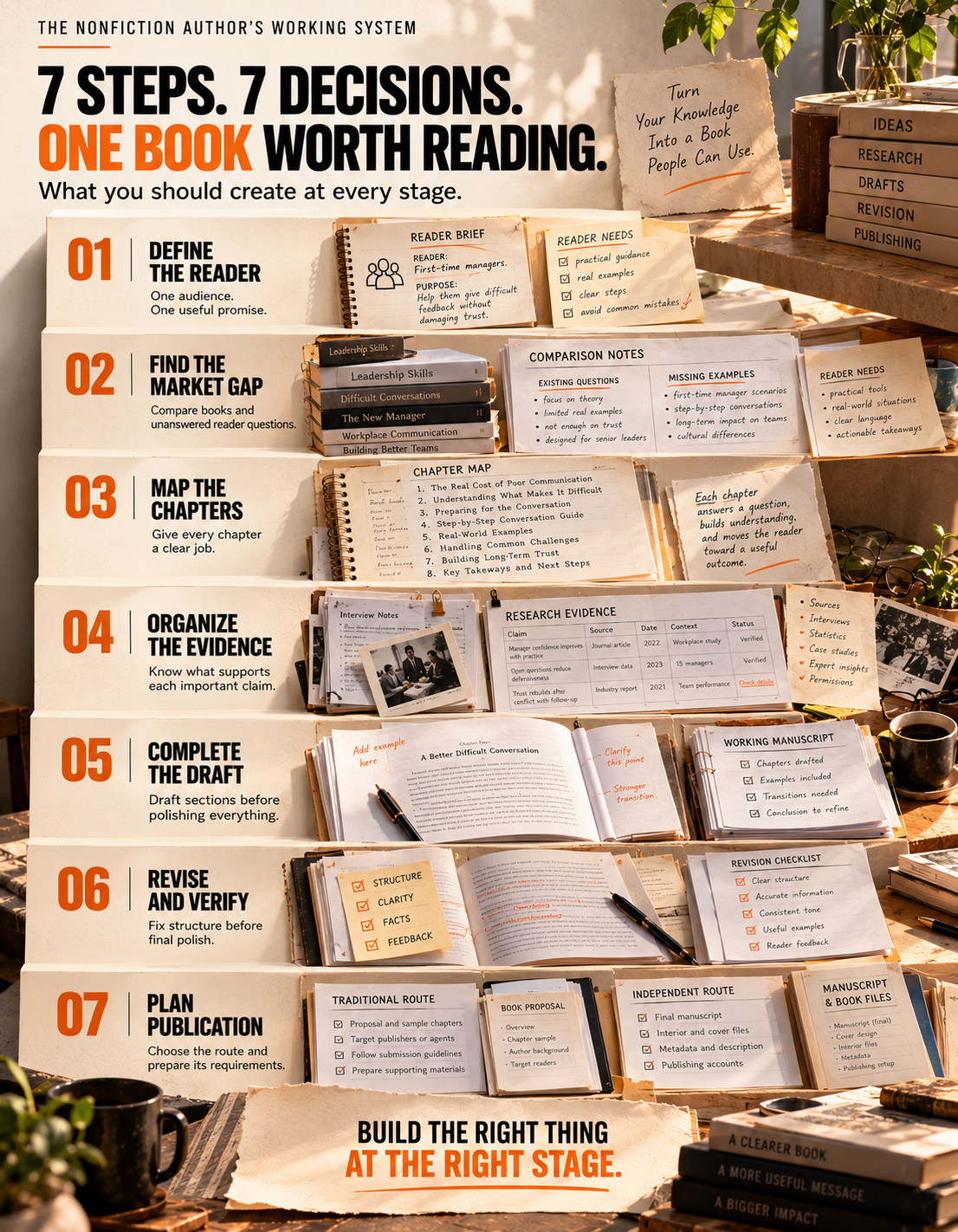
How Do You Write a Nonfiction Book From Start to Finish?
To write a nonfiction book, choose a specific subject and reader, define what the book will help them understand or accomplish, and study existing books in your category. Build a chapter outline, gather reliable research, draft consistently, revise for clarity and accuracy, and prepare the manuscript for your chosen publishing route.
The process works best when you stop treating writing, researching, editing, and publishing as one enormous task.
They are separate stages, and each requires different decisions.
You also don't need to be an academic or established author to begin. You do, however, need a clear understanding of your subject, a responsible approach to evidence, and the willingness to research what you don't know.
Here's how to move from the original idea to a complete manuscript.
Step 1: Decide Why You're Writing the Book, and Who Needs It
Before worrying about a title or word count, decide what success would look like for your particular project.
You might want to:
- Teach readers a skill or process.
- Explain a subject through research and analysis.
- Share lessons from professional experience.
- Help people make a difficult decision.
- Turn your expertise into a useful business book.
- Preserve important knowledge for a particular community.
These goals can overlap. But one should guide the book's central direction.
Find the Reader Behind Your Topic
Consider a leadership consultant who wants to write about workplace communication.
That's a subject, but it isn't a clear book idea yet.
Now consider this:
A practical guide for first-time managers who struggle to give difficult feedback without damaging trust.
The second idea identifies a reader, a situation, and a useful outcome.
That gives the author a much better starting point.
Try completing this sentence:
My book helps [specific reader] understand or accomplish [specific outcome] by explaining [central approach].
Don't worry about making the wording beautiful. Use it to test whether the idea is focused enough to develop.
Define Your Book's Central Promise
A nonfiction book needs a clear relationship between what the reader expects and what the chapters actually deliver.
For instructional nonfiction, that may be a practical result.
For narrative history or investigative nonfiction, the promise may be a deeper understanding of an event, question, or issue rather than a step-by-step solution.
Ask yourself:
- What does my reader already know?
- What are they confused about?
- What will become clearer by the final chapter?
- What can I explain that existing books don't explain as effectively?
Pro Tip: The Reader Outcome Test
Write the sentence you hope a reader could truthfully say after finishing your book:
"Before reading this, I didn't understand ____. Now I understand ____."
Use that statement to decide which chapters deserve space.
Step 2: Research Your Nonfiction Book Idea Before You Commit to It
You don't need to prove that your book will become a bestseller.
You do need to understand whether an identifiable readership exists and what those readers expect from books on your subject.
Start by looking at recent, relevant books in your intended category.
Study their titles, descriptions, tables of contents, reader reviews, and different approaches to the subject.
Find the Gap, Not Just the Competition
Imagine you're researching books about starting a consulting business.
You find several titles covering pricing, finding clients, building a reputation, and managing projects.
That doesn't automatically mean the subject is exhausted.
Look for recurring reader concerns:
- Which questions are explained too briefly?
- Where do readers struggle to apply the advice?
- What examples are missing?
- Has an important industry practice changed?
- Is there a specific audience the existing books barely address?
You might discover that first-time consultants need a practical guide to turning professional knowledge into a service offer, rather than another broad introduction to entrepreneurship.
That's a more useful book direction.
Check the Market Without Confusing Size With Opportunity
There is measurable demand for adult nonfiction generally.
According to the Association of American Publishers' 2025 StatShot Annual Report, released in August 2026, estimated U.S. adult nonfiction publishing revenue reached $6.0 billion in 2025.
This is an industry-wide figure, not a prediction of demand or earnings for your own book.
A large market doesn't remove the need for a focused idea, good writing, or reader research.
For nonfiction authors, the more useful question is:
Can I identify a particular group of readers who would benefit from this book, and can I explain why?
Choose Your Publishing Direction Early
Your intended publishing route can affect how much writing you should complete before approaching a publisher.
For many traditionally published prescriptive nonfiction projects, agents may consider a book proposal and sample chapters before the entire manuscript is written. Requirements vary by category and recipient.
If you intend to self-publish, developing a complete manuscript is normally part of your production plan.
You don't have to finalize every publication decision immediately, but investigate the route early enough to avoid unnecessary work.
Step 3: Create a Nonfiction Book Outline That Makes Sense to Readers
A strong nonfiction outline is more than a list of interesting chapter titles.
It gives the reader a logical route through your ideas.
Before outlining, empty your notes onto a page. Include your main arguments, examples, common questions, research subjects, and ideas you want readers to remember.
Then start grouping related material.
Choose the Structure That Fits Your Subject
Different nonfiction books need different structures.
| Book structure | Best suited for | Example |
|---|---|---|
| Step-by-step | How-to guides and skill development | Building a business from planning to launch |
| Problem and solution | Self-help and practical professional guidance | Understanding and addressing workplace burnout |
| Thematic | Ideas explored through several connected themes | Different aspects of effective leadership |
| Chronological | History, biography, and narrative nonfiction | Events leading to a significant historical change |
| Argument and evidence | Research-driven and analytical books | Examining why an established practice needs reconsideration |
Choose the structure that helps readers follow the subject rather than one that simply makes your notes easier to organize.
Build a Chapter-by-Chapter Blueprint
For each proposed chapter, write down:
- The question or idea the chapter addresses.
- The main point you want readers to understand.
- The evidence or experience needed to support it.
- The examples that will make it easier to follow.
- The conclusion that connects the chapter to the next.
You can use a simple planning table:
| Chapter | Reader's question | Essential material | Reader takeaway |
|---|---|---|---|
| 1 | Why does this problem occur? | Definitions, context, examples | Understand the problem |
| 2 | What needs to change first? | Core principles and common obstacles | Identify the starting point |
| 3 | How can I apply this? | Instructions, scenarios, checklists | Take a practical action |
| 4 | What happens when things go wrong? | Exceptions, troubleshooting, judgment | Adapt the method |
This is an illustrative structure, not a template every nonfiction book must follow.
Pro Tip: The Chapter Exit Test
After outlining a chapter, ask: If someone reads only this chapter, what will they understand that they didn't understand before?
If you can't answer, the chapter may need a clearer purpose.
Step 4: Research Your Book Without Getting Lost in Information
Research gives nonfiction its credibility.
It can also become the perfect excuse to postpone writing.
One source leads to another. An interesting interview becomes a new chapter idea. Soon, you're collecting material faster than you can organize it.
The solution isn't to stop researching.
It's to give the research a job.
Build a Research and Evidence File
Organize your supporting material by chapter instead of keeping everything in one enormous notes document.
For each important claim, record:
- The claim you intend to make.
- The source supporting it.
- The publication date or version, where relevant.
- Whether it's a verified fact, expert opinion, personal experience, or unresolved question.
- Any permission needed to reproduce material.
- The chapter where you'll use it.
For subjects involving health, finances, law, science, or other consequential decisions, use appropriately qualified and authoritative sources. Separate professional guidance from your personal perspective.
Don't Confuse an Interesting Claim With a Verified One
Suppose you're writing a book about workplace productivity.
A popular article claims that a particular routine dramatically improves performance.
Before repeating that claim, check where the figure originated, how the research was conducted, and whether its conclusions apply to the people you're writing for.
If the original source doesn't support the claim, don't include it as established fact.
Your authority comes partly from knowing where the evidence ends.
How Should You Handle Interviews and Personal Examples?
Keep accurate notes or recordings with appropriate consent.
If you use someone's experience as an example, determine whether you can identify them, quote them, or reproduce their material.
Avoid presenting reconstructed dialogue as a word-for-word quotation unless you have a reliable record.
When an example is hypothetical, label it clearly.
A Real Author's Experience: Joanna Penn
Independent author Joanna Penn has described how she developed nonfiction books around subjects she wanted to learn, experiences she wanted to share, and readers she hoped to help.
In her first-person guide to writing nonfiction, she explains:
"The more work you do upfront, the easier the book will be to produce."
Penn also describes Career Change, her first nonfiction book, as a project connected to decisions she was making in her own life.
The broader lesson is useful for new authors: meaningful nonfiction can begin with personal knowledge or curiosity, but the material still needs to be organized around a reader's needs.
This is a documented third-party author example, not a project attributed to Amazon KDP Experts.
Step 5: Write Your First Draft Without Trying to Perfect Every Page
Now comes the part that can feel surprisingly difficult: turning your outline into continuous prose.
You may have excellent research and still struggle to start the first chapter.
That's normal.
Writing a chapter asks you to make decisions about explanation, order, examples, and tone, all at once.
Make the task smaller.
Use a Repeatable Chapter-Writing Method
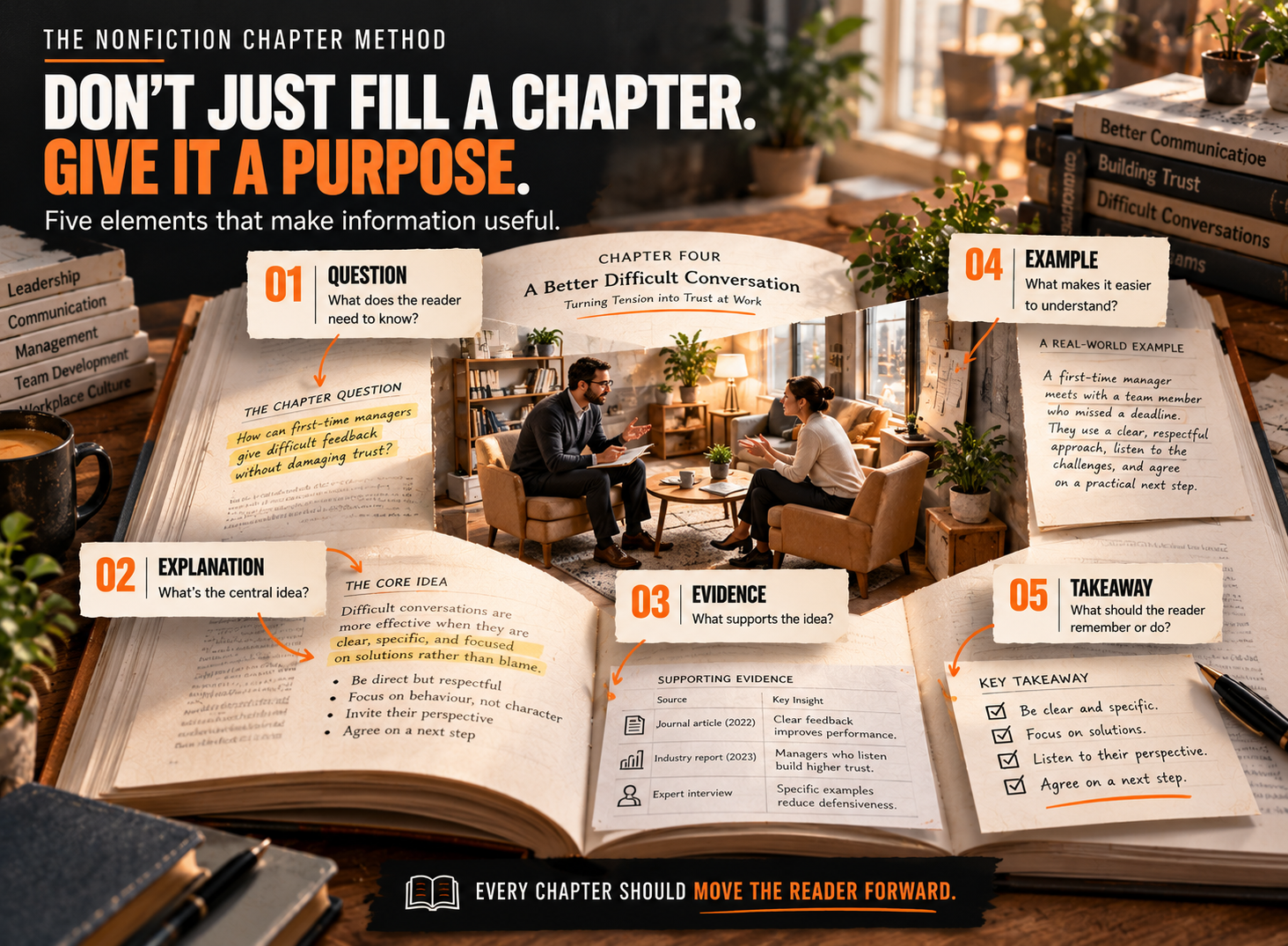
Start each chapter with a working purpose, then develop it through five elements:
1. The question: What does the reader need to understand?
2. The explanation: What is the central idea or argument?
3. The evidence: What supports that explanation?
4. The example: What makes the concept easier to understand?
5. The takeaway: What should readers remember or do next?
You don't have to arrange every chapter identically. The method simply prevents you from drifting into unrelated material.
Make Complicated Ideas Easier to Read
Compare these two approaches.
Too abstract:
Effective communication requires managers to establish constructive feedback systems and maintain transparent interpersonal expectations.
More useful:
If an employee misses a deadline, explain what happened, why it matters, and what needs to change. Make room for the employee to explain the obstacles before agreeing on the next step.
The second version gives the reader something recognizable and actionable.
Strong nonfiction doesn't have to sound academic to be intelligent.
It needs to explain its ideas well.
Turn Existing Material Into Chapters, Not a Collection of Documents
You may already have presentations, interviews, notes, workshop materials, or written articles.
Use them as source material.
Don't simply copy them into one document and call it a book.
A chapter needs its own introduction, argument or explanation, transitions, and conclusion. Material created for a presentation often assumes someone is present to explain it; a book must stand on its own.
If you've been teaching or speaking about your subject, dictation or interviews may help capture your natural explanations before you revise them into written chapters.
Build a Writing Routine You Can Maintain
Choose writing sessions that fit your actual schedule.
Some authors work best early in the morning. Others write longer sessions on selected days.
Consistency matters more than choosing an impressive daily word-count goal that you can't sustain.
Try planning the work in chapters or sections, rather than judging your progress only by the total word count.
At the end of each writing session, leave yourself a note about what comes next.
It can make restarting much easier.
Pro Tip: Separate Drafting From Checking
If you encounter a missing source while drafting, insert a clear research reminder and continue when the surrounding argument is sound.
Return to unresolved evidence before approving the chapter.
This keeps small interruptions from stopping the draft without allowing unsupported claims into the final manuscript.
Step 6: Revise Your Nonfiction Manuscript in the Right Order
Your first complete draft is not the final book.
It's the material you can now evaluate as a whole.
Read it from beginning to end before making hundreds of small sentence changes.
First Pass: Structure and Reader Experience
Ask:
- Does the opening establish a clear purpose?
- Do chapters appear in a logical order?
- Are explanations repeated unnecessarily?
- Does each chapter move the subject forward?
- Are any important steps or counterarguments missing?
- Does the conclusion deliver what the introduction promised?
For a how-to book, test whether the instructions actually work in the order presented.
For argumentative nonfiction, examine whether the evidence fairly supports the conclusions.
Second Pass: Clarity, Voice, and Examples
Shorten passages that take too long to reach the point.
Define technical terms when readers first need them.
Replace abstract claims with concrete examples where possible.
Choose a consistent approach to spelling, terminology, headings, quotations, and references. A style sheet can save substantial correction work later.
Third Pass: Factual and Source Review
Verify names, dates, quotations, figures, research summaries, permissions, and references.
Give special attention to claims that have changed during revision.
This is also the stage to identify passages where the source doesn't support the wording as strongly as you originally believed.
Fourth Pass: External Feedback and Professional Editing
Ask suitable early readers whether they understand the material and where they get lost.
A developmental editor can assess structure and the reader's experience. Copyediting addresses language and consistency. Proofreading catches remaining errors near the final production stage.
These are different tasks.
If you're uncertain whether an unfinished book needs new writing or editing, the existing guide to ghostwriter vs. editor explains the difference.
Step 7: Choose How You'll Publish Your Nonfiction Book
Your publishing route should fit your goals, audience, budget, and willingness to manage production.
Traditional publishing may involve an agent, proposal, manuscript materials, and a contract. Submission requirements vary by genre and publisher.
Self-publishing gives authors direct responsibility for arranging editing, cover design, formatting, book information, and distribution.
Some providers also offer professional assistance with selected publishing stages. Review the agreement carefully rather than assuming every service is included.
Prepare the Book for Its Actual Format
A nonfiction manuscript may contain headings, quotations, exercises, tables, charts, references, or illustrations.
Those elements need to work in the editions you choose.
Text-based Kindle ebooks commonly use reflowable formatting, while print books need fixed pages, appropriate margins, and a cover matched to the final print specifications.
Choose the initial formats based on reader needs. A practical workbook, for instance, may need different layout decisions from a text-heavy history book.
Understand Current AI Content Requirements
In 2026, authors should also understand the distinction between AI-generated and AI-assisted content.
Under Amazon KDP's content guidelines, AI-generated text, images, or translations must be disclosed when publishing through KDP. Its policy distinguishes that from content created by an author with AI used for brainstorming, editing, or refinement.
Authors remain responsible for their content, including accuracy and intellectual property rights.
Using a tool to help organize notes doesn't eliminate the need to verify research, develop an original manuscript, or comply with your publishing platform's rules.
What If You Have the Expertise but Not the Time to Write?
Not every author wants to personally draft every chapter.
You may have interviews, workshop notes, an established framework, or extensive professional experience but struggle to turn that material into a readable book.
In that situation, professional book ghostwriting services may help develop the manuscript through research, outlining, interviews, writing, and agreed review stages.
Before commissioning work, decide who will create the missing text, how your voice will be captured, what revisions are included, and who will own the final materials.
The guide on how to hire a ghostwriter explains the questions worth settling before signing an agreement.
Can a Nonfiction Book Support Your Professional Work?
Yes, but the book needs to provide real reader value first.
A consultant might write about a method they use in their work. A founder may document a business philosophy. An educator might turn years of teaching into a structured guide.
Those books can support professional credibility, workshops, consulting, or teaching opportunities.
None of those outcomes is guaranteed simply because a book exists.
Keep the Reader Ahead of the Promotion
A useful business book should explain ideas thoroughly enough that someone benefits even if they never purchase another service.
For example, a leadership consultant could include:
- A practical framework for giving feedback.
- Examples of conversations that go wrong.
- Exercises managers can use independently.
- Situations where the framework may not apply.
- Questions readers can use to assess their own progress.
This gives the book substance beyond promoting the author's expertise.
If your nonfiction project grows out of a professional framework, coaching program, leadership experience, or consulting practice, business book publishing services may help with manuscript development, editorial structure, design, and publication preparation.
The aim should be to make the knowledge useful and readable, not turn the book into an extended advertisement.
Common Mistakes That Make Nonfiction Books Harder to Finish
Most writing problems aren't caused by a lack of information.
They come from trying to do the wrong things at the wrong time.
Mistake 1: Choosing a Topic That's Too Broad
Do this: Write for a clear audience and defined purpose.
Not that: Try to explain everything about an enormous subject in one book.
Mistake 2: Collecting Research Without a Chapter Plan
Interesting material can distract you from the book's central argument.
Keep research organized around questions the chapters need to answer.
Mistake 3: Editing Every Paragraph Before Finishing the Draft
Repeatedly polishing the opening chapters can keep you from discovering what the whole manuscript needs.
Complete workable sections before performing a detailed language edit.
Mistake 4: Using Examples That Don't Support the Point
A personal story can be engaging without helping the reader.
Ask what each example demonstrates and whether the conclusion is supported.
Mistake 5: Ignoring the Publishing Route Until the Very End
A traditional nonfiction proposal and a fully self-published manuscript can involve different preparation.
Research your options early.
Mistake 6: Expecting the Book to Do Everything
A book cannot reliably serve every reader, answer every question, establish every aspect of your expertise, and generate guaranteed commercial returns.
Choose the purpose that matters most, and make the manuscript deliver on it.
Final Thoughts: The Book You Finish Should Be the Book Readers Need
You don't need to begin with a perfect title, flawless outline, or impressive word-count target.
You need a subject worth exploring, a reader worth understanding, and a clear reason to bring the two together.
Learning how to write a nonfiction book becomes more manageable when you treat it as a sequence of decisions: identify the audience, develop the argument or teaching purpose, organize the evidence, write the draft, and revise until the book delivers what it promises.
Research should make the writing more trustworthy. Structure should make it easier to follow. Editing should make the ideas clearer.
The best next step isn't always to write another thousand words.
Sometimes it's to decide exactly what the next chapter needs to accomplish.
Your Knowledge Deserves More Than an Unfinished Draft
You've got the ideas. You may already have the research, interviews, or chapters. What matters now is identifying what's keeping the book from moving forward.
Amazon KDP Experts can discuss your nonfiction project, what you've completed, and whether you need manuscript development, editorial guidance, or publishing preparation.
Tell Us About Your Nonfiction Book Project →