
You've written the last sentence. Maybe you've spent years piecing together memories, revisiting painful moments, and trying to explain experiences that even your closest friends don't fully understand.
Now your life story exists as a manuscript.
But what happens next?
Do you send it to a literary agent? Publish it yourself? Ask permission before including family photographs? And how do you know whether the book is genuinely ready for someone who doesn't know you?
These questions matter because finishing a memoir and preparing it for publication are two different accomplishments.
If you're wondering how to publish a memoir, the answer isn't simply to find a publishing platform and upload your manuscript. You need to know whether the story is ready, which rights need attention, what publishing route fits your goals, and what kind of book you want readers to receive.
At Amazon KDP Experts, the starting point is the manuscript itself. Some memoirs need another editorial review. Others need professional book files, a suitable cover, or help preparing for publication.
The goal is to identify the work that remains, not purchase services your book doesn't need.
Key Takeaways
- Finish the story before producing the book. Check narrative focus, editing, facts, and sensitive material first.
- Choose the right publishing route. Traditional publishers, independent presses, and self-publishing involve different responsibilities.
- Check rights and permissions. Photographs, letters, quotations, and stories involving real people need careful review.
- Prepare each edition separately. Kindle ebooks, paperbacks, and hardcovers have different production requirements.
How Do You Publish a Memoir After Finishing Your Manuscript?
To publish a memoir, review the manuscript's structure, complete the necessary editing, and check sensitive personal details and third-party material. Next, choose between traditional publishing and self-publishing. Prepare the appropriate submission package or publication-ready files, review the final book, and complete the publishing process through your selected route.
The steps are straightforward to describe. Making the right decisions for your particular story takes more thought.
You may have written a memoir for your children and grandchildren. Someone else may be writing about overcoming a difficult experience, documenting a family history, or sharing a professional journey.
Those books may need very different publishing approaches.
Before choosing a platform or publisher, understand three things:
What story have you written? Who is it for? What do you want publication to accomplish?
Your answers shape nearly everything that follows.
Is Your Memoir Really Ready for Readers?
You know the people, places, and events in your story. Readers don't.
A chapter that feels deeply meaningful to you may leave someone else wondering why it belongs in the book.
That doesn't mean your experience lacks value. It means the manuscript needs to communicate that value to someone encountering it for the first time.
Make Sure Your Memoir Has a Clear Narrative Focus
Memoirs and autobiographies share personal history, but they generally approach it differently.
An autobiography often covers a broader account of someone's life. A memoir usually concentrates on particular experiences, relationships, or periods and explores their meaning.
You don't need to tell readers everything that has happened to you.
You need to help them understand the experience at the heart of the book.
Ask yourself:
- What is the central experience that connects the chapters?
- Why does the story begin where it does?
- What changes between the opening and the ending?
- Which memories deepen the reader's understanding?
- Which passages repeat information without moving the story forward?
Here's an illustrative example.
An author finishes a manuscript covering childhood, marriage, work, and retirement. Every chapter contains genuine memories, but the manuscript feels like a sequence of unrelated events.
During revision, the author notices that the strongest material concerns the years spent caring for an aging parent.
The memoir becomes more focused when those years form the central narrative, with earlier memories appearing where they help explain the relationship.
The author's other experiences haven't lost their meaning. They've found their appropriate place.
Pro Tip , Try the One-Sentence Story Test
Complete this sentence:
My memoir follows ______ through ______ and explores how ______ changed.
If the sentence is difficult to finish, revisit your chapter structure before spending money on publication files.
Turn Memories Into Scenes Readers Can Follow
A memoir doesn't need dramatic events on every page. It does need enough context for readers to understand what happened and why it mattered.
Instead of summarizing years of family disagreements, you might focus on a conversation that changed your understanding of a relationship.
Instead of listing everything that happened during a difficult medical experience, you might build a chapter around a meaningful decision, explaining the necessary background without overwhelming the scene.
Use journals, letters, and notes to reconstruct the story, but don't assume a collection of documents automatically creates a narrative.
Give readers a reason to continue.
Does Your Memoir Need Professional Editing Before Publication?
A finished manuscript may still need editing, even if you've revised it several times.
The important question is which kind of editing your memoir needs.
Developmental Editing: Does the Story Work?
Developmental editing looks at the bigger picture.
An editor may examine chapter order, narrative focus, pacing, chronology, transitions, repetition, and whether readers have enough context to follow the story.
This work should happen before final formatting because substantial changes can affect the entire book.
Copyediting: Is the Writing Clear and Consistent?
Once the structure is settled, copyediting addresses grammar, clarity, sentence construction, consistency, and style.
A copyeditor may help establish consistent treatment of names, dates, locations, and terminology.
That doesn't mean replacing your personal voice with someone else's writing style.
Proofreading: Is the Final Text Ready?
Proofreading identifies remaining spelling, punctuation, and presentation errors in text approaching publication.
A final proof review may also catch layout problems introduced during formatting.
These services aren't interchangeable.
If the chapters still need restructuring, proofreading alone won't make the memoir publication-ready.
Real-World Example: Editing Niyati Tamaskar's Memoir
Memoir author Niyati Tamaskar described the editorial work behind her book Unafraid in a first-person account published by Reedsy.
Tamaskar worked with editor Adam Rosen, who identified problems involving pacing, repeated material, unnecessary background information, and transitions between parts of her story.
According to Tamaskar, the developmental editing process helped her shape the narrative and connect passages that weren't contributing clearly to the book's direction.
The important lesson isn't that every memoir needs the same editor or editing package.
It's that personal writing can become clearer and more compelling when the author receives thoughtful feedback about how readers experience the story.
This is a documented third-party publishing example, not a client project of Amazon KDP Experts.
If you're unsure where your manuscript stands, professional book editing services can help identify whether you need structural feedback, language editing, proofreading, or a more focused manuscript review.
What Should You Check Before Publishing Stories About Real People?
Memoirs are different from many other books because the people in them often exist outside the manuscript.
Your story may include living relatives, former partners, coworkers, medical professionals, friends, or people connected to painful events.
You may remember those experiences clearly.
That doesn't automatically resolve every question about what you can publish.
Review Sensitive Claims and Personal Information
Read the manuscript again specifically looking for references to other people.
Check:
- Serious allegations or disputed events.
- Personal medical or financial information.
- Details about children or vulnerable individuals.
- Conversations presented as exact quotations.
- People who remain identifiable even if you've changed their names.
- Sensitive material that doesn't contribute meaningfully to the story.
The Authors Guild's guidance on writing about real people explains defamation, privacy, and publicity concerns that nonfiction authors should consider.
The applicable rules vary by jurisdiction and circumstances.
You don't automatically need someone's permission merely to mention them in a memoir. However, changing a name doesn't necessarily remove legal risks, and publication of private or disputed information can raise separate concerns.
If your manuscript contains sensitive allegations, significant privacy issues, or disputed claims, consider having a qualified publishing attorney review the relevant material.
Can You Include Family Photographs and Old Letters?
Possibly, but you should check the rights involved.
Owning an old photograph doesn't always mean you own its copyright. The same issue can arise with letters, newspaper excerpts, artwork, and other material created by someone else.

Before including third-party material, identify its creator, determine what rights or permissions may be needed, and keep records of the decisions you make.
Pro Tip , Create a Memoir Permissions Tracker
Use a simple document with these fields:
| Material | Who Created It? | Permission Status | Next Action |
|---|---|---|---|
| Family photograph | Photographer or rights holder | Confirmed / unclear | Obtain permission or assess whether an exception applies |
| Personal letter | Letter's author or rights holder | Confirmed / unclear | Review intended reproduction |
| Newspaper excerpt | Publisher or rights holder | Confirmed / unclear | Check copyright and applicable exceptions |
| Reconstructed conversation | Based on personal recollection | Accuracy review | Clarify recollection and presentation |
This isn't a substitute for legal advice. It helps you identify unresolved questions before they delay publication.
Decide What Should Remain Private
Writing something doesn't obligate you to publish it.
Some memoirists keep a complete private manuscript and prepare a separate public edition.
You may decide to remove identifying details, revise passages, or leave certain events outside the book.
Those choices should reflect your editorial goals and any relevant legal advice.
The goal is to publish the story intentionally, not include every private detail simply because it appeared in the first draft.
Should You Self-Publish Your Memoir or Find a Traditional Publisher?
| Publishing Route | Best Suited For | What You Need | Main Consideration |
|---|---|---|---|
| Traditional publishing | Memoirs suited to a publisher's list and acquisition goals | Query letter, requested sample or manuscript, sometimes a proposal | Competitive submissions and contractual publishing rights |
| Small or regional press | Stories relevant to particular communities or specialist readers | Press-specific submission materials | Submission policies and distribution arrangements vary |
| Independent self-publishing | Authors who want to direct the publication process | Edited manuscript, cover, files, metadata, and distribution plan | You manage production decisions and associated expenses |
| Assisted self-publishing | Authors who want professional support with selected stages | Manuscript details and an agreed service scope | Review deliverables, pricing, rights, and author approvals carefully |
Both approaches can work. The better choice depends on your story, readership, goals, budget, and the amount of control you want over publication.
When Traditional Publishing May Be Worth Pursuing
If you want to approach literary agents or established publishers, research their interests before preparing submissions.
An agent who represents memoir may still prefer particular themes, readerships, or kinds of narrative nonfiction.
Some agents request a query letter and opening chapters. Others may request a complete manuscript, synopsis, or book proposal.
Follow their current guidelines.
What Should a Memoir Query or Proposal Include?
Depending on the recipient, the materials may include:
A query letter: A concise introduction presenting the central story, intended audience, and reason the book may fit the agent's interests.
A synopsis: An account of the memoir's narrative development, including its conclusion when a full synopsis is requested.
A book proposal: Information about the book's concept, readership, comparable titles, author background, and market positioning.
Sample chapters: Writing that demonstrates the quality and direction of the manuscript.
Don't assume every publisher requires the same package.
Also, read contract terms carefully. Publishing agreements may address rights granted, territories, editions, royalties, advances, publication obligations, and circumstances in which rights can revert.
If a contract is unclear, seek qualified advice before signing.
When Self-Publishing May Be a Better Fit
Self-publishing gives you more direct involvement in preparing and releasing the memoir.
You can make decisions about editing, cover design, formats, pricing, and distribution.
This route can also make sense when your intended audience is specific.
For example, a family-history memoir may be written primarily for relatives and future generations. A memoir about a professional experience may appeal to readers interested in that field.
Neither book necessarily needs a major commercial publishing deal to fulfill its purpose.
Self-publishing also involves responsibility.
You must arrange the necessary production work, check publication files, and understand the platform terms.
Pro Tip: Study Comparable Memoirs Before Choosing Your Route
Find three reasonably recent memoirs that appeal to readers similar to yours.
Examine their central story, descriptions, formats, publishing approach, and how clearly they communicate their intended audience.
Use those books to understand reader expectations.
Don't assume your memoir will achieve the same commercial results.
What Does Current Publishing Data Tell Memoir Authors?
The broader nonfiction market remains substantial, but industry revenue doesn't predict how an individual memoir will perform.
According to the Association of American Publishers' 2025 StatShot Annual Report, released August 10, 2026, estimated U.S. adult nonfiction publishing revenue reached $6.0 billion in 2025.
That figure covers adult nonfiction broadly. It does not represent memoir sales alone, self-published memoir revenue, or guaranteed demand for personal stories.
In discussing the report, AAP Chief Operating Officer Syreeta Swann observed that “Print formats continue to dominate Trade publishing”.
For your memoir, the important decision is still more personal: Who do you want to reach, and how will those readers prefer to experience your story?
That question should influence your publishing route and book formats more than broad market figures.
How Do You Prepare a Memoir for Amazon KDP?
Once you've approved the manuscript and addressed the necessary publishing concerns, you can prepare it for independent publication.
Amazon Kindle Direct Publishing allows eligible authors to publish Kindle ebooks and supported print editions without paying an upfront platform publishing fee.
That doesn't mean editing, professional cover design, formatting, or other optional services are free.
Choose Your Book Formats Before Production
Your memoir might work well as a paperback, Kindle ebook, hardcover, or combination.
Each requires different preparation.
| Requirement | Kindle Ebook | Paperback | Hardcover |
|---|---|---|---|
| Interior | Usually reflowable for a text-based memoir | Print-ready fixed-page layout | Hardcover-ready fixed-page layout |
| Cover | Ebook front cover | Full-wrap paperback cover | Hardcover-specific full-wrap cover |
| Photographs | Optimized for digital display | Suitable for selected print options | Suitable for selected print options |
| Navigation | Functional ebook chapter navigation | Print contents and page references as appropriate | Print contents and page references as appropriate |
| Quality check | Ebook preview | Print preview and physical proof | Print preview and physical proof |
The final print page count can affect cover dimensions, particularly spine width.
That's why final formatting should generally follow major manuscript revisions.
The existing KDP formatting requirements checklist explains the differences between Kindle, paperback, and hardcover production in more detail.
Prepare Your Book Description and Publishing Details
Your book description should help someone unfamiliar with your life understand the memoir's central story.
It isn't a place to summarize every chapter.
Focus on the experience, its significance, and the type of reader who may connect with it.
You should also prepare accurate title and author information, relevant categories and keywords, publishing rights, territorial details, and pricing decisions.
These details help form the book's retail listing.
Do You Need an ISBN?
Not for every format.
Under Amazon KDP's current rules, a Kindle ebook does not require an ISBN. Supported paperback and hardcover editions generally require separate ISBNs.
KDP offers free ISBNs for eligible print editions, but those ISBNs cannot be used to publish outside KDP.
If you intend to use other print distribution services, review whether obtaining your own ISBN is more appropriate before making the decision.
How to Publish a Memoir: Six Steps From Manuscript to Release
Once you've chosen a publishing route and approved the text, follow a practical sequence instead of trying to handle everything at once.
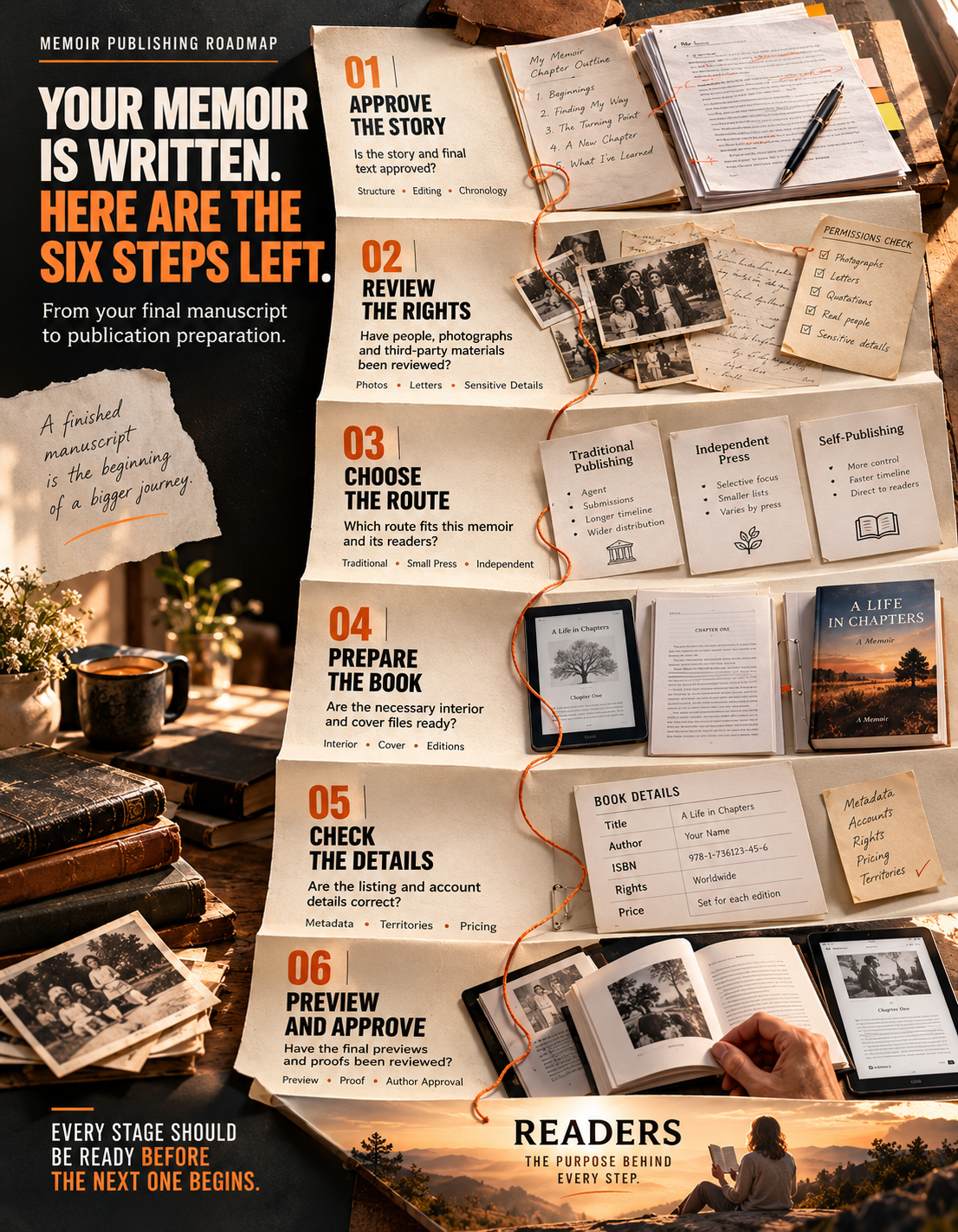
Step 1: Approve the Final Manuscript
Confirm the memoir's structure, chronology, chapter order, and editorial changes.
Make sure that major revisions are finished before final layout begins.
Review any author's notes, acknowledgments, and other front or back matter you intend to include.
Step 2: Resolve Outstanding Rights and Permissions
Review the permissions tracker.
Check photographs, third-party text, quotations, private details, and material that may need legal advice.
Keep the supporting documents with your publishing files.
Step 3: Finalize Your Publishing Route and Formats
Confirm whether you're submitting to agents, approaching a publisher, or preparing the book independently.
For self-publishing, choose the editions you want to release and review their production requirements.
Don't finalize a print cover before the necessary size and page-count decisions are settled.
Step 4: Prepare the Interior and Cover Files
Check chapter headings, page breaks, paragraph spacing, fonts, and any photographs or captions.
Prepare a suitable ebook file and separate print-ready files where needed.
Review the cover's readability, genre suitability, and format-specific dimensions.
Step 5: Check Your Book Listing and Account Information
Confirm the title, author name, description, ISBN information where required, categories, keywords, territories, and pricing.
If someone is helping with the publishing setup, clarify which work they will perform and who approves the final submission.
Keep control of your account credentials and payment information.
Step 6: Preview, Proof, and Submit
Inspect every completed edition as a reader would.
Check the ebook's chapter navigation and image placement.
For print, review the digital preview and examine a physical proof where practical.
Correct problems before submitting the final files for platform review.
Amazon controls its own review and publication decisions.
Pro Tip: Keep an Approved Publishing File Set
Save a dated copy of your final manuscript, approved cover files, ebook and print files, rights records, and proof approvals.
If you update the book later, you'll know exactly which version was approved and what changed.
What Do First-Time Memoir Authors Commonly Get Wrong?
Publishing mistakes often happen because the author starts the next stage before finishing the previous one.
Mistake 1: Including Every Memory
A memoir doesn't need to reproduce your entire life chronologically.
Do this: Keep scenes that contribute to the central story.
Not that: Include every event because it happened.
Mistake 2: Treating Proofreading as a Substitute for Editing
A manuscript can be grammatically clean and still have a weak narrative structure.
Review pacing, progression, and chronology before moving to final production.
Mistake 3: Ignoring Third-Party Material Until the Last Minute
Unresolved rights questions can affect the manuscript, photographs, captions, and final layout.
Identify those issues early, before finalizing the book.
Mistake 4: Buying a Full Publishing Package Too Soon
Your memoir may already have an approved manuscript and cover.
You might need only format preparation or a final publishing review.
Match professional services to the work actually unfinished.
Mistake 5: Setting a Release Date Before the Book Is Ready
Editing, author approvals, permissions, formatting, proof copies, and platform review can affect the schedule.
The guide on how long it takes to publish a book explains the different stages involved.
Build your timeline around the manuscript's condition, not a promised upload date.
What If Your Memoir Is Finished but Not Publication-Ready?
You may have already completed most of the difficult work.
Perhaps your manuscript has been professionally edited, but you still need a print-ready interior.
Maybe the story is complete, but the photographs and captions require additional attention.
Or the files are ready, and you need help understanding the last publishing decisions.
Those situations don't call for identical services.
Before hiring anyone, ask for a clear scope describing the work to be performed, files to be delivered, revision arrangements, costs, and author approvals.
Amazon KDP Experts provides independent publishing assistance, not Amazon's own publishing services. Your rights, account access, royalty arrangements, and final decisions should remain clearly defined in writing.
The right professional support should solve an actual problem in your memoir's publishing process.
It shouldn't create unnecessary work.
Final Thoughts: Your Story Is Written. Now Prepare It for Readers.
Finishing a memoir takes commitment. Publishing it asks you to make a different set of decisions.
The story needs to stand on its own. The people and personal materials in it deserve careful consideration. The publishing route should fit your goals, and the final editions should give readers a comfortable experience.
That's what learning how to publish a memoir really involves.
You don't have to complete every possible publishing task or purchase every available service.
Start with the question that matters now: What is the one unfinished decision keeping your memoir from becoming a book?
Ready to Turn Your Finished Memoir Into a Published Book?

You've done the deeply personal work of telling your story. The next step may be a manuscript review, final book formatting, or help preparing the edition for publication.
Amazon KDP Experts can help you identify the work your memoir still needs while keeping your publishing decisions and final approval in your hands.
Explore Memoir Publishing Services and Request a Publishing Review →