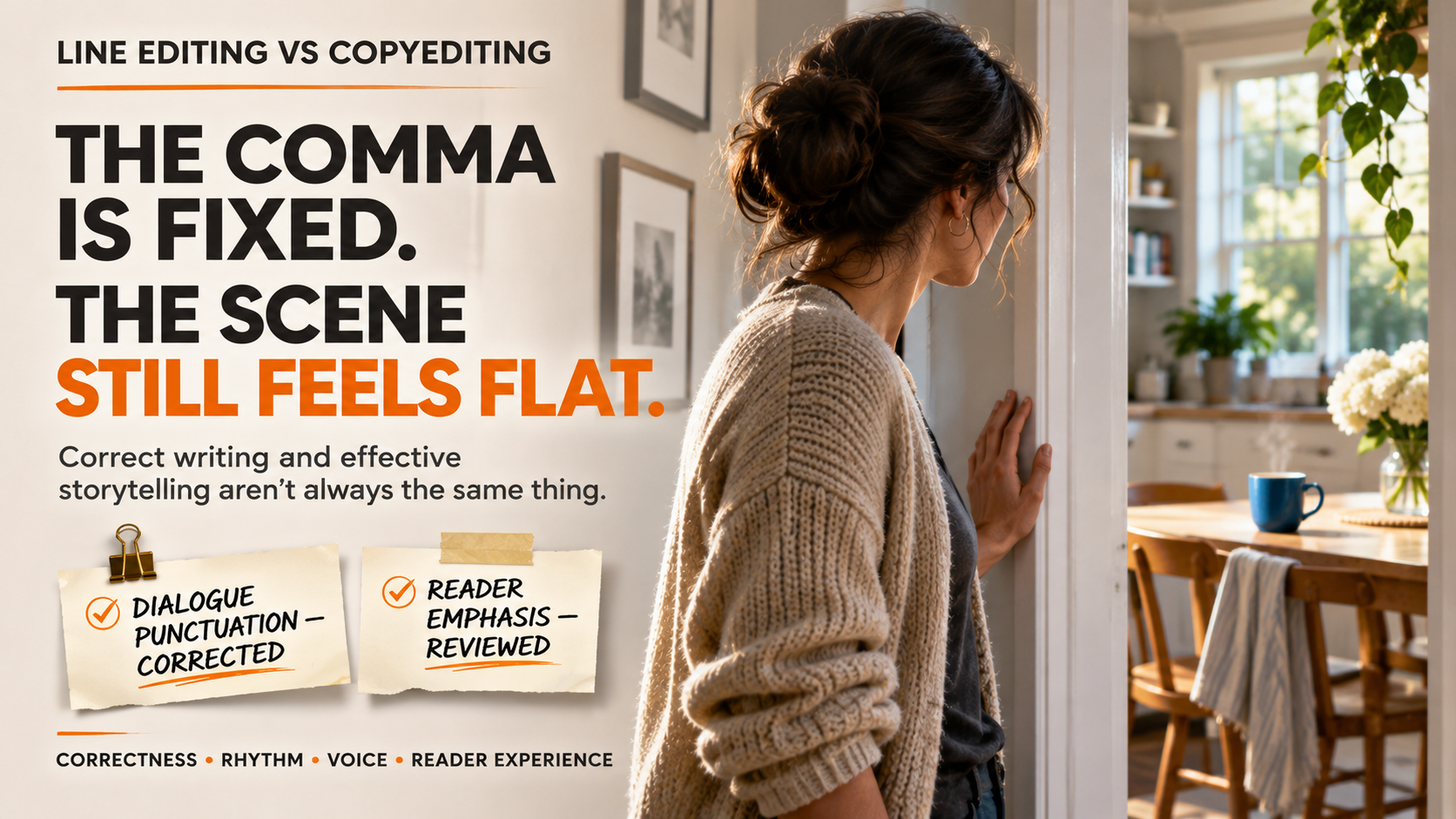
An editor sends your manuscript back. Every misplaced comma is fixed. The character names match. The punctuation is consistent.
But the opening chapter still feels slow, the dialogue sounds stiff, and several paragraphs take too long to make their point.
So you hire another editor.
This time, the sentences flow. The dialogue feels more natural. The emotional moments finally land.
Yet a few grammatical errors remain.
Neither editor necessarily did a bad job. You may have asked them to solve two different problems.
That's the confusion behind line editing vs copyediting. Both involve close attention to your words, but they don't always aim to accomplish the same thing.
Line editing improves how your writing communicates: its clarity, rhythm, tone, sentence structure, and impact. Copyediting improves the manuscript's correctness and consistency, addressing grammar, punctuation, spelling, usage, and editorial style.
The distinction sounds simple until you see actual changes on the page.
And because different editors define their services differently, hiring someone based on the service name alone can leave important work undone.
At Amazon KDP Experts, the useful starting question is not which editing package sounds more comprehensive. It's what your manuscript needs at its current stage, and which editorial decisions should happen before you prepare the book for publication.
Let's examine the differences using original manuscript examples, realistic editorial decisions, and a practical way to choose the right level of editing.
Key Takeaways
- Line editing improves the writing itself. It addresses awkward phrasing, repetition, weak transitions, tone, pacing, and sentence-level clarity while protecting the author's voice.
- Copyediting prepares the language for publication. It focuses on grammar, punctuation, spelling, usage, terminology, consistency, and the agreed editorial style.
- The services overlap. Some editors combine them; others offer separate passes. The written scope matters more than the label.
- Edit in the right order. Resolve major structural problems first, refine the prose, correct remaining language inconsistencies, and proofread the final book files.
- Compare sample edits before commissioning work. What an editor changes, and deliberately leaves alone, can tell you more than a service description.
What Is the Difference Between Line Editing and Copyediting?
The main difference between line editing and copyediting is editorial purpose.
A line editor asks: Is this the clearest, strongest, most effective way to express the author's meaning?
A copyeditor asks: Is this text correct, internally consistent, and prepared according to the agreed editorial conventions?
Both may make changes to individual sentences. But they approach those sentences with different priorities.
Line Editing vs Copyediting at a Glance
| Editorial Question | Line Editing | Copyediting |
|---|---|---|
| Is the sentence grammatically correct? | May correct obvious errors | Primary responsibility |
| Is the sentence awkward or unnecessarily long? | Primary responsibility | May address for clarity |
| Does the writing sound like the author? | Central consideration | Must preserve intentional voice |
| Is the dialogue natural and purposeful? | Reviews rhythm and expression | Checks punctuation, consistency, and usage |
| Are words and phrases repeated unnecessarily? | Reviews stylistic repetition | May flag or correct repetition |
| Are character names consistent? | May identify inconsistencies | Tracks and checks consistency |
| Is terminology applied consistently? | May flag unclear word choices | Primary responsibility |
| Are capitalization and hyphenation consistent? | Usually secondary | Primary responsibility |
| Does a paragraph move effectively into the next? | Primary responsibility | May address clarity within scope |
| Are facts, quotations, and references accurate? | May raise questions | May flag or verify within agreed scope |
| Does the manuscript need major restructuring? | May identify an issue | Usually outside scope; developmental review may be needed |
There is no universal industry rule requiring every editor to separate the services.
The Editorial Freelancers Association's definitions of editorial services recognize that line editing can be performed independently or alongside other manuscript-editing work.
The practical lesson: Ask what the editor will do with your sentences, what they will check for consistency, and which problems fall outside the agreed service.
What Does a Line Editor Actually Change?
Line editing is a close examination of language at the sentence and paragraph level.
The editor works on how the text sounds, moves, and communicates.
A sentence can be grammatically correct yet still feel flat, confusing, overly formal, repetitive, or emotionally unconvincing.
That's where line editing becomes useful.
Sentence Rhythm and Flow
A line editor may shorten an overloaded sentence, combine choppy statements, or rearrange information so that the reader reaches the important point at the right moment.
Not every long sentence needs to be shortened.
In some genres, a deliberate run of language creates urgency, intimacy, or a distinctive narrative voice.
The editor needs to recognize when complexity is purposeful and when it becomes an obstacle.
Word Choice and Precision
Line editing often replaces vague or repetitive language with wording that expresses the intended meaning more clearly.
But stronger wording doesn't always mean more dramatic wording.
An editor shouldn't replace an author's quiet observation with an exaggerated emotional statement simply because it sounds more impressive.
Tone and Narrative Voice
A memoir might depend on a restrained, conversational voice.
A thriller might need clipped dialogue and controlled tension.
A business book might require direct, accessible explanations without losing technical accuracy.
The line editor's job is to strengthen the experience that the author is trying to create.
Paragraph Movement and Transitions
A passage can contain several good sentences that don't belong in their current order.
A line editor may suggest a better progression, remove unnecessary repetition, or identify transitions that confuse the reader.
If the problem involves entire chapters, missing plot developments, or a fundamentally broken argument, the manuscript may need developmental editing instead.
What Does a Copyeditor Actually Change?
Copyediting checks the manuscript's language for correctness, clarity, and consistency according to an agreed editorial approach.
The work may include:
- Grammar and sentence mechanics.
- Spelling, punctuation, and capitalization.
- Word usage and commonly confused terms.
- Hyphenation and number treatment.
- Proper names, titles, dates, and terminology.
- Consistency in character details or recurring references.
- Headings, abbreviations, and internal cross-references.
- Queries about ambiguous statements or factual inconsistencies.
- Preparation of an editorial style sheet.
Copyediting is more than running spellcheck.
A word can be spelled correctly but used incorrectly.
A sentence can be grammatical but refer to the wrong person.
Two chapters can each read well independently while disagreeing about a character's surname, the timing of an event, or the terminology used for an important concept.
A skilled copyeditor looks for these problems across the manuscript.
The Role of an Editorial Style Sheet
A style sheet records decisions the editor and author need to apply consistently.
For example:
| Element | Recorded Editorial Decision |
|---|---|
| Language convention | U.S. English |
| Character name | Catherine Bell, not Katherine Bell |
| Place name | East Harbor, two words |
| Time expressions | Spell out time in narrative prose unless otherwise specified |
| Numbers | Follow the agreed book style, with documented exceptions |
| Hyphenation | Use well-known before a noun when appropriate |
| Dialogue | Preserve intentional dialect and character-specific grammar |
| Technical terminology | Use approved terms consistently throughout |
Illustrative style-sheet entries, not a universal set of editorial rules.
This document becomes especially helpful when several people work on the book or a proofreader reviews the final pages.
Real Manuscript Example 1: The Same Fiction Passage, Two Different Edits
Here's where the difference becomes visible.
The following examples are original, fictional manuscript excerpts created for this article. They are designed to demonstrate realistic editorial decisions, not presented as excerpts from actual clients.
Original Manuscript
Leah was standing in the hallway and she felt really uncomfortable about going into the kitchen because the blue mug her sister always used was sitting there on the table. "You kept it" she said.
The scene is understandable.
Leah sees an object that has emotional significance. She hesitates. Then she speaks.
But the sentence is overloaded, the emotional language is generic, and the dialogue punctuation needs correction.
Version A: Copyedited Passage
Leah was standing in the hallway, and she felt really uncomfortable about going into the kitchen because the blue mug her sister always used was sitting there on the table. "You kept it," she said.
What changed?
The copyeditor corrected the punctuation around the dialogue and adjusted the sentence mechanics.
The scene's wording, order, and narrative emphasis remain mostly intact.
The paragraph is more technically polished, but it still spends considerable time explaining Leah's discomfort.
That's not necessarily a failure.
If the agreed scope was primarily mechanical copyediting, the editor may reasonably leave deeper stylistic improvements for a different stage, or query the author.
Version B: Line-Edited Passage
Leah paused in the hallway. Her sister's blue mug sat on the kitchen table.
"You kept it," she said.
What changed?
The line edit brings the meaningful object forward and gives the scene more breathing room.
Instead of explaining that Leah feels uncomfortable, the revision lets her hesitation and the familiar mug carry more of the emotion.
The dialogue also gains emphasis because it follows a shorter setup.
The Editorial Decision Behind the Change
A line editor isn't simply making the paragraph shorter.
The editor is changing how the reader experiences the moment.
But there is also a boundary.
If the author's intention is to emphasize Leah's specific fear of entering the kitchen, the revised passage might remove too much.
A thoughtful editor could leave a comment:
Is Leah reluctant to enter because of the mug, or is there another reason for her discomfort? The revision emphasizes the mug, but I want to confirm that this matches your intended emotional focus.
That question matters more than producing the most elegant sentence.
The takeaway: Copyediting can make a sentence correct. Line editing examines whether that sentence is doing its narrative job.
Real Manuscript Example 2: Dialogue, Dialect, and Author Voice
Now consider a passage involving a character whose speech is deliberately informal.
Original Manuscript
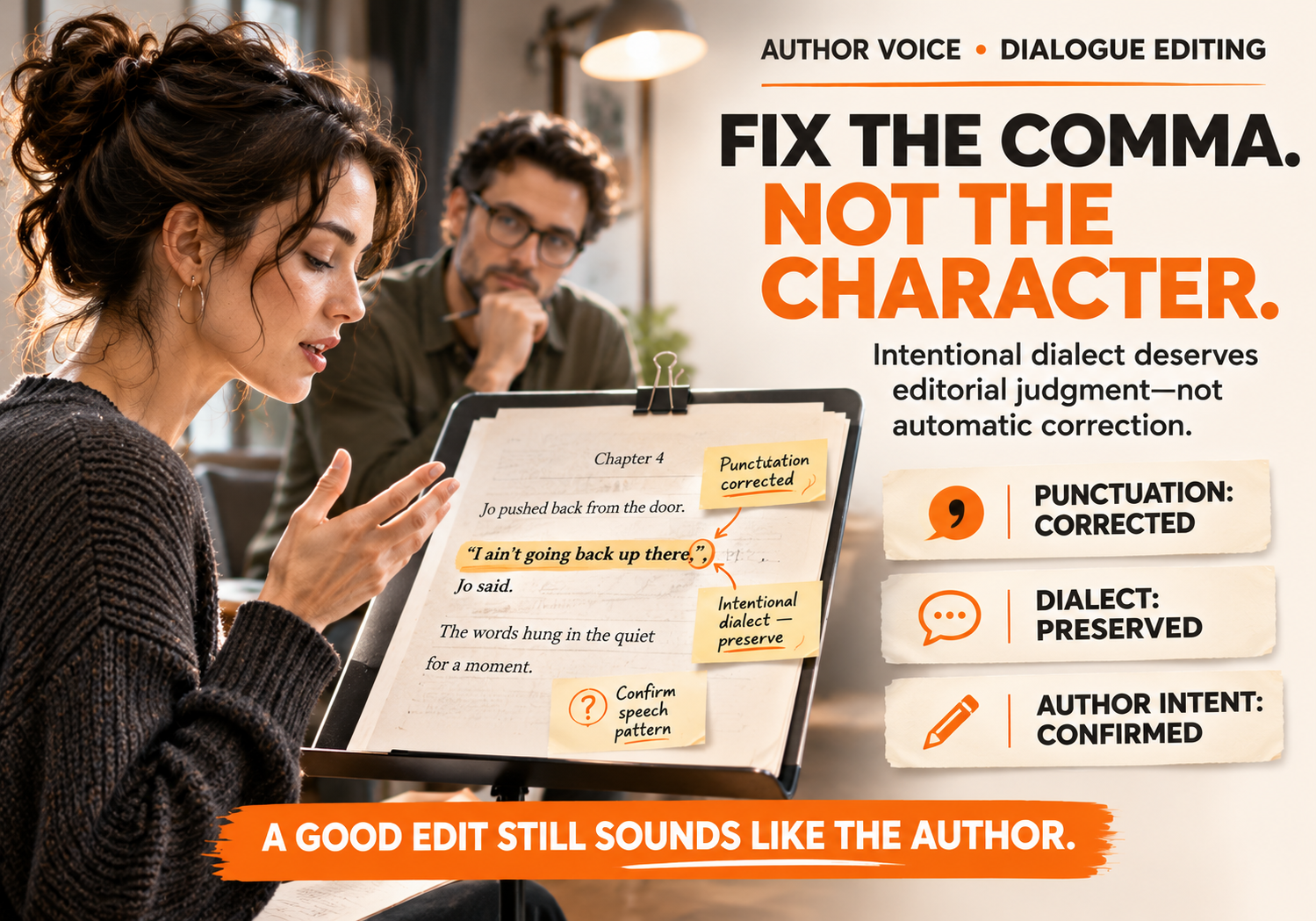
"I ain't going back up there" Jo said. "There's some things what don't stay buried." She looked towards the stairs, and she was shaking quite a lot.
There are technical problems, but the character also has a distinctive voice.
An editor who treats every nonstandard construction as an error could unintentionally erase it.
Copyedited Version
"I ain't going back up there," Jo said. "There's some things what don't stay buried." She looked toward the stairs, and she was shaking quite a lot.
The correction fixes the dialogue punctuation and makes the directional wording consistent with the chosen editorial style.
The nonstandard dialogue remains.
A copyeditor may query whether Jo's speech patterns are intentional and consistent elsewhere.
But automatically changing every line into formal standard English would be a poor choice if the dialect belongs to the character.
Line-Edited Version
Jo looked toward the stairs, shaking.
"I ain't going back up there. There's some things what don't stay buried."
Here, the action moves before the dialogue.
The line edit removes a cumbersome explanatory phrase and places the reader's attention on Jo's reluctance.
The character's speech remains recognizable.
What This Example Teaches
Strong line editing doesn't mean replacing informal language with polished literary prose.
It requires judgment about:
- Which words are deliberately part of a character's identity.
- Whether the sentence order supports the scene.
- Whether repetition strengthens or weakens the moment.
- How much the editor can change without altering the author's intention.
The same caution applies to regional expressions, memoir voices, humor, purposeful fragments, and unconventional narrative styles.
A good edit should make the author easier to hear, not replace the author with the editor.
Real Manuscript Example 3: A Nonfiction Paragraph With Clear Grammar but Weak Communication
Fiction isn't the only genre where the distinction matters.
Business books, memoirs, educational guides, and professional nonfiction can contain technically correct passages that don't communicate clearly.
Original Manuscript
Managers that have just been promoted often have a lot of problems because the team does not know what they should be doing. This makes communication difficult and causes confusion.
The meaning is broadly understandable.
But the passage is vague and repetitive.
What kind of problems?
What creates the uncertainty?
Can the writer state the point more clearly without introducing unsupported claims?
Copyedited Version
Managers who have just been promoted often have a lot of problems because the team does not know what it should be doing. This makes communication difficult and causes confusion.
The copyeditor improves the relative pronoun and agreement.
The revised paragraph is mechanically cleaner.
It is still wordy and imprecise.
A copyeditor working under a more substantial scope could also query the vague wording or suggest a tighter sentence. Service boundaries aren't absolute.
Line-Edited Version
New managers often struggle to lead when their teams lack clear responsibilities. Vague instructions make everyday communication harder and leave employees uncertain about what to do next.
The revision gives the paragraph a clearer central idea.
It removes the repeated explanation of problems and confusion.
The statement becomes easier to follow.
The Important Limitation
A line edit doesn't turn an unsupported business claim into a verified fact.
The author may still need to establish whether the problem described is based on professional experience, interviews, research, or another credible source.
The editor should not invent studies or examples to make the paragraph appear authoritative.
For a research-heavy nonfiction manuscript, fact-checking and source verification should be separately defined in the editorial agreement.
The takeaway: Line editing improves clarity and reasoning as expressed in the prose; copyediting helps ensure the language and presentation remain accurate and consistent within the agreed scope.
Real Manuscript Example 4: A Memoir Passage That Shouldn't Lose Its Personality
Memoir editing requires particular restraint.
A passage can be grammatically imperfect yet emotionally genuine.
The editor needs to understand what gives the narration its identity.
Original Manuscript
I was really nervous when I arrived at the school. I didn't know if anybody would remmember me, and I thought about leaving before I even went inside.
Copyedited Version
I was really nervous when I arrived at the school. I didn't know if anybody would remember me, and I thought about leaving before I even went inside.
The clear spelling error is corrected.
The writer's sentence structure and emotional emphasis remain.
Line-Edited Version
When I reached the school, I considered leaving without going inside.
What if nobody remembered me?
The revision brings the decision to the front.
It also turns the narrator's worry into a direct question, creating a more immediate reading experience.
But an editor should not assume that this version is automatically better.
Some memoirists prefer a reflective, understated style. Others want a closer sense of the moment as it unfolded.
The final choice belongs in conversation with the author.
What an Editor Must Not Invent
An editor shouldn't add details such as a trembling hand, a cold doorway, a childhood smell, or a memory of the principal unless those details come from the author or verified source material.
Adding vivid description can make prose feel polished while making the memoir less truthful.
Good memoir line editing makes the real experience more legible without manufacturing a more dramatic one.
What the Four Examples Reveal
| Manuscript Problem | Primary Editorial Need | Why |
|---|---|---|
| An important scene feels emotionally flat | Line editing | Reader experience, emphasis, and rhythm |
| Dialogue punctuation is incorrect | Copyediting | Mechanical correctness |
| A character's dialect has been standardized inconsistently | Copyediting with voice-sensitive judgment | Style consistency and author intent |
| Nonfiction explanations are wordy and repetitive | Line editing | Clarity, precision, and progression |
| Names change spelling across chapters | Copyediting | Internal consistency |
| A memoir passage lacks meaningful detail | Author revision or possible line-edit query | The editor cannot invent memories |
| The central argument doesn't hold together | Developmental editing | Manuscript-level structure and reasoning |
| A formatted paperback contains broken page references | Proofreading or production correction | Final-file quality control |
The lesson is not that an editor must ignore everything outside one column.
It's that each service should have a defined primary responsibility.
Can a Copyeditor Also Do Line Editing?
Yes.
Some experienced editors provide a combined line-and-copyediting service. Others separate the stages.
Both approaches can be legitimate.
The important question is whether the quoted scope allows adequate attention to the manuscript's actual problems.
When a Combined Edit May Work
A combined pass may be practical when:
- The book's structure is already sound.
- The prose requires moderate stylistic refinement rather than major rewriting.
- Technical problems are manageable.
- The editor is experienced with both kinds of work.
- The agreement clearly identifies the level of intervention and deliverables.
When Separate Passes May Be Better
Separate stages may be more appropriate when:
- The manuscript needs substantial sentence rewriting.
- Dialogue, point of view, or tone requires extensive work.
- The author expects to revise heavily after the line edit.
- A fresh editor would provide useful final consistency checks.
- The budget and schedule allow for distinct review stages.
A substantial line edit can introduce new mechanical errors during revision.
That's one reason copyediting is commonly performed after major prose work is complete.
However, a manuscript doesn't automatically need both services simply because they're available.
Ask About the Work, Not the Label
Instead of asking:
Do you offer complete editing?
Ask:
Will you rewrite awkward sentences for clarity and flow, check grammar and punctuation, build a style sheet, flag continuity problems, and review the manuscript after I accept revisions? Which of those tasks are included in your quote?
The answer tells you far more.
Where Do Developmental Editing and Proofreading Fit?
Line editing and copyediting sit within a broader manuscript preparation process.
They cannot replace every other form of editorial work.
Developmental Editing: Does the Book Work?
Developmental editing addresses the book at a structural level.
For fiction, that may involve plot logic, pacing, character development, stakes, viewpoint, and scene progression.
For nonfiction, it may involve the central argument, reader journey, chapter organization, missing evidence, and repeated ideas.
If the manuscript requires major changes to its structure, those changes should generally happen before extensive sentence-level editing.
Otherwise, the author may pay to polish chapters that later need to be rewritten or removed.
Line Editing: Does the Writing Work?
Once the major content and structure are reasonably settled, a line editor can concentrate on the language.
The work improves the reader's experience at the sentence and paragraph level.
Copyediting: Is the Text Correct and Consistent?
After substantial prose changes have been resolved, copyediting prepares the manuscript for publication.
The editor checks the relevant language, style, and consistency details.
Proofreading: Is the Finished Book File Ready?
Proofreading is normally the final quality-control stage.
It may catch remaining typos, missing punctuation, layout errors, broken headings, pagination problems, and issues introduced during formatting.
Once the manuscript is approved, professional book formatting services can prepare the content for the intended Kindle, paperback, or hardcover formats.
Proofreading then helps confirm the final presentation.
A Sensible Editorial Sequence
Manuscript evaluation → Developmental editing when needed → Author revisions → Line editing when needed → Copyediting → Formatting → Proofreading → Publication
This is a common workflow, not a mandatory purchase list.
The actual sequence can vary depending on the manuscript, publisher, and contracted services.
Do You Need Line Editing, Copyediting, or Both?
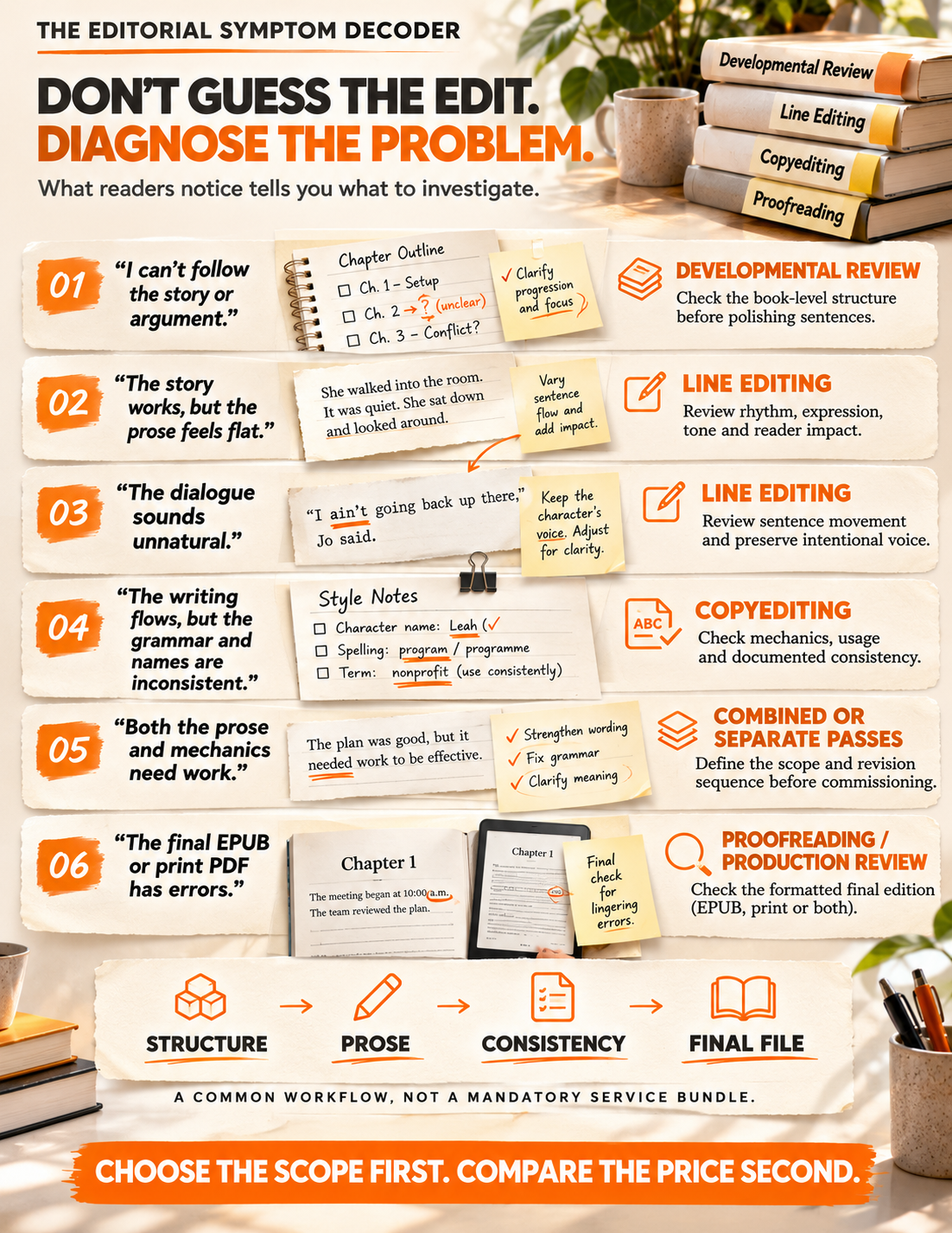
Before choosing an editor, identify the most distracting problems in your manuscript.
A quick diagnostic can help.
The Manuscript Readiness Matrix
| What You're Experiencing | Likely Next Step |
|---|---|
| Readers don't understand the plot or central argument | Developmental review |
| Scenes feel flat even though the events make sense | Line editing |
| The manuscript repeats ideas in awkward language | Line editing |
| Dialogue sounds stiff or unnatural | Line editing |
| The prose reads well but contains grammar and usage errors | Copyediting |
| Names, timelines, spellings, and terminology conflict | Copyediting, with queries where necessary |
| Both prose quality and technical correctness need work | Scoped combined edit or separate passes |
| The final EPUB or print PDF contains stray errors | Proofreading or production review |
When Copyediting Alone May Be Enough
Suppose you have already revised your book extensively.
Beta readers understand the story. The writing is controlled. The chapter transitions work.
Your remaining problems involve punctuation, inconsistent terms, dialogue conventions, and occasional grammar errors.
A focused copyedit may be a reasonable next investment.
When Line Editing Should Come First
Suppose the plot makes sense, but readers regularly mention that the prose feels repetitive, the dialogue sounds unnatural, or important emotional moments lack impact.
If the problems occur throughout the manuscript, a line edit may be more helpful than a narrowly mechanical copyedit.
When Neither Is the Right First Step
If readers cannot explain the central argument of your nonfiction book or follow the motivation behind major character decisions, sentence-level editing may be premature.
A developmental assessment or author-led revision should come first.
If you've revised repeatedly but still can't identify what's wrong, our article on book editing costs and types explains the broader editing categories and the factors that affect different levels of professional work.
How to Tell if an Editor Is Protecting Your Author Voice
An editor should improve the manuscript without making every author sound alike.
The challenge is distinguishing real language problems from purposeful stylistic choices.
The Voice Preservation Test
Review the editor's sample and ask:
1. Can I still recognize the narrator?
A quiet, reflective first-person voice shouldn't suddenly become dramatic and theatrical.
2. Does character dialogue remain believable?
Intentional fragments, dialect, and individual speech patterns shouldn't be standardized indiscriminately.
3. Does the editor preserve meaning?
A smoother sentence is not an improvement if it changes what happened or what the author believes.
4. Are subjective changes explained?
The editor should be able to explain why a revision helps rather than simply saying it sounds better.
5. Do the revisions create new problems?
Even elegant rewrites can introduce continuity errors, distort facts, or weaken important subtext.
An effective sample doesn't need to change every sentence.
Sometimes the strongest editorial decision is to leave a good sentence alone.
What Should Be Included in a Line Editing or Copyediting Quote?
A detailed quote should explain what the editor will do and what you will receive.
It should not rely entirely on phrases such as professional polish, full manuscript edit, or complete editing package.
Before You Agree, Confirm These Details
| Contract Item | What to Clarify |
|---|---|
| Editing level | Line editing, copyediting, combined editing, or another defined scope |
| Manuscript condition | Whether the fee assumes a reasonably clean draft |
| Sentence rewrites | How much stylistic intervention is included |
| Grammar and mechanics | Whether a comprehensive mechanical check is included |
| Consistency | How names, terminology, details, and style are tracked |
| Fact-checking | What is verified, queried, or excluded |
| Files | Tracked manuscript, clean copy, comments, editorial letter, style sheet |
| Author revisions | Whether a second pass is included after changes |
| Timeline | Delivery milestones and author-review periods |
| Confidentiality | How unpublished material is stored and handled |
| AI use | Whether tools are used and what permissions apply |
| Final approval | Who accepts or rejects editorial changes |
A well-defined editorial brief can prevent disagreements about what a service was supposed to include.
The Chartered Institute of Editing and Proofreading explains this in its guidance on creating an editorial brief.
Example of a Useful Editing Brief
Project: Fiction manuscript intended for independent publication.
Current stage: Major structural revisions completed.
Main concerns: Repetitive descriptions, awkward dialogue transitions, inconsistent character-name spelling, and punctuation.
Voice requirements: Preserve intentional dialect, conversational fragments, and the narrator's restrained tone.
Requested scope: Assess whether the project requires a separate line edit and copyedit or whether a combined service is appropriate.
Deliverables to confirm: Tracked manuscript, editorial comments, style sheet, and a clear policy for post-edit queries.
This gives a prospective editor enough information to recommend a service for a reason.
It also reduces the chance of paying for work that doesn't address the manuscript's most important problems.
Is Line Editing More Expensive Than Copyediting?
Sometimes, but not automatically.
Line editing may require substantial editorial judgment and rewriting, especially when the manuscript contains persistent problems with voice, flow, clarity, or sentence construction.
Copyediting can also be demanding, particularly for technical nonfiction, complex references, extensive factual queries, or manuscripts with significant consistency problems.
Costs vary according to:
- Word count and manuscript condition.
- Genre and subject complexity.
- Depth of intervention.
- Editorial experience and specialization.
- Delivery schedule.
- Number of passes.
- Fact-checking or reference requirements.
- Included reports and follow-up support.
Don't compare quotes based only on the total fee.
An inexpensive copyedit that leaves serious prose problems unresolved may not save money if the book still requires another full editing stage.
Conversely, a manuscript that already reads well may not benefit enough from an extensive line edit to justify the additional expense.
Choose the scope first. Compare prices second.
Can AI Replace Line Editing or Copyediting?
AI tools can help with certain editorial tasks.
They may identify possible grammatical errors, awkward phrasing, repetition, or inconsistencies.
But an automated rewrite is not automatically a good editorial decision.
A tool may correct intentional dialect, flatten a distinctive narrator, remove meaningful hesitation, or make a questionable nonfiction claim sound more confident without verifying it.
Where AI Can Be Useful
For copyediting support, AI-assisted tools can help surface possible:
- Repeated words.
- Spelling inconsistencies.
- Grammar problems.
- Formatting irregularities.
- Contradictory names or terms.
For line editing support, they can help authors experiment with sentence arrangements, identify cumbersome passages, or compare alternative wording.
What Still Requires Editorial Judgment?
An author or editor must decide whether a suggested change:
- Preserves the intended meaning.
- Fits the genre and target reader.
- Protects the author's voice.
- Introduces unsupported facts.
- Weakens narrative subtext.
- Changes a character's identity or speech.
- Conflicts with details elsewhere in the manuscript.
Never assume a cleaner-looking paragraph is a more truthful or effective paragraph.
Before submitting unpublished material to a third-party AI service, also consider confidentiality, contractual restrictions, and the tool's data-handling terms.
AI can support editorial review. It doesn't eliminate the need to define the editorial goal or evaluate the quality of revisions.
Common Mistakes Authors Make When Choosing Between Line Editing and Copyediting
Mistake 1: Treating Editing Levels as Universal Product Labels
Different editors use different definitions.
A service description should explain the actual work, not merely provide a familiar name.
Mistake 2: Paying for Copyediting Before Major Revisions
Structural and extensive line-level changes can make earlier technical corrections obsolete.
Mistake 3: Assuming Copyediting Means Only Grammar
Professional copyediting can also address consistency, ambiguity, style conventions, and author queries.
Mistake 4: Expecting a Line Editor to Rewrite the Book
Line editing is not an unrestricted ghostwriting or developmental-rewriting service.
The editor should work within the agreed level of intervention and preserve authorial intent.
Mistake 5: Thinking Every Sentence Must Change
A heavily marked manuscript isn't automatically a well-edited manuscript.
Good editorial judgment includes knowing what to leave untouched.
Mistake 6: Ignoring the Style Sheet
Without documented consistency decisions, later editing and proofreading stages become harder to coordinate.
Mistake 7: Skipping Proofreading After Formatting
A clean manuscript can still contain new errors after conversion into ebook or print files.
Mistake 8: Selecting an Editor Based Only on Price
A quote means little until you know the scope, deliverables, manuscript condition, and revision policy.
For a deeper hiring checklist, our guide on how to choose a book editor covers sample edits, genre expertise, confidentiality, author voice, and contractual expectations.
Final Thoughts: The Best Edit Solves the Right Problem
The most important distinction in line editing vs copyediting isn't that one editor is creative and the other is technical.
It's that each editorial approach prioritizes a different kind of improvement.
Line editing asks whether the writing creates the experience the author intended.
Copyediting asks whether the manuscript communicates consistently and correctly under the agreed conventions.
Both matter.
But not every book needs both as separate paid services, and neither should be commissioned before the manuscript is ready for that level of work.
The original passages in this guide demonstrate something worth remembering: a sentence can be grammatically correct but ineffective. It can also be beautifully written but contain mistakes.
A strong editorial process addresses both without confusing polish with progress.
Don't pay for more edits than your manuscript needs. Pay attention to the changes that make your book clearer, more consistent, and more recognizably yours.
Your Manuscript May Need a Different Edit Than You Think
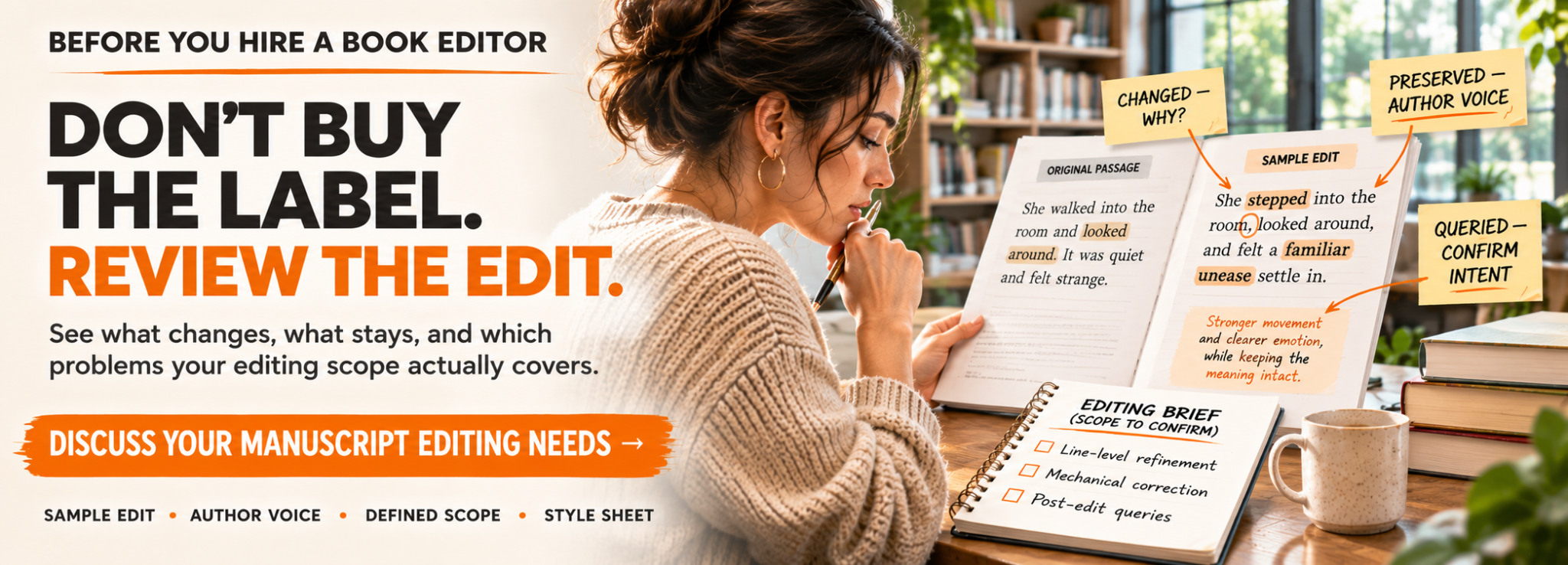
You don't need to know every publishing term before asking for editorial help.
You do need to know what isn't working in your manuscript, and what you want the finished book to feel like.
Amazon KDP Experts provides independent manuscript editing and publishing-preparation support for authors. We can discuss your book's current stage, the problems you've identified, and the editorial scope that may be appropriate.
No automatic editing package. No assumption that every manuscript needs the same treatment.