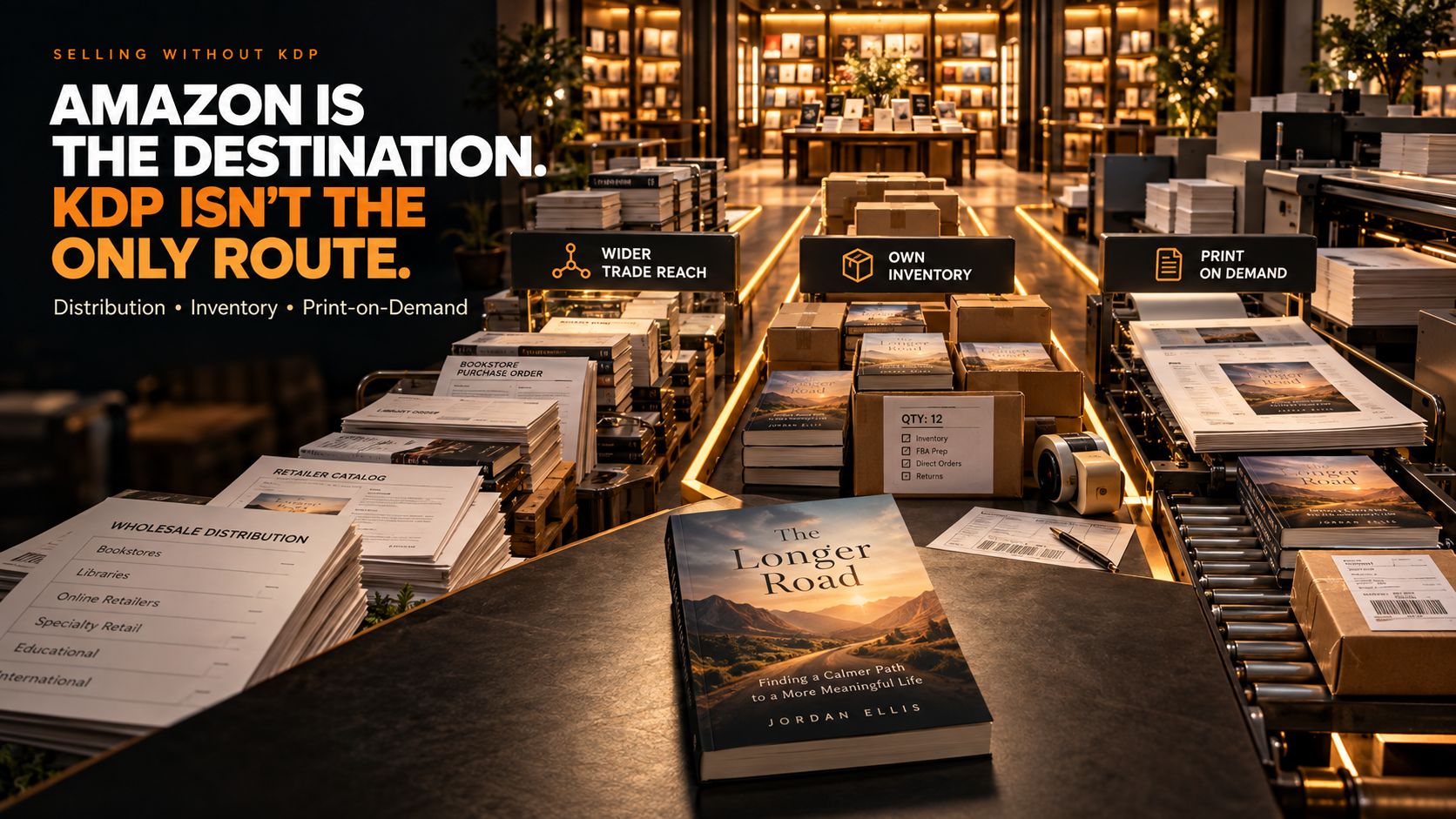
Want your self-published book on Amazon but do not want to use KDP for that edition? You have options.
IngramSpark can make eligible print and ebook titles available to Amazon through its distribution network, while Amazon Seller Central lets you sell physical copies you already own. The better route depends on your book format, ISBN choice, inventory, bookstore goals, and how much selling work you want to handle.
Platform choice should come after you understand what the book actually needs. That author-first approach is also central to Amazon KDP Experts: keep the manuscript, production decisions, rights, account access, and final approval centered on the author rather than forcing every book through the same process.
Key Takeaways
- Yes, you can sell a self-published book on Amazon without publishing that edition through KDP.
- IngramSpark makes more sense when you want print-on-demand plus wider retail and library distribution.
- Amazon Seller Central makes more sense when you already own printed inventory and want to sell those copies yourself.
- KDP's free ISBN stays with KDP, so authors planning multi-platform print distribution should make the ISBN decision before publishing.
Can You Sell Self-Published Books on Amazon Without KDP?
Yes. Self-published books can reach Amazon without being published through KDP. For print books, the two most practical routes are wider distribution through IngramSpark or selling your own physical inventory through Amazon Seller Central. Ebook distribution can also have non-KDP routes, but retailer coverage and eligibility require closer checking.
The important distinction is simple:
Selling on Amazon is not the same thing as publishing with Amazon KDP.
KDP combines publishing, print-on-demand, and Amazon distribution.
IngramSpark works as a publishing and distribution platform that can make titles available through the wider book trade.
Seller Central turns you into a marketplace seller responsible for physical inventory and fulfillment choices.
All three routes can place a physical book in front of Amazon customers, but they do very different jobs.
What Are Your Main Options for Selling on Amazon Without KDP?
Option 1: Use IngramSpark for Print-on-Demand Distribution
IngramSpark is one of the clearest alternatives when you want your book available beyond Amazon.
According to the current IngramSpark distribution network, its publishing network connects titles to more than 45,000 retailers, libraries, online stores, universities, and other book-buying channels. Its North American distribution list includes Amazon, Barnes & Noble, Walmart.com, independent bookstores, libraries, and schools.
That is the one external market statistic used in this guide.
You provide the book files and metadata, select the relevant distribution settings, and make the title available through Ingram's network. Print-on-demand can remove the need to order a large quantity before readers start buying.
This route is worth considering when you want Amazon availability and broader access to the book trade.
It can also suit authors who care about:
- Bookstore Ordering
- Library Availability
- Print-On-Demand Production
- Broader Retail Distribution
- Greater Control Over Their ISBN and Imprint Strategy
One distinction matters here: distribution availability does not guarantee bookstore shelf placement.
A bookstore may be able to order your book without deciding to stock copies in the store.
Option 2: Sell Your Own Copies Through Amazon Seller Central
Seller Central solves a different problem.
Instead of asking Amazon or another publishing platform to produce each copy, you sell physical inventory you already own.
You can fulfill eligible orders yourself or use Amazon fulfillment services when they fit your setup.
This route can make sense when you have already completed a print run and want Amazon to function as another retail channel for that inventory.
Current Amazon Seller pricing lists an Individual plan at $0.99 per item sold or a Professional plan at $39.99 per month, before applicable selling fees. Amazon currently lists Books under its Media category with a 15% referral fee and an additional media closing fee.
Those are fees, not publishing royalties.
That difference matters.
Seller Central makes you the merchant. You need to think about inventory, fulfillment, returns, seller-account requirements, fees, and listing accuracy rather than only book production.
Option 3: Use an Eligible Distributor for Your Ebook
Ebooks require a little more care because not every wide-distribution service handles Amazon Kindle in the same way.
IngramSpark currently includes Amazon among its ebook retail channels. However, its distribution page also says that if you have provided ebooks to Amazon for Kindle during the previous 12 months, it cannot provide Kindle service for those ebooks through the IngramSpark program.
So never assume that a service advertising “wide ebook distribution” automatically gives your specific title unrestricted access to Kindle.
Check three things first:
- Does the distributor currently deliver ebooks to Amazon?
- Is your title eligible?
- Does any previous Amazon distribution affect that eligibility?
That check can prevent an unnecessary upload, duplicate distribution problem, or change of plan later.
IngramSpark vs Seller Central vs KDP
| Route | How the Book Reaches Amazon | Inventory Needed? | Wider Book-Trade Reach | Best Fit |
|---|---|---|---|---|
| IngramSpark | Distributed through Ingram | Usually no for POD | Yes | Authors wanting Amazon plus wider retail/library availability |
| Seller Central | You sell physical inventory as a merchant | Yes | No built-in trade distribution | Authors who already own printed stock |
| Amazon KDP | KDP publishes and prints on demand | No | Amazon-first, with separate Expanded Distribution options | Authors prioritizing a simpler Amazon-focused publishing route |
Three Questions Can Clarify the Decision
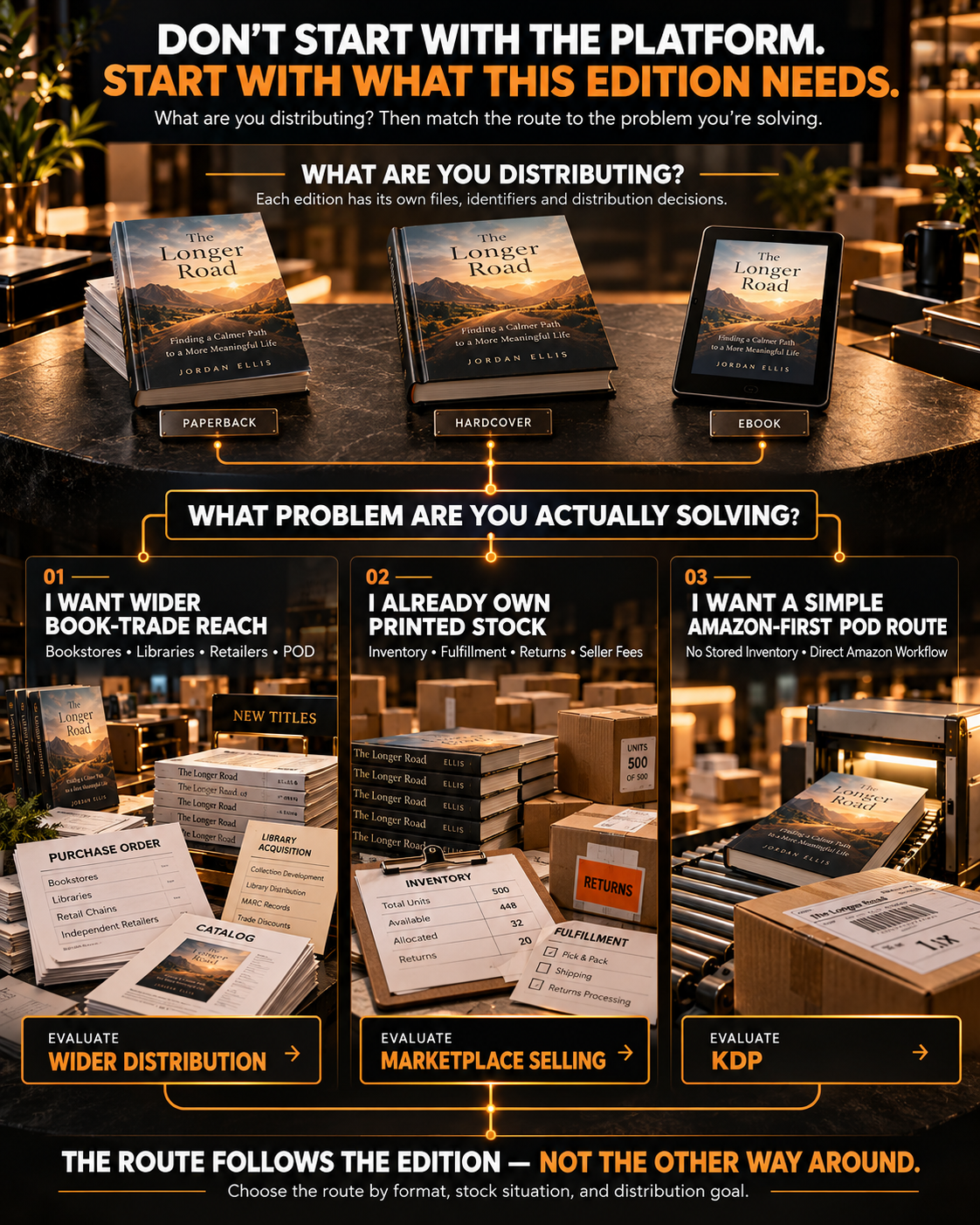
Do you want wider book-trade distribution?
Start by evaluating IngramSpark.
Do you already own physical inventory that you want to sell?
Evaluate Seller Central.
Do you mainly want a straightforward Amazon-focused print-on-demand route?
KDP may still be the better fit.
The decision becomes much easier when you choose according to what the edition needs rather than trying to find one platform for every situation.
Do You Need Your Own ISBN to Sell Without KDP?
ISBN planning becomes especially important when your print edition may appear on more than one publishing platform.
Amazon's current KDP ISBN guidance states:
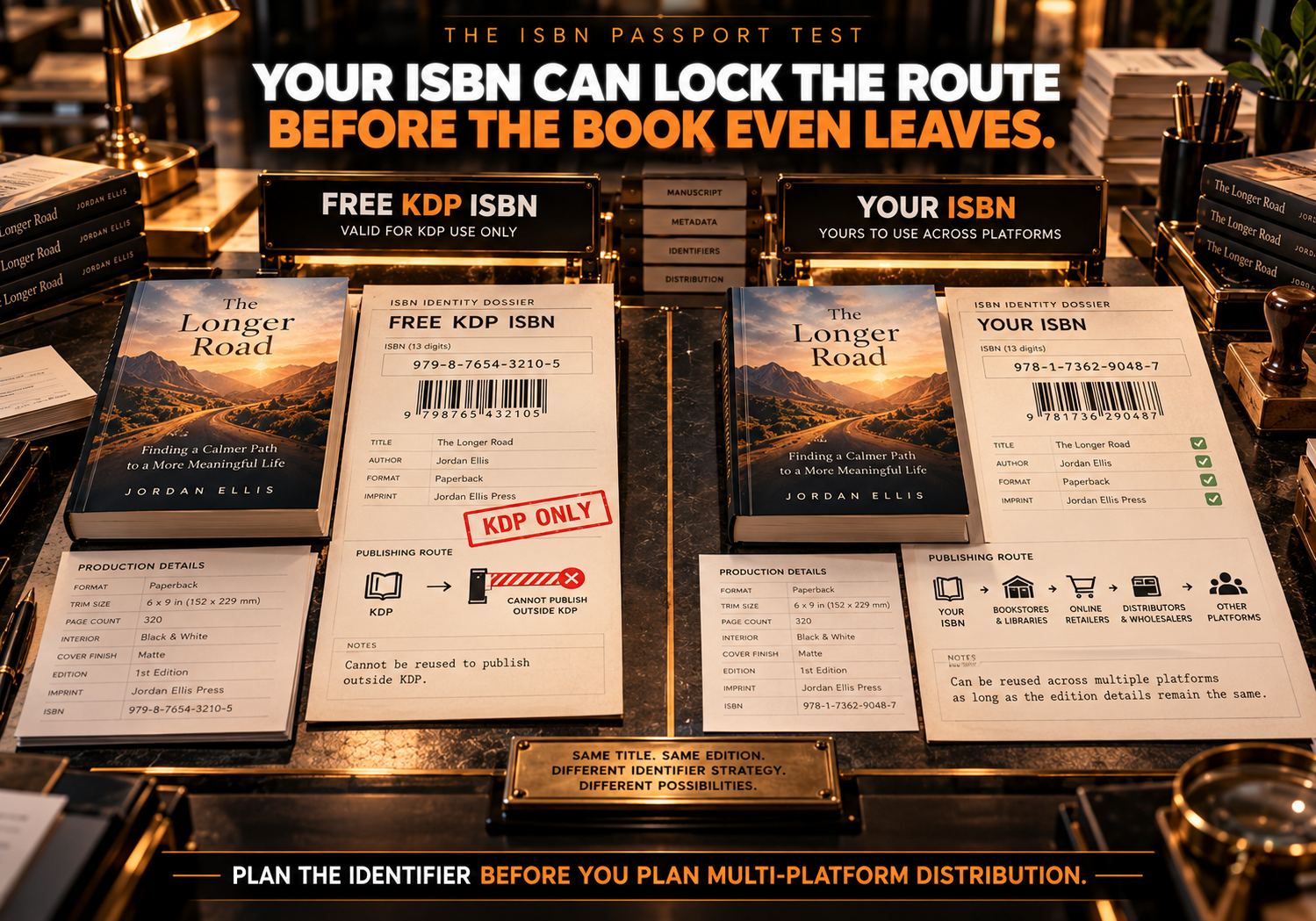
“Free ISBNs from us can only be used on KDP.”
KDP also says its free ISBN uses “Independently published” as the imprint. Authors who purchase and register their own ISBN can use it when publishing the same qualifying edition through other publishing services, provided the registered information matches.
That makes ISBN planning something to settle before the first print edition goes live.
Do This, Not That
Do: decide the format, imprint, ISBN ownership, and likely distribution route before assigning the identifier.
Not that: use a platform-restricted ISBN first and assume you can transfer that exact number elsewhere later.
Paperback and hardcover editions also require separate ISBNs because they are separate book formats.
Is Selling Without KDP Actually Cheaper?
Not necessarily.
Each route moves the costs to a different place.
IngramSpark combines print-on-demand with wholesale distribution economics. Printing costs and wholesale settings affect what remains from a sale.
Seller Central introduces merchant fees, fulfillment decisions, inventory costs, and potentially storage or shipping expenses.
KDP follows its own print-on-demand pricing and royalty structure.
So the useful question is not:
“Which platform takes the smallest percentage?”
Ask:
“What will it cost to produce, distribute, fulfill, and maintain this edition, and what distribution do I receive in return?”
Those numbers can look very different from one book to another.
If you're still separating publishing-platform charges from editing, cover, formatting, ISBN, proof, and production expenses, the existing guide to how much it costs to self-publish a book explains those cost categories in more detail.
How Do You Sell a Self-Published Book on Amazon Without KDP?
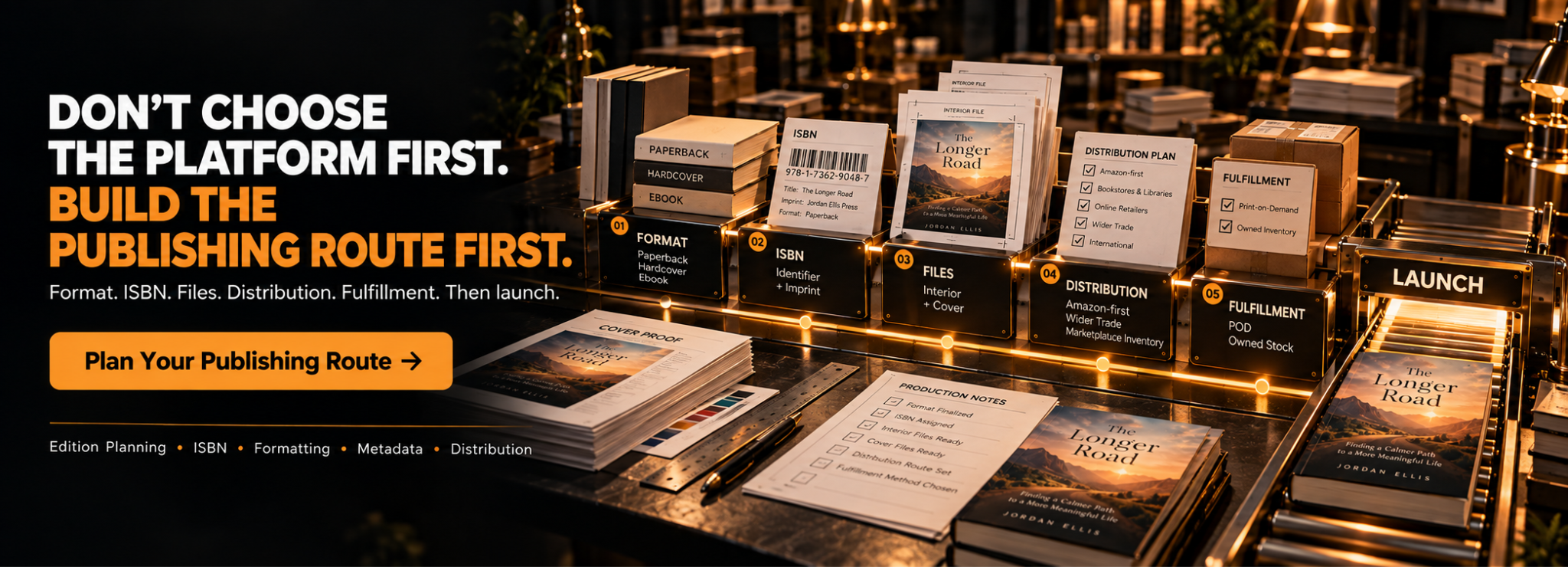
1. Decide Which Edition You Are Distributing
Start with the actual format.
Paperback, hardcover, and ebook editions have different files, identifiers, production requirements, and distribution choices.
Do not build the distribution plan around “the book” as one item. Build it around each edition.
2. Decide Your ISBN Strategy
If the print edition may appear through multiple publishing services, settle ISBN ownership before publication.
Keep core metadata such as title, author name, format, and imprint consistent with the registered ISBN information.
3. Prepare the Correct Interior and Cover Files
A finished manuscript is not necessarily a production-ready book.
Print platforms need correct dimensions, margins, bleed settings, page count, cover measurements, fonts, and image treatment.
Ebook files require a different structure.
The existing KDP formatting requirements checklist explains why Kindle, paperback, and hardcover versions should not be treated as one interchangeable production file.
Authors whose files still need production work can also use professional book formatting services to prepare approved text for the selected digital or print editions.
4. Match the Distribution Route to Your Goal
Choose IngramSpark when wider print distribution and print-on-demand are the priorities.
Choose Seller Central when you already own printed copies and want to operate as the seller.
For ebooks, confirm current Amazon coverage and title eligibility with the distributor before uploading.
5. Review the Proof, Listing, and Costs
Check a physical proof where your chosen production route allows it.
Review:
- Page Order And Interior Layout
- Cover Alignment And Spine
- Title And Author Information
- ISBN and Imprint
- Book Description And Metadata
- List Price
- Distribution Settings
- Expected Print Or Fulfillment Costs
A small production mistake becomes harder to correct once several retailers have already received the book data.
What Do Authors Commonly Get Wrong When Skipping KDP?
Mistake 1: Thinking “Without KDP” Means One Alternative
It does not.
IngramSpark and Seller Central solve different problems.
One focuses on publishing and distribution. The other lets you operate as a marketplace seller.
Mistake 2: Assuming an Amazon Listing Equals Bookstore Distribution
Seller Central can put your inventory on Amazon, but it does not automatically place your title into the broader book wholesale network.
Authors who care about bookstore and library ordering need to evaluate distribution separately.
Mistake 3: Trying to Reuse KDP's Free ISBN Elsewhere
KDP explicitly restricts its free ISBN to KDP.
Plan for an ISBN you control when the same print edition needs to move across publishing services.
Mistake 4: Uploading the Same Production File Everywhere
Different platforms can have different cover templates, file specifications, metadata fields, proofing systems, and distribution settings.
Reuse the underlying approved content where appropriate—not assumptions about the final file.
Mistake 5: Comparing Only the Money Per Sale
More control often means more responsibility.
Seller Central can give you direct control of inventory but adds merchant work.
Trade distribution can broaden availability while introducing wholesale economics.
Compare responsibilities along with revenue.
Which Route Makes Sense? A Simple Example
Suppose your paperback is complete.
You want Amazon customers to find it, but you also want bookstores and libraries to be able to order it. You do not want hundreds of copies stored at home.
IngramSpark may fit that goal because you need distribution and print-on-demand, not inventory management.
Now change one detail.
You already own a large batch of printed books and your main goal is selling those existing copies through Amazon.
Seller Central now becomes more relevant because the problem has changed from publishing and distribution to selling inventory.
Neither route wins every time.
The right choice follows the book format, stock situation, and distribution goal.
When Does KDP Still Make Sense?
Skipping KDP should solve a real publishing problem.
If your priority is a straightforward Amazon-focused print-on-demand setup and you do not want to manage physical inventory, KDP may still fit the project well.
That is why the most useful comparison is not “KDP versus everything else.”
Instead, ask what each edition needs.
Amazon-first publication may point toward KDP.
Wider print distribution may point toward IngramSpark.
Existing physical inventory may point toward Seller Central.
Different editions can also use different routes when the ISBN, metadata, and distribution strategy support that setup.
Where Professional Publishing Support Fits
Distribution comes late in the production process.
Before a book reaches a retailer, the manuscript, interior, cover, ISBN plan, metadata, categories, rights information, pricing, and final publication files need to work together.
Amazon book publishing services from Amazon KDP Experts focus on organising those publication details and final-file decisions before submission. Amazon KDP Experts operates as an independent publishing-support provider and is not affiliated with Amazon or Kindle Direct Publishing.
Professional help makes the most sense when you need support with file readiness, metadata, edition planning, or the order of publishing decisions.
Your account access, copyright, royalties, and final publishing approval should remain under your control.
Final Thoughts: Choose the Route That Fits the Book
You can sell self-published books on Amazon without KDP. What matters is understanding which system replaces the part of KDP you are choosing not to use.
IngramSpark can connect a print-on-demand title with Amazon and the wider book trade.
Seller Central can help you sell physical copies you already control.
Ebook distribution can also have non-KDP options, but Amazon coverage and eligibility need to be checked for the exact title.
Do not choose a route because it sounds more independent or more professional. Choose it because its costs, responsibilities, ISBN rules, and distribution model fit the edition you are publishing.
When the files, identifiers, and publishing details are settled, the platform decision becomes much easier.
Ready to Choose the Right Publishing Route?
Getting the distribution decision right becomes easier once the manuscript, cover, ISBN plan, metadata, and publication files are settled.
Amazon KDP Experts can review the stage your book has reached and help identify what should happen before submission, while your rights, publishing accounts, royalties, and final decisions stay under your control.