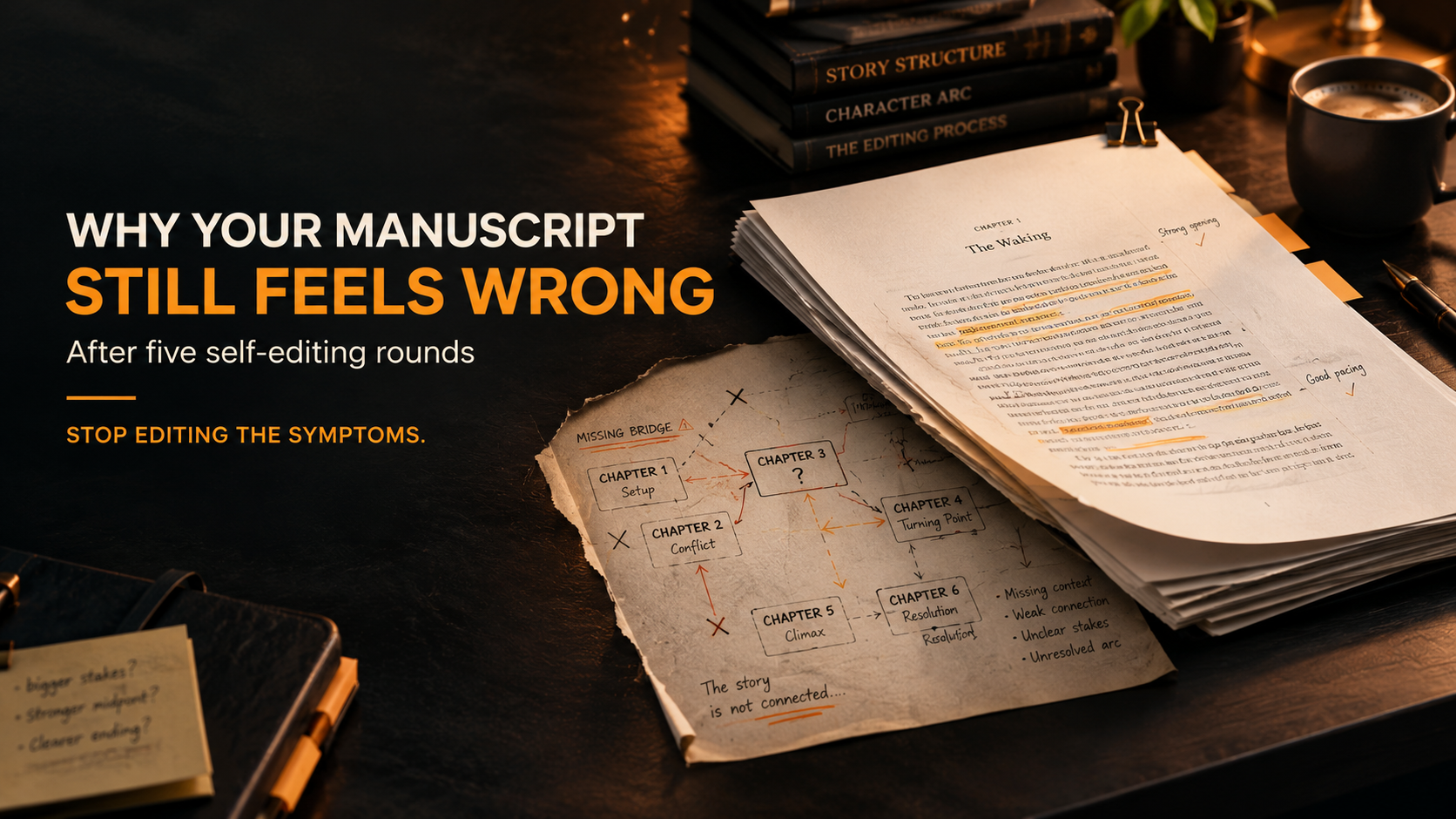
Five editing rounds later, the manuscript is cleaner.
That should feel reassuring.
Instead, you open Chapter One again and get the same uncomfortable thought:
This still does not feel finished.
You have cut repetition, strengthened verbs, rewritten dialogue, corrected continuity, checked grammar, moved scenes, restored scenes you previously cut, and probably stared at the same paragraphs long enough to stop knowing whether they are good at all.
So why does my manuscript feel unfinished when you have already worked on it this much?
Usually, the problem is not a lack of effort.
The problem is that you have been editing what you can see, while the issue that bothers you sits at a different level of the book.
Sometimes the sentences are polished but the story structure is still unstable.
Sometimes every chapter works alone but the chapters do not build toward anything.
Sometimes you know exactly what a scene means because you wrote it, while the reader receives only half of that meaning.
Another general editing pass will not necessarily solve those problems.
Diagnosis has to come first.
Key Takeaways
- More revision does not automatically mean deeper revision.
- Sentence polishing cannot repair an unresolved story, argument, character arc, or chapter structure.
- Writers often supply missing context from memory without realizing readers do not have it.
- When you cannot name the problem anymore, outside feedback may be more useful than Self-Edit Round Six.
Why Does My Manuscript Feel Unfinished Even Though the Draft Is Complete?
The word finished can mean several different things.
You may have reached the final chapter.
Every scene may be written.
Grammar may be clean.
The manuscript may even look ready for publication.
Yet readers experience a book at several levels at once: the whole-book promise, structure, progression, emotional or intellectual movement, scene execution, language, and mechanical correctness.
One weak layer can create the vague feeling that “something is off.”
That is why counting revision rounds is rarely useful.
A fifth copy edit does not equal one developmental edit.
Three rounds of sentence tightening cannot replace one honest look at whether the middle of the story actually changes anything.
The Editorial Freelancers Association’s current definitions of editorial services separate developmental editing, line editing, copyediting, and proofreading precisely because those stages solve different problems. Developmental work looks at content, organization, and genre-level concerns, while later stages move progressively closer to sentence correctness and final error checking.
Stop Counting Drafts: Check These Four Layers Instead
Use this order whenever a manuscript feels polished but incomplete.
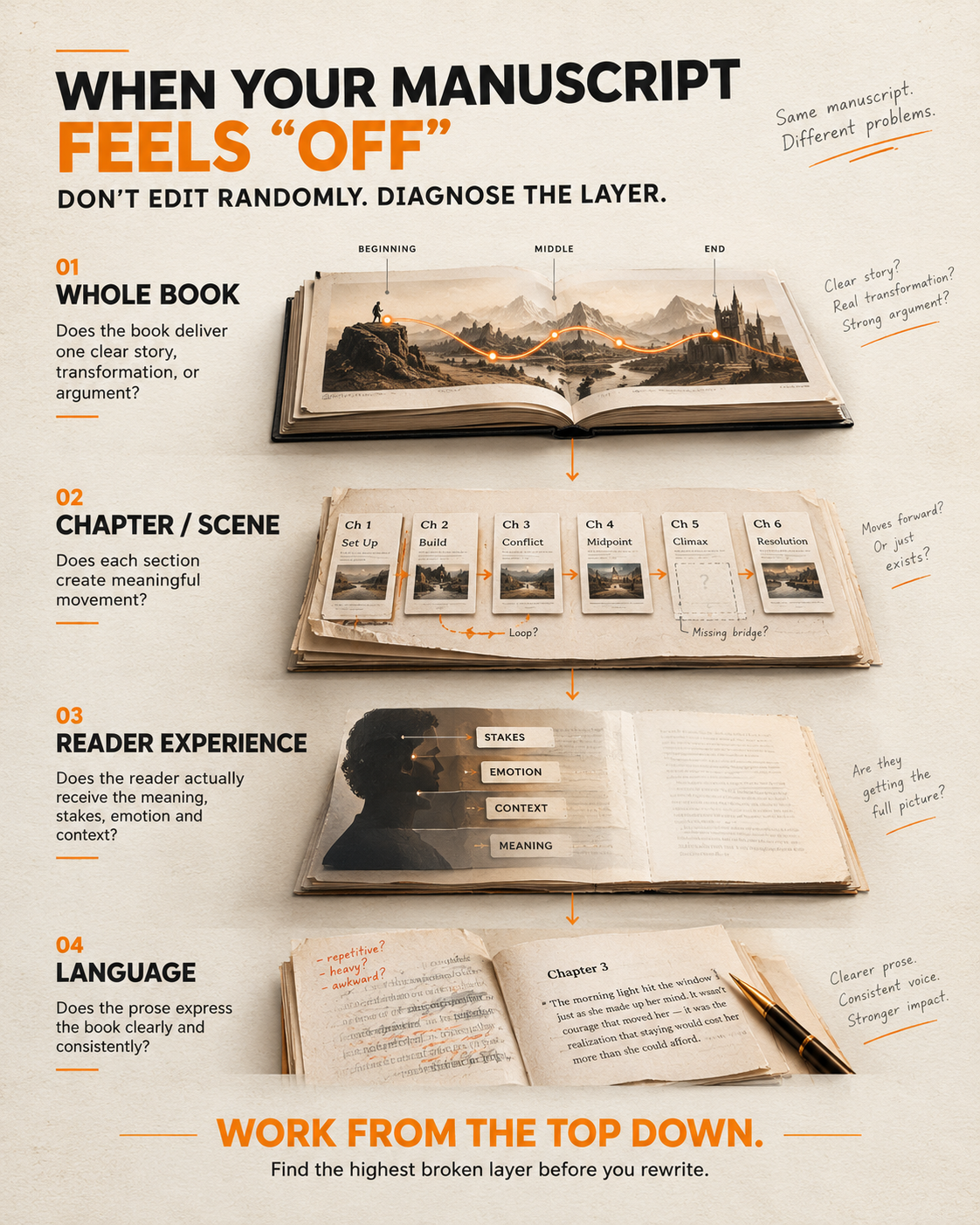
| Layer | Main Question | What Failure Feels Like |
|---|---|---|
| Whole Book | Does the book deliver one clear story, transformation, or argument? | “There are good parts, but I don't know what the book is really doing.” |
| Chapter / Scene | Does each section create meaningful movement? | “Nothing is obviously bad, but the middle drags.” |
| Reader Experience | Does the reader receive the meaning, stakes, emotion, and context you intended? | “It makes sense to me, but readers keep missing things.” |
| Language | Does the prose express the book clearly and consistently? | “The book works, but individual pages still feel heavy or rough.” |
Work from the top down.
If the whole-book structure is still changing, sentence-level polishing comes too early.
If the structure works but the prose remains repetitive or awkward, then moving down to line-level revision makes sense.
This one change can prevent months of circular editing.
1. The Book May Be Complete Without Having a Clear Center
Try describing your manuscript in one sentence without summarizing the plot.
For fiction:
What changes inside the protagonist because this story happened?
For memoir:
What understanding does the reader reach that the narrator could not have reached at the beginning?
For nonfiction:
What central belief, solution, or capability should the reader leave with?
If the answer changes every time you try to explain it, the manuscript may contain several strong ideas without one clear center.
That often creates an unfinished feeling because chapters seem related without feeling necessary to one another.
Test It
Write this sentence:
By the final page, the reader should understand or feel __________.
Now examine each major section.
Does it move the reader toward that destination?
If several chapters could disappear without changing the book's progression, structure deserves attention before wording.
2. Your Chapters May Contain Events Without Creating Movement
A scene can be interesting without moving the book.
Characters may argue.
New facts may appear.
Beautiful description may fill the page.
Someone may travel somewhere, remember something, investigate something, or discuss something.
Movement requires more.
Something should be different at the end of the scene because the scene happened.
That difference might involve:
- New Information
- A Decision
- A Loss
- An Irreversible Action
- Changed Expectations
- Increased Danger
- A Damaged Relationship
- A New Question
- A Shift In Belief
Nonfiction needs the same progression.
One chapter should change what the reader can understand before the next chapter begins.
When five consecutive chapters mostly add more examples of the same idea, the book can feel repetitive even when none of those chapters is individually poor.
Use the “Because of This…” Test
After every chapter, finish this sentence:
Because of what happened or was established here, the next part of the book can now __________.
If you cannot finish that sentence, ask whether the chapter is progressing the book or simply occupying space inside it.
3. You Know More Than the Reader Does
This is one of the hardest self-editing problems to detect.
You remember deleted scenes.
You know why the protagonist hates her brother.
You know what the strange photograph means.
You understand why Chapter Eight comes before Chapter Nine.
You remember the research behind a conclusion even if only part of that reasoning remained in the final draft.
The reader has none of that private knowledge.
They see only the words still on the page.

Catriona Turner, writing in a 2026 CIEP feature after experiencing publishing from both the editor's and author's side, describes the problem simply:
“there’s no perfect objectivity with our own words”
Her experience reinforces why outside reading can reveal gaps that remain difficult to spot after repeated self-editing. Read the 2026 CIEP feature
Run a Knowledge Audit
Mark every place where the reader must understand:
- why a character reacts strongly
- what happened earlier
- what a term means
- how two events connect
- why a decision matters
- why an argument follows from the previous chapter
Then ask:
Did I actually put the necessary information on the page, or do I simply remember it?
That question catches more problems than another grammar pass.
4. You May Be Explaining What the Scene Already Shows
Repeated self-editing can create a strange problem.
Writers become less certain that readers will understand them, so they add explanation.
Then they explain the explanation.
Consider:
Lena pushed the chair back and left without answering. She was angry because Mark had ignored her again, and she felt he no longer respected her.
The first sentence may already communicate much of what matters.
The rest removes interpretation from the reader.
Try:
Lena pushed the chair back.
“Ask somebody else.”
She left before Mark could answer.
Now the reader participates.
You do not have to remove every explanation. Clarity still matters.
The test is simpler:
Has the scene already made this feeling or idea understandable?
If yes, trust what is already working.
5. Your Dialogue May Be Too Clear
Dialogue often becomes less believable during repeated editing because writers keep making it more precise.
Real conflict is rarely precise.
People interrupt themselves.
Avoid direct answers.
Hide behind practical details.
Say the wrong thing first.
Return to an old argument.
Change the subject because the actual subject hurts.
Compare these:
Too explicit
“I'm conflicted because I want to accept the promotion, but I'm worried that moving will hurt our relationship.”
More human
“They want an answer Friday.”
“And?”
“And the office is in Denver.”
The second version leaves work for the reader.
That work creates subtext.
Read Conversations Aloud
Listen for characters who:
- explain their emotions in complete summaries
- answer every question directly
- never hesitate
- use the same sentence rhythm
- tell each other information they both already know
Clean dialogue should not mean clinically perfect dialogue.
6. Your Stakes May Be Present but Still Feel Abstract
“The consequences will be terrible.”
“She could lose everything.”
“He must succeed.”
Those phrases communicate importance without giving the reader much to feel.
Specific stakes work differently.
Instead of:
If she fails, her whole career could collapse.
Try identifying the actual consequence:
She loses the research grant.
Her team loses funding.
The colleague who trusted her has already turned down another position.
Now failure has shape.
Fiction benefits from the same principle.
So does memoir.
So does nonfiction, where the reader needs to understand what changes if they ignore or apply the book's central idea.
Ask three questions:
- What exactly can be lost?
- Who pays the price?
- What becomes impossible afterward?
The more concrete the answer, the more likely the stakes will reach the reader.
7. Your Pacing May Have Flattened
Slow writing is not automatically bad pacing.
Fast writing is not automatically good pacing.
Problems appear when the entire manuscript receives roughly the same amount of narrative attention.
Tense scenes should not always breathe like reflective scenes.
Minor discoveries should not receive the same page weight as turning points.
Important nonfiction concepts may need room for examples and explanation, while transitional material often needs less.
Map the Emotional Temperature
Beside every chapter, write one label:
build / release / reveal / decide / recover / escalate / resolve
Then look at the pattern.
Six chapters marked build usually indicate a problem.
So do six chapters marked explain.
Books need changes in pressure.
Readers feel those changes even when they cannot describe them technically.
8. The Opening May Still Contain Your Warm-Up Pages
Writers often need several pages to discover where the story actually begins.
Readers do not need to watch that discovery happen.
Maybe Chapter One starts with waking up.
Then breakfast.
Then travel.
Then background.
Then, on page six, something changes.
Try opening on page six.
For nonfiction, the same problem appears when the introduction spends several pages proving that the subject is important before answering the question that brought the reader to the book.
Ask:
Where does the reader first encounter the problem, decision, conflict, or promise that actually drives the book?
Everything before that point needs to justify its place.
9. The Prose May Be Polished but Overwritten
Self-editing often adds as much as it removes.
One sentence becomes three because you want greater clarity.
One image becomes four because you want stronger atmosphere.
One emotional beat receives several variations because none feels quite sufficient.
Eventually, the writing can stop breathing.
Try the One-Strong-Detail Rule
Look for paragraphs containing several descriptions that perform the same job.
Keep the detail that carries the most meaning.
Instead of:
Rain fell heavily beneath dark clouds while wind shook the branches and loose paper raced across the empty pavement.
You might need only:
Rain hammered the empty street. Receipts skittered beneath parked cars.
The goal is not minimalism.
The goal is selection.
Readers need enough to imagine the moment, not every detail available to the author.
Before Self-Edit Round Six, Run This 30-Minute Diagnostic
Do not rewrite anything during this exercise.
Diagnosis only.
Step 1: Write the Book's Promise
Finish one sentence:
This book gives the reader __________.
Keep it concrete.
Step 2: Build a Reverse Outline
Ignore your original outline.
List what each chapter actually does in the current manuscript.
One sentence per chapter.
Step 3: Mark Change
Beside every chapter, record what becomes different because that chapter exists.
No change means the section deserves another look.
Step 4: Track Reader Knowledge
Mark information the reader must understand before each major decision or revelation.
Check whether the necessary setup truly exists.
Step 5: Identify the Highest Broken Layer
Choose one:
whole book / chapter progression / reader experience / language
Start there.
Do not fix all four at once.
Step 6: Give the Next Revision One Job
Examples:
Round Six: protagonist decisions
or
Round Six: chapter progression
or
Round Six: remove explanations after emotional actions
That is an editing plan.
“Make it better” is not.
Another Self-Edit, Beta Readers, or Professional Editing?
The next step depends on what you already know.
| Your Situation | Best Next Move |
|---|---|
| You can clearly name the problem and know what to test | Focused self-edit |
| You need to know where ordinary readers lose interest or become confused | Beta readers |
| You know something is wrong but cannot identify the cause | Manuscript evaluation |
| Structure, pacing, character arcs, argument flow, or chapter order remain unstable | Developmental editing |
| Structure works but prose is heavy, inconsistent, or awkward | Line editing |
| Structure and language are settled but correctness needs attention | Copy editing |
| The edited, formatted manuscript needs final error checking | Proofreading |
The distinction matters financially too.
The 2026 EFA Rate Chart currently lists fiction developmental editing at 2.7 to 3.5 cents per word. Rates vary by editor and project, but the figure shows why authors should identify the correct editing stage before purchasing the wrong service.
What Repeated Self-Editing Often Gets Wrong
Polishing Chapters That May Still Be Cut
Beautiful sentences do not justify a chapter that no longer belongs.
Fix structure first.
Treating Every Beta-Reader Suggestion as an Instruction
One reader says, “Cut this scene.”
Another says, “I need more explanation.”
Those recommendations conflict.
Their experience may not.
Both might be reacting to a scene whose purpose is unclear.
Look for the shared problem underneath the proposed solutions.
Formatting Before the Text Is Stable
Formatting makes a manuscript feel finished.
That psychological shift can make necessary structural changes harder to accept.
The live Amazon KDP Experts services structure also places editing before final formatting and publishing preparation, because those stages solve different problems.
Asking AI to “Fix” a Problem You Cannot Name
AI may help inspect repetition, wording, possible inconsistencies, or other defined questions.
A prompt such as “make my chapter better” gives the tool permission to make editorial decisions you have not diagnosed yourself.
The related Amazon KDP Experts guide to AI book editing explains why structure, voice, subtext, and reader response require more caution than surface cleanup.
What This Looks Like in Practice
Picture a thriller that has already been revised five times.
The author has:
- tightened dialogue
- removed repeated words
- fixed continuity
- cut unnecessary description
- corrected grammar
The middle still drags.
Round Six could become another sentence edit.
Instead, the author writes a reverse outline.
Chapters 10 through 15 reveal different pieces of information, but the protagonist makes no meaningful decision during that entire stretch.
The scenes are not individually bad.
The sequence is static.
Now the author has something useful to revise.
One revelation moves earlier.
Two chapters combine.
The protagonist must make a choice in Chapter 12 that creates the consequences of Chapter 13.
Suddenly, pacing improves without anyone telling the author to “make the prose faster.”
That is the difference between polishing a symptom and fixing its cause.
When Should You Stop Self-Editing?
Stop the current kind of self-editing when:
- you keep changing sentences back to earlier versions
- your revision notes become “something feels off”
- the same beta-reader concern survives several drafts
- paragraphs improve but the whole book does not
- you are polishing scenes whose structural purpose remains uncertain
- you can identify discomfort but not its cause
- you no longer know whether the writing is weak or simply too familiar
Stopping does not mean the book is ready to publish.
It means your current perspective may no longer be producing useful information.
That is an important difference.
What Should Professional Manuscript Feedback Give You?
Useful editing should not leave you with a larger pile of opinions.
It should create priority.
You should understand:
- What is already working
- What the biggest remaining problem is
- Why that problem affects the reader
- Where the pattern appears
- What needs fixing before lower-level editing begins
- What should remain untouched
The current Amazon KDP Experts book editing service begins with manuscript review and editing-level selection before specialist editing, rather than applying the same service to every draft. Its published workflow separates manuscript review, editing plan, specialist editing, author review, and final delivery.
Writers comparing editors can also use the site's guide to choosing a book editor, which covers stage fit, editorial judgment, scope, files, confidentiality, AI use, and author control.
Final Thoughts: Stop Editing the Symptoms
Five rounds of self-editing do not mean you have failed.
They may simply mean the manuscript has reached the limit of what the same editing approach can show you.
When you keep wondering why does my manuscript feel unfinished, do not immediately rewrite Chapter One again.
Zoom out.
Check what the book promises.
Check whether chapters create change.
Check whether readers receive the information and emotion you intended.
Check whether the problem sits in structure, progression, reader experience, or language.
Then revise that layer.
Clean pages are useful.
A book that works as a whole matters more.