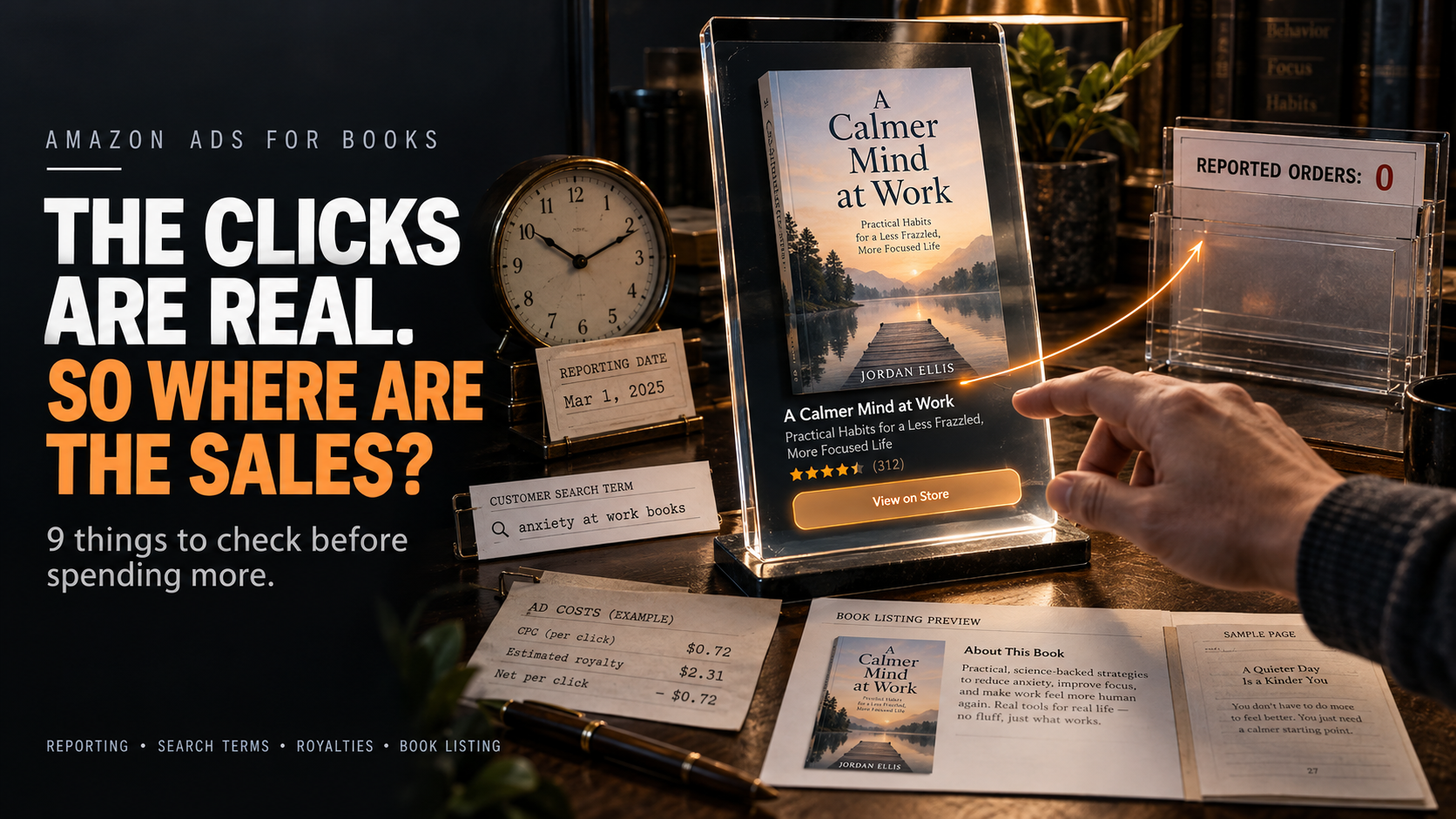
You open your Amazon Ads dashboard. Your book has impressions. People are clicking. The advertising charges are adding up.
But the sales column still shows zero.
Your first instinct might be to increase the bid, rewrite the description, or pause the campaign entirely. You may even wonder whether the cover is driving away potential readers.
Any of those decisions could be premature.
When Amazon ads for books show no sales, the problem isn't necessarily that shoppers dislike your book. Some conversions take time to appear, subscription reading can be reported separately, and not every click comes from someone who intended to buy your particular kind of book.
A click confirms interest in the advertisement. It doesn't tell you what happened after the shopper reached your listing.
Before spending more, you need to establish whether the problem is reporting, targeting, advertising costs, or the book's presentation.
At Amazon KDP Experts, the useful starting point for a struggling book campaign is the evidence already available, not an automatic recommendation to increase spending.
Here are nine checks that can help you make your next advertising decision with greater confidence.
Key Takeaways
- Check attribution and Kindle+ activity first. Zero reported orders don't always mean no reader activity or future attributed sales.
- Investigate actual search terms. A relevant-looking keyword can still generate clicks from readers searching for something else.
- Calculate advertising costs against royalties. A campaign can report sales and still spend more than the author earns.
- Fix the right problem. Better targeting won't repair a weak product page, and a better description won't make irrelevant clicks profitable.
Why Are Your Amazon Book Ads Getting Clicks but No Sales?
Amazon book ads can receive clicks without generating sales because the campaign reaches poorly matched shoppers, the product page doesn't meet reader expectations, or advertising costs exceed the book's earning potential. Before making changes, check reporting delays, subscription page reads, search terms, targeting, royalties, and the buying experience on your Amazon listing.
There is no single number of clicks that proves your book description, cover, or campaign is failing.
An author receiving ten clicks is working with a very different amount of evidence from an author who has spent heavily across several relevant search terms without seeing a purchase.
The key is to determine what the data actually supports.
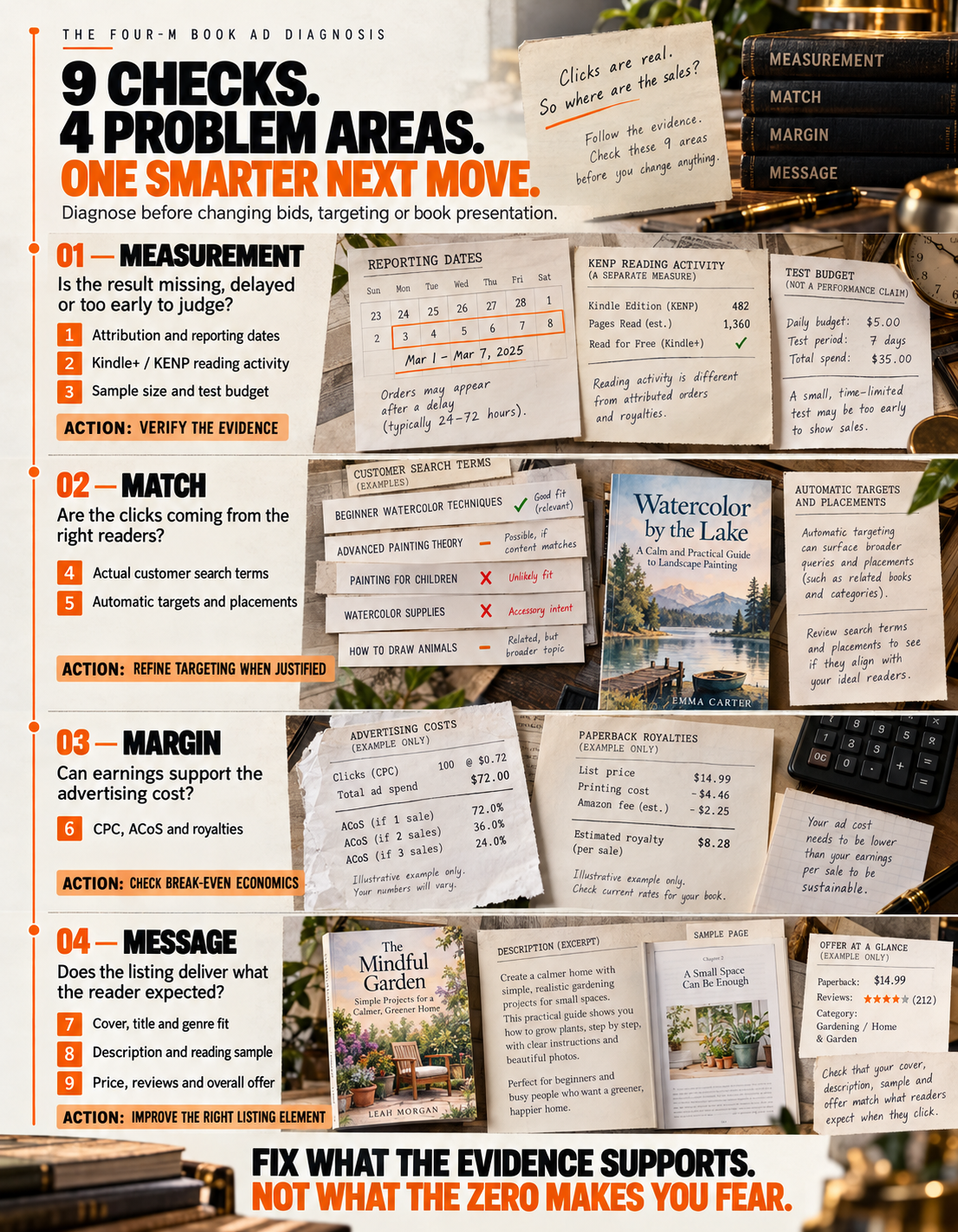
The Four-M Diagnosis: Find the Problem Before You Change the Campaign
Use these four questions to guide your investigation.
| Diagnostic Area | Question to Answer | Where to Look |
|---|---|---|
| Measurement | Are sales or reading activity missing, delayed, or reported differently? | Amazon Ads and KDP reports |
| Match | Are your ads attracting readers who actually want this type of book? | Search terms, targets, ASINs and placements |
| Margin | Can the royalties reasonably support the cost of acquiring a buyer? | CPC, conversion rate, royalty estimates and ACoS |
| Message | Does the listing confirm the promise that earned the click? | Cover, title, description, sample, price and reviews |
This framework matters because each problem calls for a different response.
An irrelevant search term may need exclusion. An expensive but productive target may need a lower bid. A relevant click followed by no purchase may justify examining the book's presentation.
And a recently launched campaign may simply need enough time for the data to become useful.
Check 1: Make Sure Your Sales Aren't Delayed or Reported Somewhere Else
Start by checking what the dashboard is actually measuring.
Amazon Ads and KDP reports serve different purposes.
Amazon Ads reports sales attributed to qualifying advertising interactions within the applicable reporting window. KDP reports reflect activity associated with your published books, including sales from sources other than advertising.
That means the two dashboards will not always show identical figures.
Understand the 14-Day Attribution Window
For author Sponsored Products campaigns, Amazon uses a 14-day click-attribution window.
A qualifying purchase may be attributed to an earlier ad click rather than appearing as a same-day result.
The reports also update on different schedules.
For example, an attributed paperback order can appear in Amazon Ads based on the purchase date, while KDP typically reports the paperback sale after the book ships.
Amazon explains these reporting differences in its official guidance for advertising KDP books.
Before diagnosing a campaign as unsuccessful, check:
- The campaign's reporting date range.
- Whether the clicks occurred recently.
- The correct Amazon marketplace.
- The advertised book format or ASIN.
- Whether orders are still being processed.
- Whether KDP shows activity absent from the ad-sales column.
Pro Tip: Keep the date range and marketplace consistent when comparing reports, but don't expect attributed ad revenue and total KDP royalties to match exactly.
Check 2: Look for Kindle+ Reading, Not Just Book Purchases
This is especially important for authors enrolled in KDP Select.
In October 2026, Amazon renamed Kindle Unlimited to Kindle+, expanding the subscription offering to include additional audiobook access.
Eligible readers can borrow enrolled books through the subscription rather than purchasing an individual ebook.
For the author, that activity can generate Kindle Edition Normalized Pages, or KENP, when subscribers read or listen to eligible content.
Why Your Orders Column Can Be Misleading
Suppose someone clicks your Sponsored Products ad and chooses to read the book through Kindle+.
You may not see that activity as a standard book purchase.
Instead, relevant advertising reports may show estimated attributed KENP reads and royalties, while KDP provides its broader reading and royalty information.
These figures need to be interpreted separately from ordinary retail orders.
When reviewing an eligible subscription title, examine:
- Attributed book purchases.
- KENP Read or related subscription reading metrics.
- Estimated attributed KENP royalties.
- Total KDP reading activity.
- Whether the reporting window is complete.
Important: A borrow doesn't guarantee that the reader will finish the book or generate meaningful royalties. Don't count every subscription interaction as a full-price sale.
For a paperback-only title, this check usually won't apply.
Check 3: Decide Whether You Have Enough Clicks to Judge the Result
Fifteen clicks with no sales can feel discouraging.
But it doesn't prove that your book description needs rewriting.
Every click represents a chance of purchase, not a guaranteed order.
Without enough observations, normal variation can look like a campaign problem.
Why There Is No Universal Click Threshold
Imagine a hypothetical book with a 5% chance of converting each qualified click into an order.
If we assume independent clicks with the same conversion probability, the chance of receiving zero orders from twenty clicks is still approximately 36%.
That isn't an Amazon industry conversion benchmark. It's an illustrative probability calculation.
The actual conversion rate for your book could be much lower or higher.
The point is that a small sample can be inconclusive.
Look at Cost Alongside Click Count
Instead of asking only, How many clicks have I received?, ask:
How much have those clicks cost, and how much could an average sale earn me?
A campaign with twenty inexpensive clicks may deserve further observation.
A campaign with twenty costly, poorly matched clicks may already justify tightening the targeting.
Pro Tip: Set a test budget in advance. Decide how much you are prepared to spend gathering initial evidence before you launch, rather than allowing frustration to determine when to stop.
Check 4: Read the Search Terms That Actually Generated Clicks
Your target keyword isn't always the shopper's search query.
That distinction is one of the most useful parts of Amazon Ads reporting.
Imagine advertising a beginner's book about watercolor painting.
You target a broad term related to watercolor books.
Your ads might attract shoppers interested in advanced techniques, children's painting activities, art-history collections, or professional reference manuals.
Those readers are interested in the general subject, but they may not want your book.
Open Your Sponsored Products Search Terms Report
Use Amazon Ads reporting to inspect the actual customer searches that resulted in clicks.
Amazon's official book advertising reporting guide explains the available Search terms, Targeting, Advertised product and Placement reports.
For each meaningful search term, ask:
- Would someone using this phrase reasonably expect a book like mine?
- Does the search indicate the right genre, format, audience or skill level?
- Has the term generated orders or relevant subscription activity?
- Is the spending justified by the results?
- Should this term be excluded, monitored or tested with more controlled targeting?
Example: Related Words, Wrong Readers
Suppose you're advertising a workbook for adults learning conversational Spanish.
Your ad receives clicks from searches for advanced Spanish literature, children's picture dictionaries and Spanish grammar exam preparation.
All three relate to Spanish.
None necessarily matches your intended reader.
Do this: Review specific search terms and exclude clearly irrelevant traffic when supported by sufficient evidence.
Not that: Increase bids because a broad target has a high number of impressions or clicks.
Check 5: Examine Automatic Targeting and Product Placements
Automatic campaigns can help discover where Amazon considers your book relevant.
But that doesn't mean every placement is a good commercial fit.
Sponsored Products automatic targeting can include close match, loose match, substitutes and complements.
Each represents a different way your ad may be matched with shopping activity.
Know What the Targeting Groups Are Doing
Close match: Attempts to reach shoppers using searches closely related to the advertised book.
Loose match: Can reach broader searches associated with the book.
Substitutes: May display your book in contexts involving similar books.
Complements: May place the ad around related or complementary products.
These options create different opportunities for discovery.
They also need to be evaluated separately.
Review the Products and Pages You're Appearing Against
A business memoir might be suitable beside other personal business stories but a poor match beside advanced corporate finance textbooks.
A historical romance could attract interest from readers browsing a similar historical setting, but the emotional tone and genre expectations still matter.
Check the available targeting and placement data.
For poor-performing product targets, consider reducing exposure or excluding irrelevant products.
For search terms that consistently show a strong fit, consider more controlled manual targeting.
Pro Tip: Automatic targeting is a research tool, not an instruction to trust every placement indefinitely. Use what you learn to make the campaign more selective.
Check 6: Calculate Whether Your Cost per Click Makes Financial Sense
This is where many authors confuse activity with performance.
A campaign can have impressions, clicks and even sales while still losing money on directly attributed transactions.
To evaluate that risk, you need to understand the money you receive per book, not just the retail price.
Understand CPC, ACoS and Royalties
CPC (cost per click): Advertising spend divided by clicks.
ACoS (advertising cost of sales): Advertising spend divided by attributed sales value, expressed as a percentage.
Royalty per sale: The amount you expect to receive from an eligible purchase after the applicable royalty calculation, including relevant print costs or ebook delivery fees.
ACoS measures ad spending against attributed retail sales value. It does not measure author profit.
Example: The Book Is Selling, but the Ad Still Loses Money
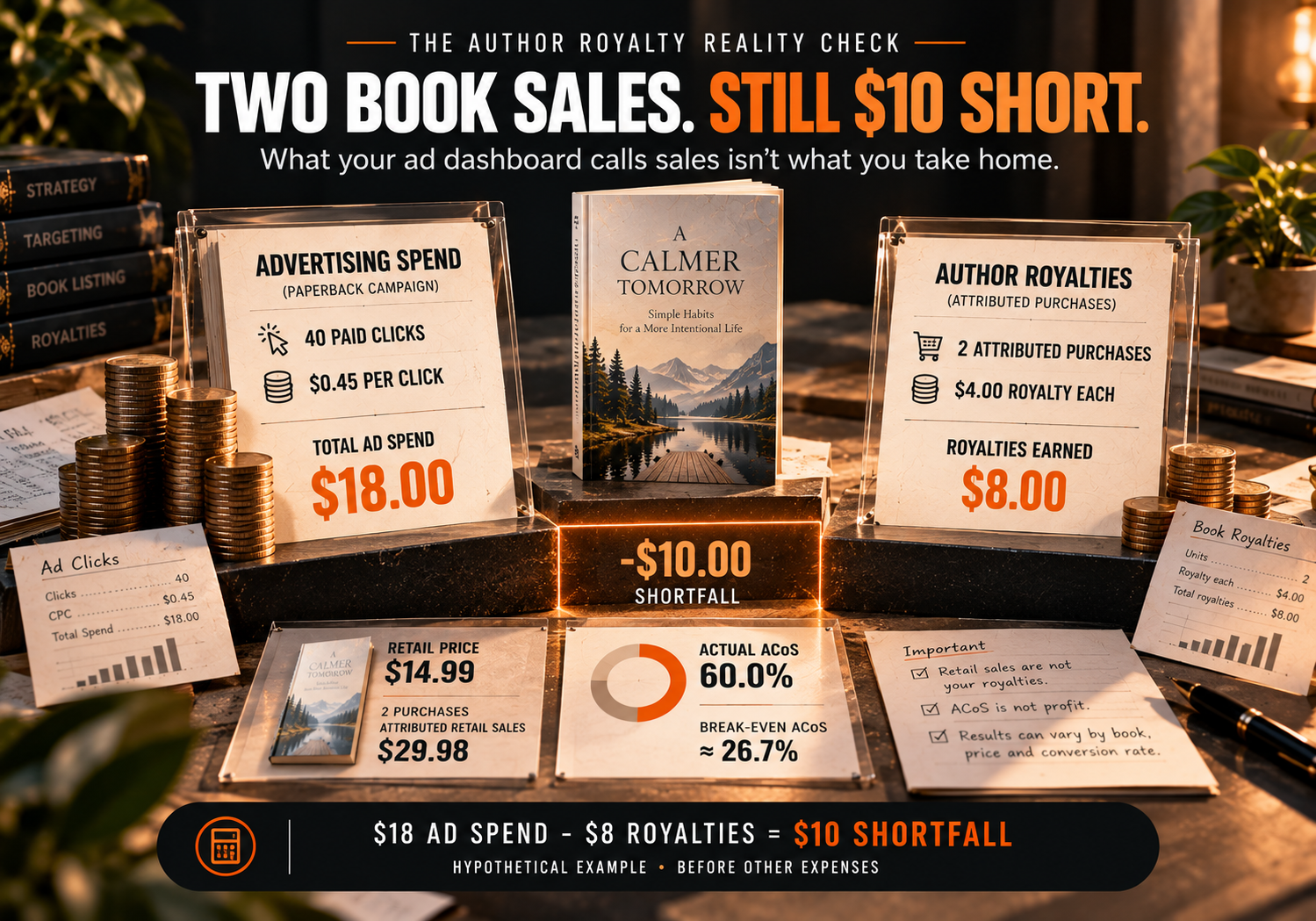
Consider a hypothetical paperback with these figures:
| Metric | Illustrative Amount |
|---|---|
| Retail selling price | $14.99 |
| Author royalty per purchased copy | $4.00 |
| Average advertising cost per click | $0.45 |
| Paid clicks | 40 |
| Ad-attributed purchases | 2 |
| Advertising spend | $18.00 |
| Approximate royalties from those purchases | $8.00 |
In this example, the campaign generated purchases.
But the author's approximate royalties from those sales are $10 less than the advertising spend.
That's before accounting for any additional production or marketing expenses.
The campaign may still have other strategic value, but those two attributed orders do not cover the direct ad cost.
How to Estimate Break-Even ACoS
For a simple single-format sales example:
Approximate break-even ACoS = royalty per sale ÷ retail price × 100
Using the hypothetical paperback:
$4.00 ÷ $14.99 × 100 = approximately 26.7%.
An ACoS higher than that would exceed the royalty margin in this simplified scenario.
For campaigns involving multiple formats, changing royalties, refunds or subscription activity, use the actual earnings information rather than relying on one fixed percentage.
How Much Can You Afford to Pay per Click?
Another useful calculation is:
Break-even CPC = expected royalty per purchase × observed purchase conversion rate
For example, if your royalty is $4 and your observed conversion rate is 5%, the approximate break-even CPC would be $0.20.
That's a planning estimate, not a bid recommendation or an Amazon benchmark.
Pro Tip: When a campaign has zero attributed sales, don't interpret an empty ACoS value as a healthy result. First inspect spend, relevant traffic, attribution timing and any separate KENP earnings.
Check 7: Make Sure Your Cover, Title and Genre Match the Reader's Expectations
Your cover has already done enough to attract some clicks.
That is useful information, but it doesn't prove the design communicates the right promise.
A shopper might click because the book looks interesting, then discover that its genre, audience or content is different from what they expected.
Test the Cover in Its Actual Shopping Context
Don't judge the artwork only at full size.
View it as a small thumbnail beside books appearing for your priority searches.
Ask:
- Is the title readable?
- Does the cover communicate the correct genre?
- Does the subtitle clarify the book's subject where needed?
- Could the design attract a different readership from the one the book serves?
- Does the cover still make sense beside established titles in the category?
For example, a serious grief memoir that resembles a light romantic comedy may earn curiosity clicks from the wrong readers.
Don't Assume Low CTR Automatically Means a Bad Cover
Click-through rate, or CTR, is clicks divided by impressions.
A low CTR could involve the cover, but it could also reflect poor placements, broad targeting, price, or stronger-looking competing offers.
Treat it as a signal to investigate, not proof of a single design problem.
If the cover itself needs attention, book cover design services may help address genre positioning, typography and presentation.
Authors still weighing the type of artwork they need can read our existing guide to premade vs. custom book covers.
Check 8: Inspect the Book Description and Reading Sample
When relevant readers click but don't buy, the product page deserves careful attention.
Amazon's own guidance states:
"A strong detail page can help convert clicks into a sale."
The detail page needs to give readers enough information to understand what they're buying and whether the book meets their expectations.
Use the Reader's Search as a Description Test
Select one relevant search term that produced paid clicks.
Then read your product description as if you were the person who searched it.
Does the opening establish the genre, topic or reading experience?
Does the description explain why this book fits the reader's needs?
Is the language specific, or could the same description appear on dozens of unrelated books?
Consider a nonfiction title about improving sleep habits.
A description listing chapter topics may be accurate but unconvincing.
A stronger description could explain the intended reader, the practical approach, and the problems the chapters address, without making unsupported medical claims.
Check the Sample Where Available
Your reading sample can expose issues the description cannot.
Review the first pages for:
- Poor opening structure.
- Unclear writing or editing problems.
- Formatting errors.
- An introduction that takes too long to establish value.
- Material that doesn't match the book's advertised level or genre.
Not every product or format has identical preview features, and samples can take time to appear.
Don't assume a missing or limited sample means the entire book is unavailable.
What About A+ Content?
A+ Content can help present appropriate book information through additional modules, images and comparison material.
It can support a stronger shopping experience when used well, but it is not a mandatory requirement or a guaranteed conversion fix.
Use it to clarify the book, not to make unsupported claims or repeat the description in a more decorative format.
Check 9: Compare Your Price, Reviews and Overall Offer With Competing Books
A shopper who clicks your ad isn't committed to purchasing your book.
They can compare alternatives before making a decision.
That makes pricing and perceived value important, but neither should be judged in isolation.
Review the Choice a Real Reader Sees
Find several genuinely comparable books in the same marketplace and format.
Compare:
- Paperback or ebook price.
- Cover and title clarity.
- Description quality.
- Relevant reader reviews.
- Sample quality.
- Book length and format suitability.
- Whether the book serves the same audience.
A new title with few reviews isn't automatically a poor purchase.
But when competing books offer clearer descriptions, more established reader feedback or better-matched content, the author may need to strengthen the overall presentation.
Should You Lower the Price?
Not automatically.
Lowering the price can reduce the royalty available to support advertising.
If the real problem is irrelevant targeting, a lower price won't make those clicks more qualified.
If readers have reasonable questions about the book's value, you may be able to answer those questions through better positioning or clearer product details.
Our guide to common self-publishing mistakes on Amazon covers several publication and listing decisions that can undermine a book before marketing begins.
Pro Tip: Evaluate the offer as a reader would. The right price is not necessarily the lowest one; it's a price that makes sense for the book, intended audience and available alternatives.
An Illustrative Campaign Diagnosis: Same Problem, Different Fixes
Consider a hypothetical first-time nonfiction author promoting a paperback.
The campaign has recorded the following activity:
| Target Group | Clicks | Spend | Attributed Purchases | Initial Interpretation |
|---|---|---|---|---|
| Broad subject keywords | 24 | $13.20 | 0 | Search-term relevance needs review |
| Specific reader-problem keywords | 12 | $5.40 | 0 | Potentially relevant, but limited evidence |
| Comparable book targets | 18 | $9.90 | 1 | Possible useful placement; check profitability |
These figures are illustrative, not results from an Amazon KDP Experts client or a real campaign.
The author shouldn't respond by increasing every bid or rewriting the entire listing.
A better sequence would be:
- Check whether reporting is complete.
- Review the actual searches behind the broad keyword clicks.
- Keep relevant, lower-cost targets under observation if the budget allows.
- Calculate whether the attributed paperback sale covers the relevant advertising cost.
- Examine the listing if strongly matched shoppers continue clicking without purchasing.
- Record each change before reviewing later results.
The same campaign may contain several different problems.
That is why a campaign-wide average can hide what is actually happening.
What Should You Fix First? A Practical Five-Step Recovery Plan
Once you've completed the nine checks, use this shorter process to make your changes.
Step 1: Export the Evidence
Download your available Sponsored Products Search terms, Targeting, Advertised product and Placement reports for a consistent period.
Record spend, clicks, attributed orders, estimated subscription royalties where relevant, and the advertised formats.
Step 2: Classify the Problem
Use the Four-M Diagnosis.
Is the issue measurement, match, margin or message?
There may be more than one problem, but identify the most immediate one first.
Step 3: Stop the Most Clearly Wasteful Spending
Consider pausing irrelevant targets, adding well-supported negative keywords, or lowering bids that exceed your spending limits.
Avoid excluding a potentially useful term solely because it has generated a handful of clicks.
Step 4: Make One Controlled Change
If search intent is the issue, adjust targeting.
If the campaign attracts relevant readers but the page is weak, improve the listing.
If the cost per click is too high for the estimated royalty, review bids and spending limits.
Record what changed and when.
Step 5: Review Comparable Data
Allow for reporting delays and the attribution window.
Then compare performance at the appropriate target and book-format level.
Don't call an experiment successful just because impressions increased. Ask whether the change improved relevant traffic, author earnings or the campaign's stated objective.
When Is Professional Amazon Book Marketing Worth Considering?
Not every struggling campaign needs an agency.
An author with a small campaign and a few irrelevant search terms may be able to correct the problem independently.
Professional guidance becomes more useful when multiple campaigns and book formats make the data difficult to interpret, advertising expenses are mounting, or the author needs a structured assessment of targeting and product-page readiness.
Amazon KDP Experts offers book marketing services that can include reader research, Amazon Ads planning, campaign review and performance reporting, based on the agreed project scope.
Before hiring anyone, clarify who controls the advertising account, who approves spending, what reports will be delivered, and how decisions will be evaluated.
Amazon KDP Experts is an independent publishing-services provider and is not affiliated with Amazon or Kindle Direct Publishing.
Final Thoughts: Stop Paying for Clicks You Don't Understand
Getting clicks without book sales is frustrating, but the dashboard is giving you information worth examining.
A click can reveal relevant reader interest, poor targeting, a reporting delay or a financial problem that won't disappear with a bigger budget.
The next decision should depend on what you can verify.
For authors dealing with Amazon ads for books and no sales, the priority isn't to test every possible change. It's to determine whether the campaign is reaching the right people, whether those readers have a convincing reason to buy, and whether each sale can justify the advertising cost.
Don't spend more simply to discover the same problem again.
Find the cause you can address, make a measured change, and let the next set of results inform your decision.