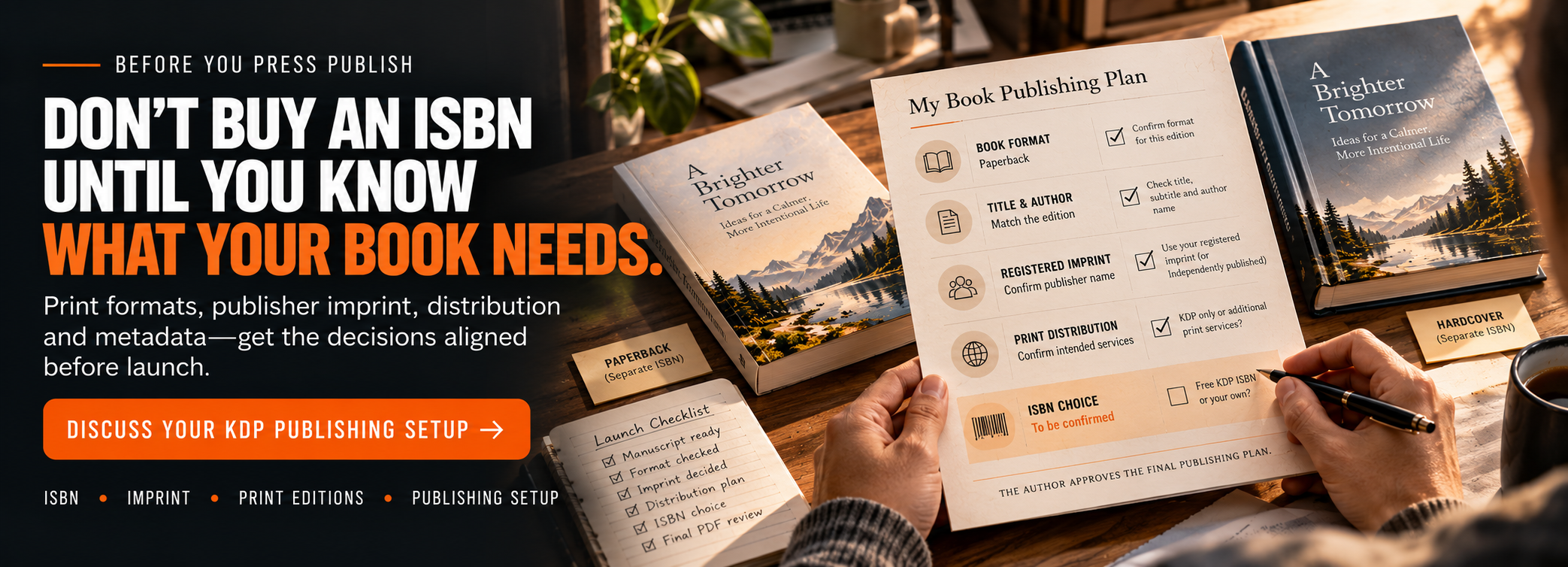
You're setting up your paperback on Amazon KDP when the platform offers you a free ISBN. One click, no payment, and you're closer to publishing.
So why would anyone pay for an ISBN instead?
The answer becomes important when you think beyond the launch.
Maybe you want your publishing brand listed on the book. Perhaps you plan to distribute the same paperback through another printing service. Or you've already published with a free ISBN and now realize your plans have changed.
The KDP free ISBN vs own ISBN decision isn't really about buying a number. It's about choosing how your print edition will be identified, which publisher name appears on its listing, and where that particular ISBN can be used.
At Amazon KDP Experts, ISBN selection is one of the publishing decisions authors should understand before submitting a print edition. Paying for a number you don't need wastes money. Choosing a restricted number without understanding your future plans can create additional work later.
Here's how to make that decision with confidence.
Key Takeaways
- Choose KDP's free ISBN if you're publishing an eligible paperback or hardcover through KDP and don't need a custom publisher imprint.
- Buy your own ISBN if you want your registered publishing name displayed or plan to use the same edition with other printing or publishing services.
- Kindle ebooks don't require an ISBN on KDP. Paperback and hardcover editions generally need separate ISBNs.
- Decide before publishing. Once a print edition is published, KDP doesn't let you replace its ISBN directly.
KDP Free ISBN vs Own ISBN: What's the Difference?
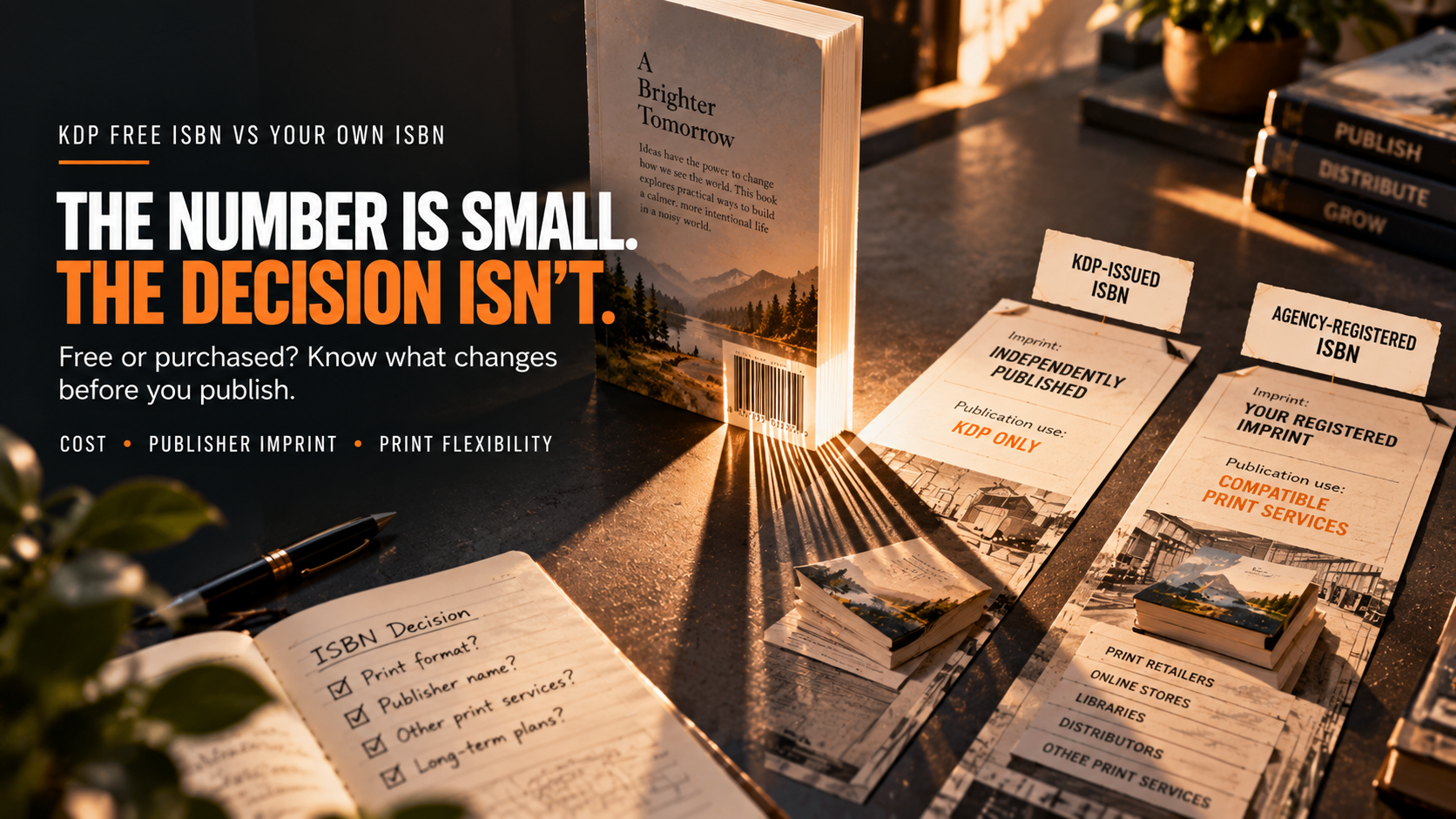
A free KDP ISBN costs nothing, but it can only be used through KDP and identifies the publisher as “Independently published.” An ISBN obtained through an official agency can display your registered publishing imprint and be used for the same edition through other publishing services. Both identify the book; neither determines copyright ownership.
The most important difference is distribution flexibility and publisher identity, not the technical quality of the number.
KDP Free ISBN vs Your Own ISBN: Side-by-Side Comparison
| Feature | Free KDP ISBN | Your Own ISBN |
|---|---|---|
| Upfront ISBN cost | Free | Agency price applies |
| Eligible KDP formats | Paperback and hardcover | Paperback and hardcover |
| Publisher imprint | Independently published | Your registered imprint |
| Use with another print service | Not with the same KDP-issued ISBN | Generally yes, for the same format and edition |
| Copyright ownership | Not determined by ISBN | Not determined by ISBN |
| KDP ebook requirement | Not needed | Not needed |
| Replace after publication | New edition required | New edition required |
| Best fit | KDP-focused publishing | Independent imprint or multiple print channels |
This comparison applies to regular eligible print books. Low-content books have different ISBN options, which we'll cover below.
What Is an ISBN, and Why Does Your Book Need One?
ISBN stands for International Standard Book Number.
It is an identifier used by publishers, booksellers, distributors, and libraries to distinguish a particular book edition and format.
Think of it as a product identity, not a certificate of ownership.
A paperback and a hardcover may have the same title, author, and manuscript, but they're different products. Each requires its own ISBN.
A new edition involving substantial changes may also need a different ISBN.
ISBN vs ASIN: What's the Difference?
An ISBN identifies a book edition within the wider publishing supply chain.
An ASIN, or Amazon Standard Identification Number, identifies a product within Amazon's catalog.
Amazon assigns ASINs to books sold on its platform, including Kindle editions.
For most authors publishing only a Kindle ebook through KDP, there's no reason to purchase an ISBN solely to satisfy Amazon's upload requirements.
Does an ISBN Protect Your Copyright?
No.
Your ISBN choice doesn't transfer copyright to Amazon, and purchasing an ISBN doesn't register copyright in your manuscript.
Owning the rights to your writing and controlling a book's publication identifier are different matters.
You can retain copyright in a book published under a free KDP ISBN. Likewise, buying an ISBN doesn't give you rights to material that someone else owns.
This distinction matters because authors sometimes spend money on ISBNs believing they must purchase one to protect their work.
They don't.
When Should You Choose KDP's Free ISBN?
KDP's free ISBN is a practical option for an author whose print distribution plan is centered on KDP.
You don't need to establish an independent publishing imprint, purchase an identifier, or register the ISBN with an agency yourself.
Amazon handles the ISBN assignment during the eligible paperback or hardcover setup.
The Main Advantages
No ISBN purchase cost. That can matter when you're funding editing, design, formatting, proof copies, and other publishing work.
Simple setup. You can request the ISBN directly from the KDP dashboard while preparing the print edition.
Suitable for many first-time authors. If you want to publish a standard paperback through KDP and don't have an independent imprint, there may be little immediate reason to buy an ISBN.
The Limitations You Need to Understand
With a free KDP ISBN, the publisher imprint appears as “Independently published.”
You can't substitute your personal publishing brand for that imprint simply by changing the book's description.
More importantly, the free ISBN cannot be transferred to another publishing service.
That doesn't mean you lose the right to publish your writing elsewhere.
It means you cannot take that particular ISBN and reuse it with another printer or publisher.
Pro Tip: Ask About Your Next Edition, Not Just Your First Sale
Before selecting the free option, consider whether you'll want the same paperback edition printed or distributed through a separate service later.
If that possibility matters, weigh the extra cost of your own ISBN now against the work of changing your publication setup later.
When Is Buying Your Own ISBN Worth It?
An independently registered ISBN makes the most sense when publisher identity or multi-platform print publishing matters to your plans.
1. You Want Your Publishing Imprint Displayed
An imprint is the publisher name associated with an ISBN.
For example, an independent author might establish a publishing name for a series of business books, educational titles, or novels.
When an ISBN is registered under that imprint and the details match, the imprint can appear in the publisher field.
A custom imprint doesn't automatically make a book more credible or commercially successful.
Its value is that it gives you a consistent publishing identity you control.
2. You Plan to Use More Than One Print-Publishing Service
Perhaps you want KDP to produce books ordered through Amazon while using another print-distribution service for additional channels.
An ISBN you register can generally identify the same format and edition across compatible publishing services, provided the metadata and distribution arrangements are consistent.
This is where the free KDP ISBN becomes restrictive: it cannot be reused outside KDP.
Important: An ISBN you own doesn't automatically create bookstore placement or distribution agreements. You still need to choose a suitable printing and distribution arrangement.
3. You're Building a Long-Term Publishing Catalog
An author releasing several books under one imprint may value consistent publisher records.
You should, however, decide which formats and editions you actually intend to produce.
Don't purchase a large block of ISBNs simply because you might write more books someday.
How Much Does It Cost to Buy Your Own ISBN in 2026?
For U.S.-based publishers, Bowker is the official ISBN agency.
As of October 2026, Bowker's published ISBN prices are:
| ISBN Package | Listed Price | Cost Per ISBN |
|---|---|---|
| 1 ISBN | $125 | $125 |
| 10 ISBNs | $295 | $29.50 |
| 100 ISBNs | $575 | $5.75 |
These are listed U.S. prices, not guaranteed checkout totals. Discounts, promotions, or other offers may affect what you actually pay. KDP also mentions discounted Bowker rates for eligible authors.
Bowker notes that ISBNs never expire.
It also estimates that many books use two or three ISBNs across their published formats. That's Bowker's planning estimate, not a requirement to purchase three ISBNs for every title.
How Many ISBNs Should You Actually Buy?
Consider a simple publishing plan.
Scenario A: One paperback through KDP
If you don't need an independent imprint or another print provider, the free ISBN may be sufficient.
Scenario B: One paperback and one hardcover under your imprint
You need separate ISBNs for those print formats. Purchasing two individual ISBNs may cost less than buying a larger package you won't use.
Scenario C: Several titles or print editions
A multi-ISBN package may become economical once you know you'll need enough identifiers.
Remember that a Kindle ebook published only through KDP doesn't require a purchased ISBN.
For a broader look at where your money should go, read our self-publishing cost guide.
Do You Need to Buy a Barcode Separately?
Not necessarily.
KDP can add a suitable barcode to your paperback or hardcover cover if you haven't supplied one.
Purchasing an ISBN doesn't mean you must also purchase a barcode from the ISBN agency.
If you're designing the cover yourself, leave the required space for the barcode and follow your printer's specifications.
The Two-Door Test: A Simple Way to Choose Your ISBN
Before making a purchase, ask yourself two questions.
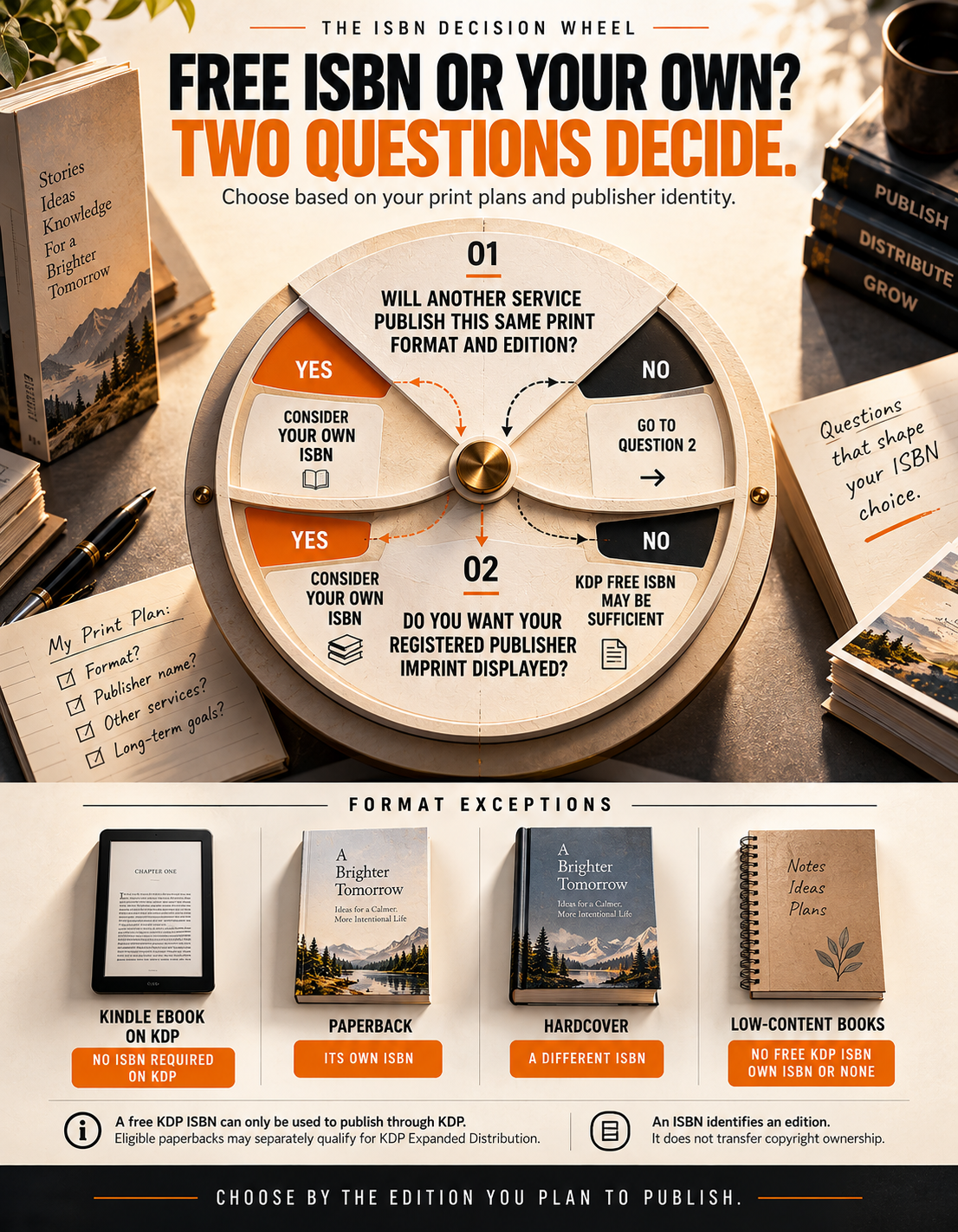
Door 1: Do You Need Independent Print Distribution?
Will you use another publishing or printing service for this same format and edition?
If yes, an independently registered ISBN is usually the more suitable option.
If you're publishing only through KDP, proceed to the next question.
Door 2: Do You Need Your Own Publisher Imprint?
Do you want your publishing name, rather than “Independently published,” associated with the ISBN?
If yes, purchase and register your own ISBN.
If not, the free KDP option is often sufficient.
| Your Publishing Plan | Recommended Starting Point |
|---|---|
| First paperback, KDP only | Free KDP ISBN |
| Kindle ebook only | No ISBN required by KDP |
| Paperback and hardcover, KDP only | Separate free KDP ISBNs, if eligible |
| Print book under your own publishing imprint | Your own ISBN |
| Same print edition through multiple publishing services | Your own ISBN |
| Low-content notebook or planner | Your own ISBN or publish without one |
The rule: Don't buy an ISBN for prestige alone. Buy one when the publisher identity or distribution flexibility is genuinely useful.
The Important Exception: Low-Content Books
This is one of the easiest areas for new KDP publishers to misunderstand.
Low-content books are not eligible for free KDP ISBNs.
KDP generally classifies books such as notebooks, planners, diaries, and certain journals as low-content because they contain minimal or repetitive interior material intended to be filled in by the user.
These publishers typically choose between:
- Publishing the low-content book without an ISBN.
- Supplying an ISBN they obtained themselves.
The free KDP ISBN option isn't available for this category.
KDP's classification matters. Not every activity book or illustrated book is automatically low-content.
What Changes if You Publish Without an ISBN?
KDP can still assign an ASIN to identify the product in Amazon's catalog.
However, certain features differ.
For example, KDP currently doesn't support the Read Sample feature for low-content books published without an ISBN.
If showing an interior preview is important to your sales presentation, review those limitations before deciding.
Pro Tip: Don't assume a blank notebook follows the same publishing rules as a novel or nonfiction book. Confirm the correct book classification first.
Can You Use a Free KDP ISBN and Still Sell Outside Amazon?
This question needs a careful distinction.
The free ISBN itself cannot be used to publish the same edition through another print service.
However, KDP's own Expanded Distribution program may make eligible paperbacks available to participating distribution channels beyond Amazon.
Availability through that program is not the same as independently publishing the book through another company.
Expanded Distribution also doesn't guarantee that a bookstore or library will order the book.
What if You Use Your Own ISBN With Multiple Distributors?
You still need to avoid distribution conflicts.
For example, KDP's Expanded Distribution rules require that the paperback's ISBN has not already been submitted for distribution through another service.
If you plan to use another print distributor, consider which service should handle wholesale distribution rather than submitting the same ISBN into competing distribution arrangements.
Also note that KDP's Expanded Distribution program applies to eligible paperbacks, not hardcovers.
An author-owned ISBN gives you more options, but it doesn't remove the need for a clear distribution plan.
What if You Already Published With a Free KDP ISBN?
Suppose you published your paperback using the free ISBN.
A year later, you establish your own publishing imprint and want that edition to carry your new name.
Can you simply replace the number?
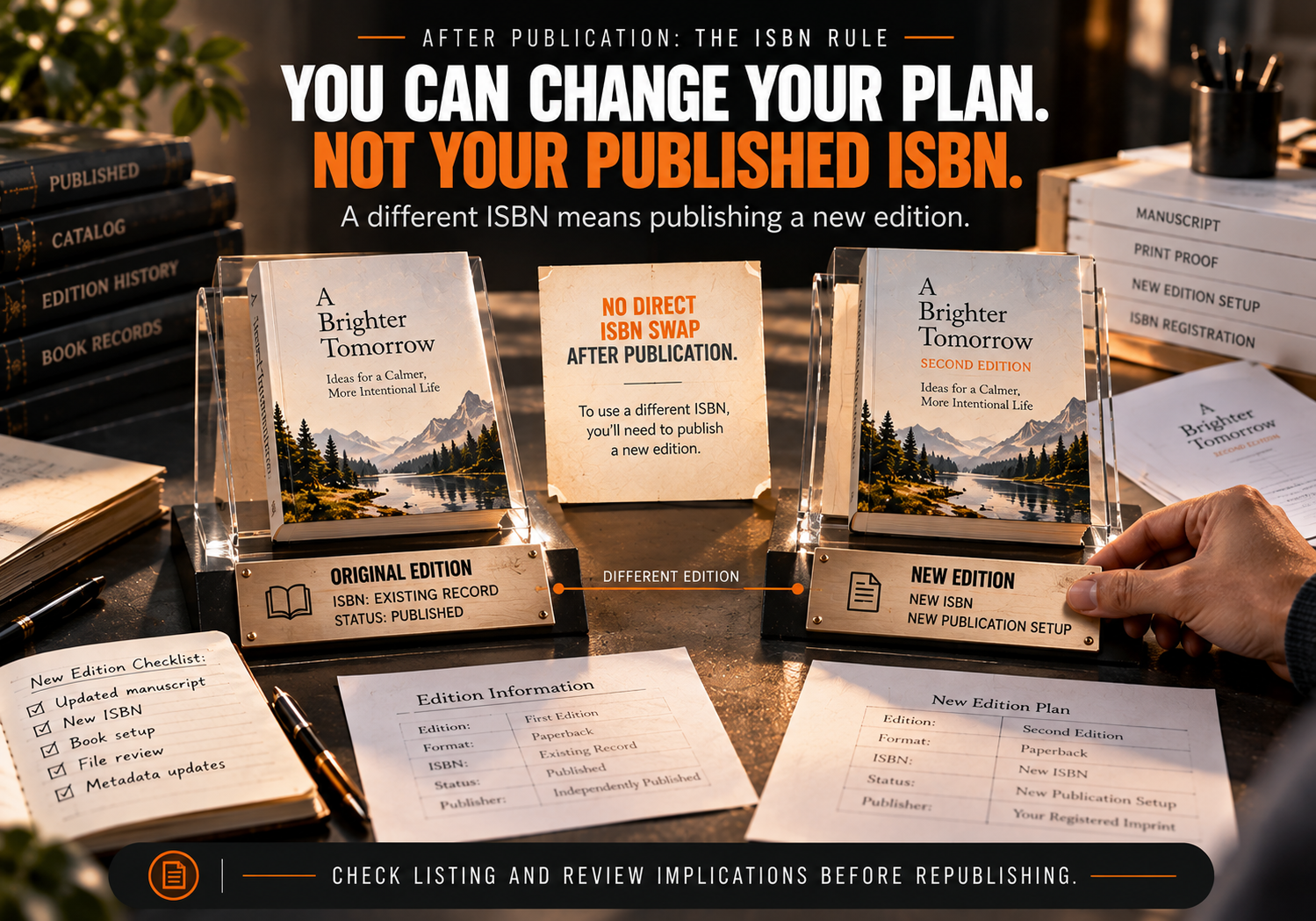
No. KDP doesn't allow an ISBN change after the print book has been published.
To publish the book with a different ISBN, KDP directs authors to unpublish the existing edition and create a new edition with the updated details.
That can involve new book setup, file review, ISBN registration, and changes to how readers find the edition.
Will You Lose Your Book Reviews?
Don't assume every review will disappear, but don't assume they will all transfer either.
Amazon's catalog and review associations can depend on the books, editions, and platform decisions involved.
A newly published edition may not preserve the existing listing history exactly as you'd prefer.
If you already have an established paperback, research the consequences of republishing before removing anything.
A Real Author's Experience: Buying ISBNs Before Planning Editions
Independent author Joey D'Urso described an instructive experience in his June 2022 article What to Know Before Buying ISBNs as a Self-Publishing Author.
While preparing his novel The Aetherverse, he purchased a block of ISBNs before fully understanding his publishing options.
He later described using more numbers as the book moved through different print-on-demand arrangements and trim sizes.
His experience isn't evidence that buying ISBNs is a bad decision.
It illustrates why format and distribution planning should come before purchasing identifiers.
His account reflects his experience at that time; current KDP rules should always take precedence when making a new publishing decision.
How to Choose and Register the Right ISBN: Six Steps
If you're preparing your first print edition, use this checklist before publishing.
Step 1: List Your Intended Formats
Identify whether you're producing a Kindle ebook, paperback, hardcover, or multiple editions.
Don't count a Kindle ebook as requiring an ISBN for KDP.
Step 2: Decide Where Each Print Edition Will Be Produced
Will the edition use KDP alone, or do you have a separate print or distribution arrangement?
Think about both your current release and realistic future plans.
Step 3: Decide Whether You Need a Publisher Imprint
If you want a custom imprint, establish the correct publishing name and registration details before purchasing the ISBN.
Use the official ISBN agency for your country or jurisdiction.
Step 4: Obtain the ISBN
For an eligible free KDP ISBN, open your Bookshelf, edit the paperback or hardcover content, and choose Get free KDP ISBN.
For your own ISBN, enter the registered number in the same section.
Amazon's official ISBN setup instructions describe both workflows.
Step 5: Check Every Metadata Field
For an ISBN you own, compare the agency record with your KDP information.
Verify the title, author, format, and imprint.
Even differences in spelling, capitalization, spacing, or punctuation can create validation problems.
If you've recently updated an ISBN agency record, allow time for the changes to become available to KDP before submitting again.
Step 6: Review the Print Edition Before Publishing
Confirm your ISBN selection, publisher identity, print format, interior file, cover, and product details.
Your paperback and hardcover are separate editions with separate setup requirements.
If you're preparing multiple print formats, professional book formatting services may help keep the files and edition specifications organized.
Final pre-publication check: Can you explain why you selected this ISBN, whose imprint appears, and which print services may use it?
If not, resolve those questions before pressing Publish.
Common ISBN Mistakes That Can Cost Authors Time or Money
Mistake 1: Believing a Free ISBN Gives Amazon Your Copyright
An ISBN identifies a publication. It doesn't determine copyright ownership.
Do this: Review your actual publishing rights and agreements.
Not that: Buy an ISBN solely because you're afraid the free option transfers your manuscript ownership.
Mistake 2: Buying an ISBN Before Choosing the Book's Format
An ISBN belongs to a particular edition and format.
Changing the format or creating a substantially revised edition can require another number.
Decide on your publication plan before purchasing.
Mistake 3: Assuming a Purchased ISBN Guarantees Bookstore Distribution
A registered ISBN helps identify the book, but it doesn't create bookstore demand or guarantee stocking.
Distribution depends on additional publishing and retail arrangements.
Mistake 4: Entering an Imprint That Doesn't Match the Agency Record
KDP checks your supplied ISBN against the registered metadata.
Use the registered publisher name rather than a variation you prefer for marketing.
Mistake 5: Treating Every Book as Eligible for a Free ISBN
Low-content books follow different rules.
Check the classification before designing your production and distribution plan.
For other avoidable setup problems, see our guide to common mistakes when self-publishing on Amazon.
When Does Professional KDP Publishing Support Make Sense?
You don't need a publishing service merely to request a free ISBN.
The KDP dashboard already provides that option for eligible books.
Professional assistance is more relevant when several decisions need to work together: ISBN registration, publisher metadata, paperback and hardcover setup, print-distribution planning, manuscript files, cover specifications, and final submission checks.
For example, an author preparing both paperback and hardcover editions under a registered imprint may want help checking the consistency of those records before submission.
Amazon KDP Experts provides KDP book publishing support for authors who need assistance preparing their book information and selected editions.
The scope should clearly identify what work is included, who registers and controls any purchased ISBN, and which decisions remain with the author.
Amazon KDP Experts is an independent publishing-services provider, not Amazon or Kindle Direct Publishing.
Final Thoughts: Choose the ISBN That Fits Your Publishing Plan
The best ISBN isn't automatically the one you pay for.
If you're publishing an eligible paperback through KDP and don't need a custom imprint, the free option can be entirely appropriate.
If you want your publishing identity displayed or intend to use other print services for the same edition, an ISBN registered in your own name or imprint is usually the more flexible choice.
The KDP free ISBN vs own ISBN decision should reflect the editions you're publishing, the distribution arrangements you want, and the publisher identity you intend to use.
Make that choice before publication, when your options are easiest to manage.
Your ISBN should support your publishing plans, not determine them.