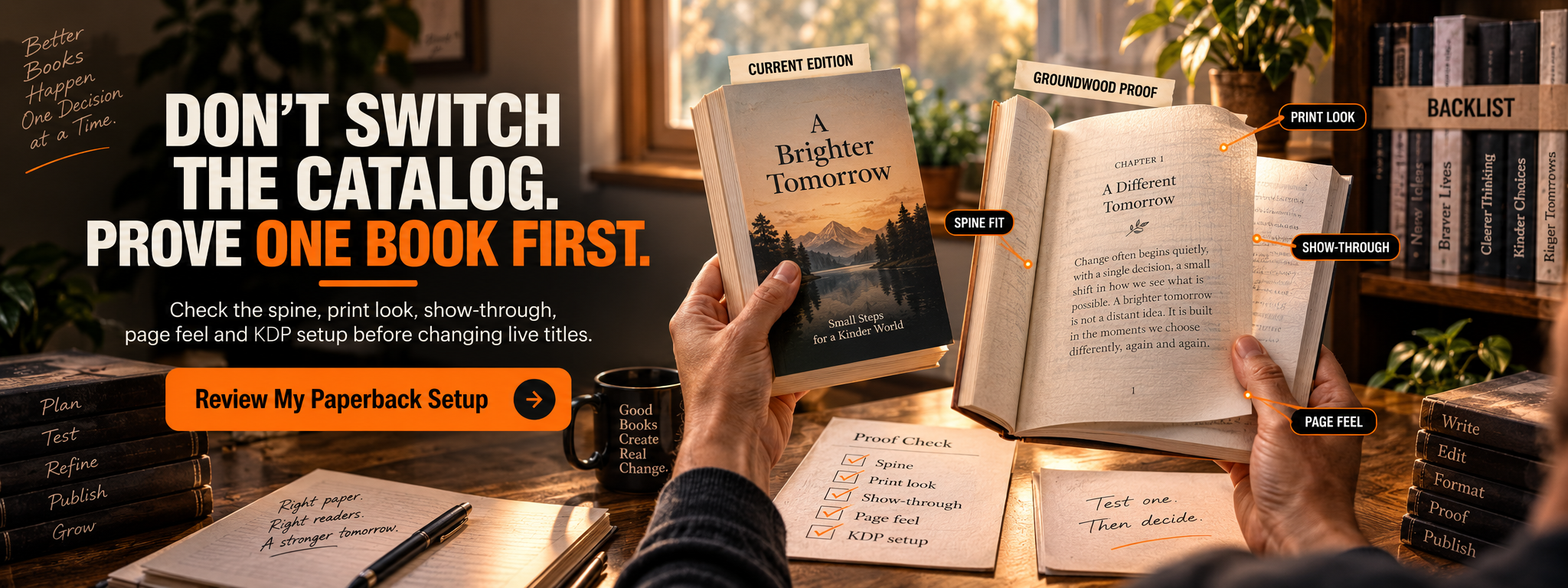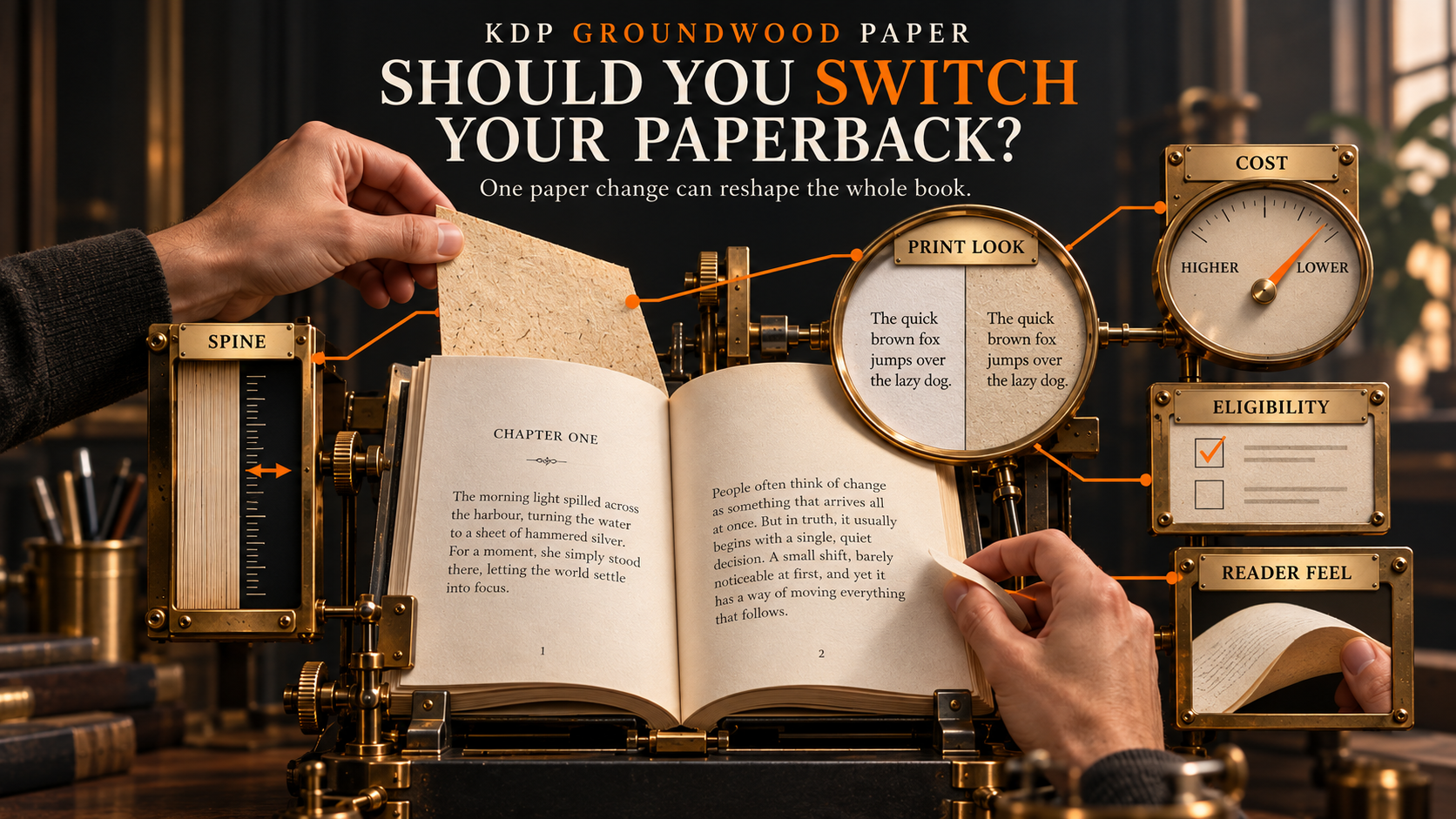
You open your KDP Bookshelf to update a paperback and see a paper option that was not part of your original production plan: groundwood.
It sounds like an easy upgrade. The paper is lighter, Amazon positions it for novels and text-heavy books, and the printing cost can be lower.
But changing paper affects more than what a page feels like between your fingers.
Your cover may need a different spine width. Dark illustrations may reproduce differently. Expanded Distribution eligibility can depend on the trim size. And a paper that feels right for a long novel may be a poor match for an image-heavy workbook.
That is why the real question behind KDP groundwood paper is not, “Is it better?”
It is:
Is it better for this particular paperback?
At Amazon KDP Experts, print choices are treated as part of the book's production plan rather than an isolated KDP setting. Interior formatting, page count, cover dimensions, print options, and the intended reading experience need to work together.
Key Takeaways
- Groundwood is mainly suited to black-and-white, text-led paperbacks, especially novels and other reading-heavy books.
- Do not switch an image-heavy book simply for lower print cost. Amazon specifically warns against groundwood when ink coverage is heavy.
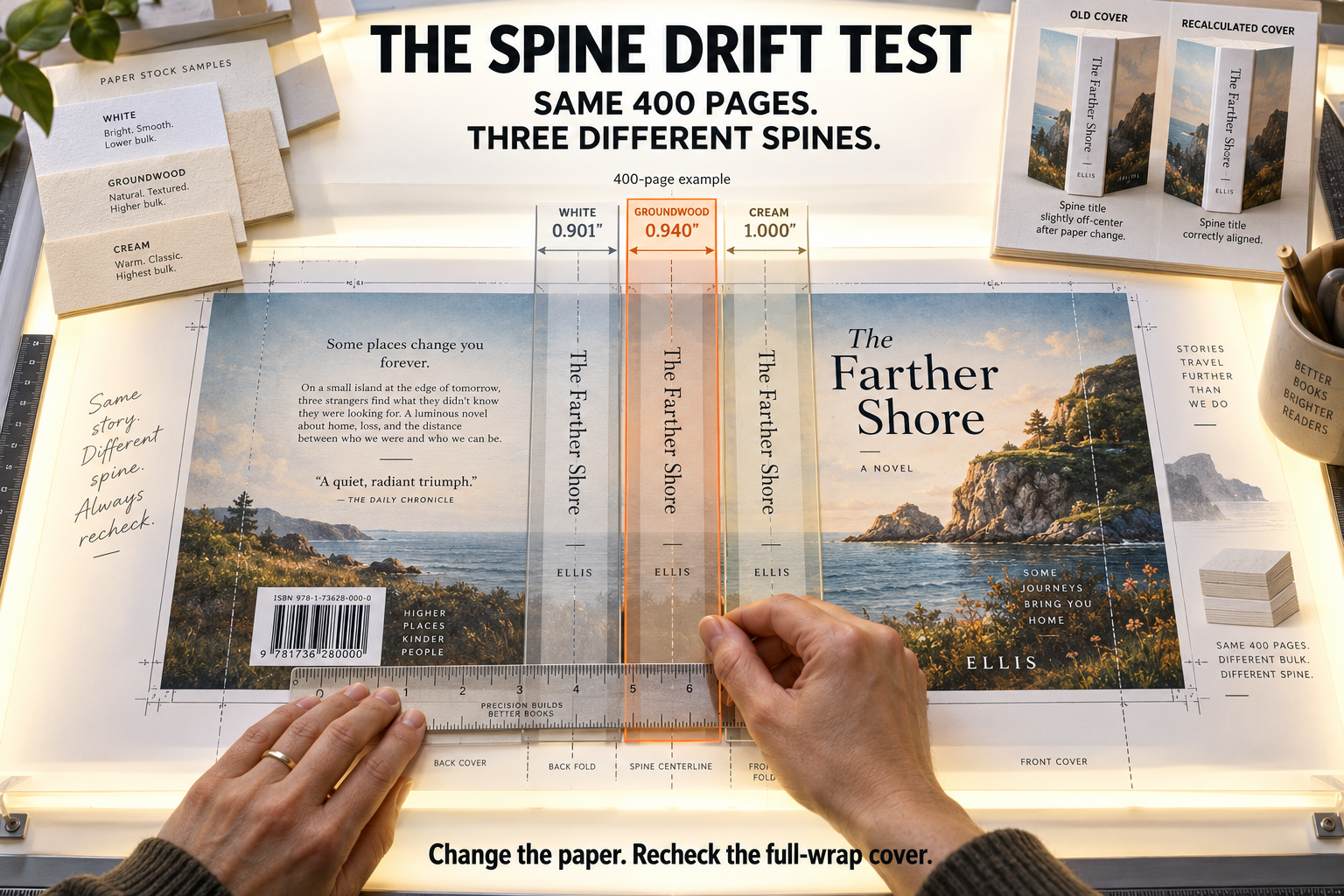
- Changing paper can change the required spine dimensions, so check your full-wrap cover before submitting the update.
- Order a proof before changing a large backlist. Paper feel and print appearance are reader-experience decisions, not just technical settings.
Should You Switch to KDP Groundwood Paper in 2026?
Groundwood is worth testing if your paperback is black-and-white, mostly text, and would benefit from a lighter, textured reading feel. Keep cream or white when strong image reproduction, dense black areas, or an existing production setup matters more. Check the cover and order a proof before changing a live title.
Amazon now makes groundwood available for eligible black-and-white paperbacks across the marketplaces where KDP paperbacks are supported. It describes the stock as particularly suited to novels and text-heavy books because of its opacity and textured feel.
Amazon's own wording is:
“lower carbon option perfect for paperback novels and text-heavy books.”
That description is useful, but “perfect” should not be read as “right for every text-based book.” Your interior design still matters.
What Is KDP Groundwood Paper?
Groundwood is a lighter paperback stock available for black ink interiors. KDP currently lists it separately from its standard white and cream stocks, and it is not a hardcover option.
Visually, it sits closer to the warm, textured feel many readers associate with trade or mass-market fiction than the bright, smoother appearance of white paper.
Hands-on responses are not identical. One recent paperback comparison described groundwood as softer and more natural to handle, while another found the texture visually busier behind type and less convincing as a true mass-market-paperback substitute. That disagreement is useful: paper choice is partly tactile and genre-dependent, which is exactly why a proof matters.
Groundwood vs White vs Cream Paper
| Factor | White | Cream | Groundwood |
|---|---|---|---|
| Page appearance | Bright | Warm | Warm, more textured |
| Typical fit | Graphics, reference material, general B&W books | Novels and text-heavy books | Novels and text-heavy books |
| Black ink | Yes | Yes | Yes |
| Color interior | White stock required | No | No |
| Heavy black coverage | Better candidate | Depends on design | KDP does not recommend it |
| Relative sheet thickness | Thinnest of the three | Thickest | Between white and cream |
| Maximum page capacity | Generally highest | Generally lower | Generally between white and cream |
| Physical feel | Smoother | Traditional warm stock | Lighter, textured stock |
The important point is not that one paper wins every category.
Each one changes the physical character of the book.
Which Books Are the Best Match for Groundwood?
Groundwood makes the strongest case when the interior depends on reading rather than visual reproduction.
Strong Candidates
Text-heavy fiction is the clearest fit. Long-form nonfiction, memoir, narrative history, and other books where the page mainly carries ordinary body text may also work well.
The slightly warmer surface can feel familiar to readers who already associate novels with softer, less clinical paper.
Books That Need More Caution
Workbooks, planners, journals, manuals, and educational books need more testing.
Even when the interior is black-and-white, these books may contain dark boxes, charts, bold headings, tables, large display type, or writing areas. Groundwood's texture may affect how some of those elements appear.
If readers are expected to write directly in the book, do not assume the sheet will behave like your current cream or white edition. Test the actual proof with the pens or pencils your readers are likely to use.
Poor Candidates for a Blind Switch
Image-heavy interiors are where caution becomes much more important.
Amazon says books with heavy ink coverage are not eligible or recommended for groundwood because ink can show through the paper. KDP also reserves the right to print an unsuitable title on cream or white instead when necessary for print quality.
So a book may technically be black-and-white and still be the wrong candidate.
Does Groundwood Actually Save Money?
Yes, but read the pricing language carefully.
Amazon currently states that groundwood printing costs per page are approximately 5% lower than cream and white paper with black-and-white ink. That is the one current external statistic used in this article.
The important words are per page.
That does not mean every author's total publishing economics improve by exactly the same amount.
Your actual printing cost still depends on factors such as:
- page count
- trim size
- marketplace
- list price
- whether the book falls into a fixed-cost or per-page pricing structure
Use KDP's current Paperback Printing Cost guidance or its royalty calculator for the actual title rather than estimating from another author's paperback.
A lower manufacturing cost may improve the royalty calculation or give you more pricing flexibility, but paper should still fit the book.
Saving money on the wrong production choice is not much of a saving.
Will Groundwood Change Your Paperback Cover?
This is the part authors should check before changing a live book.
Paper stock affects book-block thickness.
KDP's current paperback specifications calculate the groundwood spine using:
page count × 0.00235 inches (0.0596 mm).
That differs from the calculations used for both white and cream paper.
KDP currently warns that when converting an existing title, a cover adjustment is required when a cream-paper book exceeds 350 pages or a white-paper book exceeds 525 pages. Only titles that do not require a cover update appear in KDP's bulk-conversion tool.
Those thresholds should not become an excuse to ignore the cover below them.
KDP separately instructs authors to review the cover in Print Previewer when switching paper types because the page count and paper choice can affect how the existing wrap fits.
Do This, Not That
Do this: recalculate or verify the cover against the final paper type and page count.
Not that: assume the PDF that fitted your cream edition will automatically remain correct on groundwood.
For professionally prepared print files, Amazon KDP Experts' book formatting support covers paperback interior structure, margins, pagination, print-ready PDFs, and format-specific file preparation.
What Happens to Page Count Limits?
Groundwood does not have exactly the same maximum page capacity as cream or white.
For many common paperback trim sizes, KDP currently permits up to:
- 828 pages on white
- 776 pages on cream
- 812 pages on groundwood
Those figures come from KDP's technical submission table and can differ for certain larger trim sizes, so always check the row for your actual dimensions.
This creates an interesting middle position.
Groundwood can accommodate more pages than cream in many common formats, while white still allows the highest count.
For a long novel sitting near cream's limit, that may be relevant.
For an ordinary-length book, reader experience will probably matter more.
What About Expanded Distribution?
Do not assume a title that currently qualifies for Expanded Distribution will continue to qualify after the paper change.
KDP allows groundwood books in Expanded Distribution, but eligibility depends on the trim size. Its Expanded Distribution table lists eligible combinations of paper, ink, and trim size.
If Expanded Distribution matters to the book, check that table before changing the paper stock.
This is particularly important for authors with several paperback editions or a backlist where distribution settings were established months or years ago.
Does Groundwood Look Better Than Cream Paper?
There is no universal answer.
Cream tends to feel familiar and relatively clean. Groundwood has more visible texture and a different physical character.
One hands-on comparison in your supplied research described the paper as light, off-white, textured, and close to the feel of mass-market fiction.
Another current review found the texture attractive at normal reading distance but noticed more surface noise when examining bold and larger type closely.
This leads to a more useful decision than “which looks premium?”
Ask:
Which one looks intentional for this book?
A gritty crime novel and a diagram-heavy professional manual may deserve completely different answers.
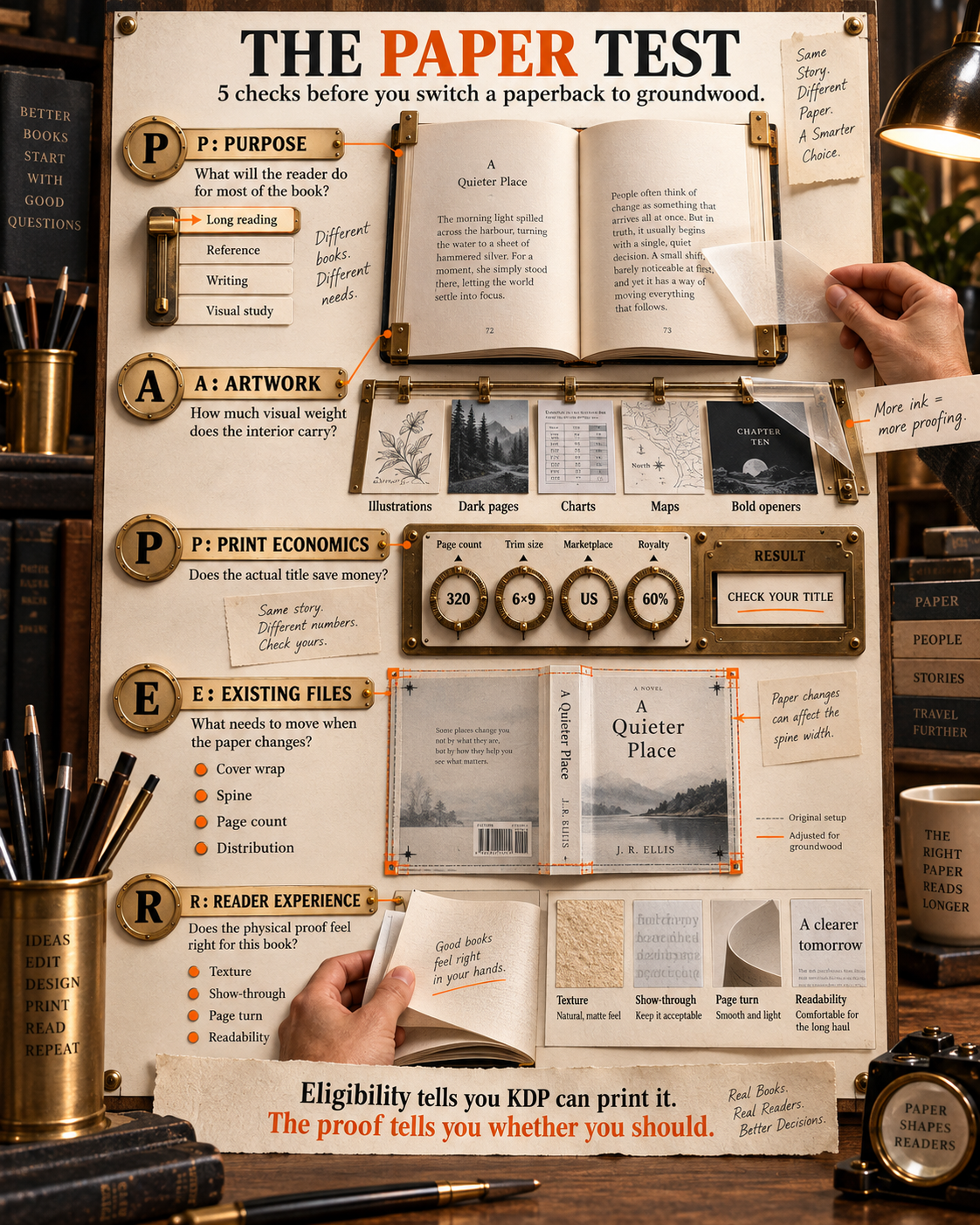
Use the PAPER Test Before You Switch
A quick framework can prevent a cheap paper decision from turning into a production problem.
P: Purpose
What does the reader spend most of the book doing?
If the answer is uninterrupted reading, groundwood has a stronger case.
A: Artwork
Check illustrations, dark backgrounds, maps, charts, bold chapter openers, and any page with dense ink.
The more visual weight the interior carries, the more important the proof becomes.
P: Print Economics
Compare the actual print cost and royalty result for your title, not a generic example.
E: Existing Files
Check the cover wrap, spine, page count, trim size, and Expanded Distribution requirements before changing anything.
R: Reader Experience
Hold the proof.
Read several pages under normal light. Flip through it. Check show-through, headings, illustrations, page turning, and the overall physical impression.
That last step is difficult to replace with a specification table.
How to Switch an Existing Paperback Safely
KDP allows published black-and-white paperbacks to switch between white, cream, and groundwood paper.
Use this process rather than converting the whole catalog in one move.
- Confirm eligibility. Check that the book has a black-and-white interior and review any Expanded Distribution requirements.
- Keep your current files. Save the existing interior, full-wrap cover, and editable source files before changing the title setup.
- Check the cover dimensions. Use KDP's current cover specifications or cover calculator with the final page count and groundwood setting.
- Change the paper type. In Bookshelf, open Edit Paperback Content, then update the Ink & Paper selection to groundwood.
- Review Print Previewer carefully. Inspect spine placement, barcode area, front and back cover alignment, margins, and interior pages.
- Order a proof before deciding. Compare it with the existing edition in ordinary reading conditions.
KDP also notes that a newly ordered retail copy can sometimes come from previously printed inventory after an update, so do not assume one immediate customer copy proves that the conversion failed.
What Most Authors Can Get Wrong About Groundwood
“It Is Cheaper, So I Should Switch Everything”
Cost is only one production variable.
A lower per-page rate does not make textured paper right for an illustrated interior or a brand whose print presentation depends on bright, crisp pages.
“Amazon Says It Is for Books, So My Cover Can Stay the Same”
Paper changes spine calculations.
Do this: verify the final cover against the selected paper.
Not that: reuse an old wrap without running it through the updated preview.
“Groundwood Is Just Cheaper Cream Paper”
It is not merely another shade.
The stock has a different weight, texture, thickness, appearance, print behavior, and page-count profile.
“One Proof Tells Me What Every Copy Will Look Like”
Print-on-demand books can show normal manufacturing variation.
Judge whether the design tolerates that variation rather than expecting every physical copy to match at a microscopic level.
An Illustrative Decision
Picture a text-heavy paperback novel currently printed on cream.
It has ordinary body type, restrained chapter headings, no photographs, no heavy black backgrounds, and the author wants a slightly lighter physical book.
That title is a sensible groundwood candidate.
Now picture a black-and-white instructional book with screenshots, shaded tables, thick graphic elements, and several dark pages.
Both interiors technically use black ink.
Only one behaves like the kind of book Amazon is describing when it recommends groundwood for text-heavy reading.
That distinction is more useful than choosing paper by genre name alone.
When Does Professional File Review Make Sense?
You probably do not need professional help merely to select a radio button in KDP.
Support becomes more useful when the change affects several connected production decisions: an older cover file, uncertain spine dimensions, multiple editions, complex interior pages, Expanded Distribution, or a paperback that has already produced preview warnings.
Professional KDP publishing support from Amazon KDP Experts includes paperback print options, interior and cover uploads, trim size, bleed, margins, pricing, and Print Previewer checks while keeping final approval with the author.
If the interior itself needs work before the paper decision, start with professional paperback formatting support rather than trying to solve a layout problem through paper selection.
Final Thoughts: Switch the Book, Not the Whole Catalog
KDP groundwood paper is a useful addition to the paperback options in 2026.
It gives text-heavy authors another physical reading experience, a lower print-cost option, and a lower-carbon paper choice. But none of those benefits means every black-and-white book belongs on it.
The strongest candidates are books where uninterrupted reading matters more than dense visual reproduction.
Before switching, check the interior, cover, page count, distribution settings, and final cost. Then order a proof and make the decision with the book in your hands.
If the proof looks like the book you meant to publish, the switch makes sense. If it does not, the old paper was probably doing more work than you realised.
Check the Paperback Before You Change the Paper
If your manuscript is ready but switching paper changes the spine, cover fit, interior presentation, or KDP setup, review those files before resubmitting the book.
Amazon KDP Experts' publishing support can help review the paperback setup while the author keeps control of the KDP account, files, pricing, and final submission decision.