Somewhere in your podcast archive, there's probably a conversation you still think about.
Maybe a guest explained something better than you ever could. Maybe you told a personal story that listeners kept mentioning afterward. Or perhaps you've spent years answering the same questions, refining your ideas one episode at a time.
All that material feels like the beginning of a book.
Then you open the transcripts.
Every conversation starts with an introduction. Ideas repeat across episodes. Guests interrupt each other. Sentences trail off. Stories depend on context the reader doesn't have.
You've got plenty of words, but not necessarily a manuscript.
Learning how to turn a podcast into a book means deciding what belongs in the book, why readers need it, and how to rebuild spoken material into chapters that work without a microphone.
At Amazon KDP Experts, developing a manuscript from existing material starts with understanding the intended reader and the work the source material can realistically support. A podcast can provide valuable ideas, examples, and a recognizable voice. It cannot automatically provide the structure of a finished book.
The goal isn't to reproduce your episodes.
It's to give your strongest ideas a second life in a form worth reading.
Key Takeaways
- Start with the reader, not the episode list. Choose one clear book promise before deciding which recordings belong.
- Treat transcripts as research material. Extract useful ideas, stories, and evidence instead of lightly editing conversations.
- Track sources and permissions. Guest quotations, co-created material, and third-party content need careful review before publication.
- Write for the page. A successful podcast-based book should offer something useful even to someone who has heard every episode.
Can You Really Turn a Podcast Into a Book?
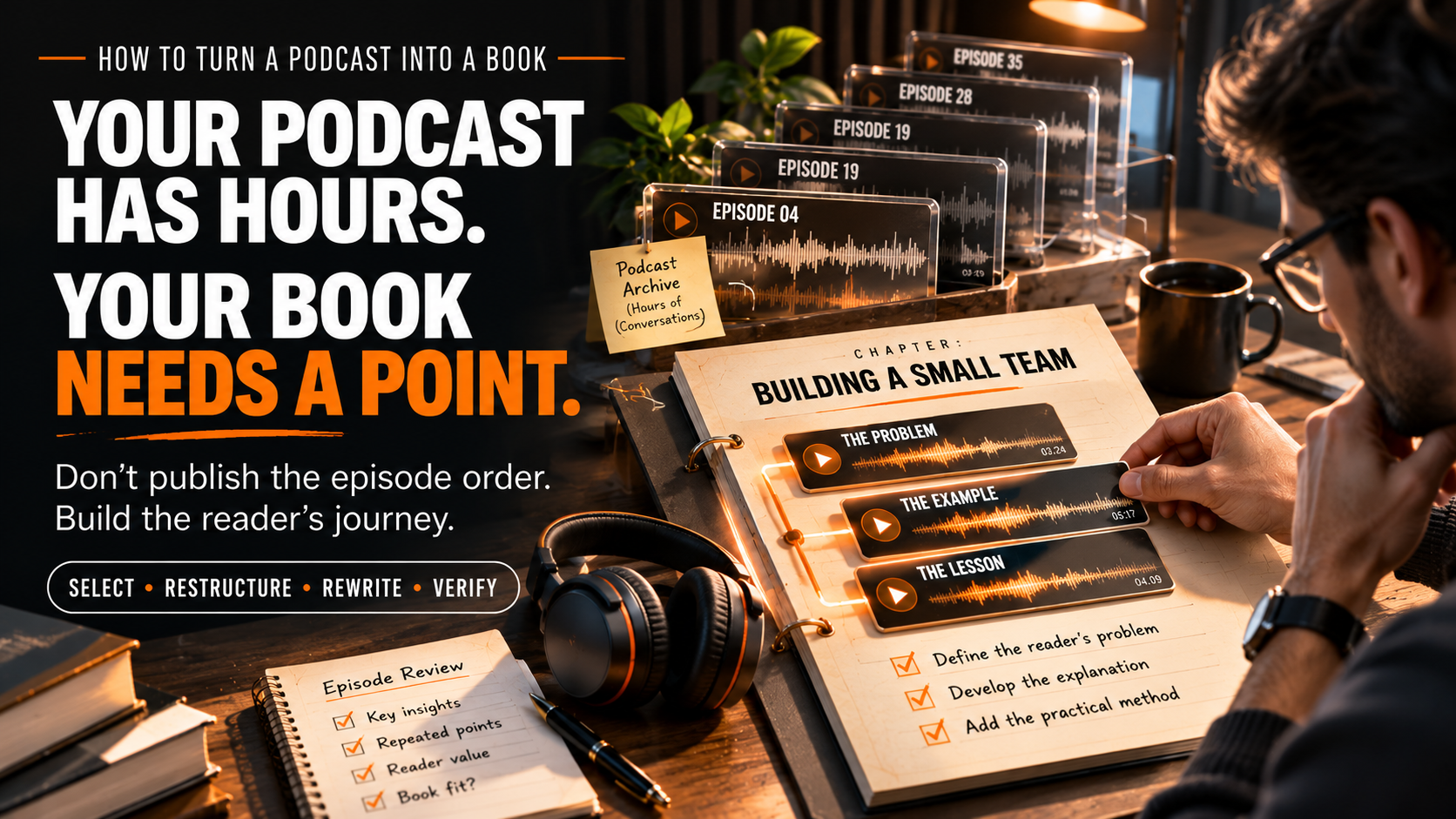
Yes. You can turn a podcast into a book by selecting a focused subject, reviewing relevant episodes, extracting useful ideas, and developing them into a structured manuscript. The strongest results usually come from reorganizing and rewriting the material rather than publishing transcripts in recording order.
Podcast episodes are created to be heard over time. A book needs to guide readers through a deliberately arranged experience.
That difference is important because podcast audiences are substantial, but a familiar audience doesn't automatically create demand for a book.
According to Edison Research's The Infinite Dial 2026, 58% of Americans aged 12 and older had listened to or watched a podcast in the previous month.
That figure describes podcast consumption in the United States, not the number of people likely to purchase podcast-based books.
Still, it provides useful context. Creators have built archives of conversations, interviews, and specialist knowledge that can support other forms of publishing.
The real question is whether those archives contain enough focused material for a reader-first book.
What Kind of Book Can You Create From a Podcast?
Before outlining chapters, decide what reading experience you're trying to create.
A podcast isn't automatically suited to one type of book.
| Book Format | Best Source Material | What the Author Must Add |
|---|---|---|
| Practical nonfiction guide | Educational episodes, tutorials, expert discussions | Clear progression, exercises, updated evidence |
| Expert interview collection | Conversations with specialists or recognizable guests | Editorial themes, context, attribution, permissions |
| Business or leadership book | Founder interviews, professional experience, recurring frameworks | Original argument, case examples, practical application |
| Memoir or personal journey | Solo reflections, personal storytelling, life interviews | Narrative arc, chronology, emotional continuity |
| Thematic essay collection | Cultural commentary, analysis, opinion-led episodes | Distinct arguments, transitions, editorial cohesion |
A leadership podcast, for example, might contain enough material for a practical management guide.
But that doesn't mean every leadership interview deserves a separate chapter.
A reader may benefit more from chapters organized around difficult conversations, decision-making, hiring, and team accountability than from a chronological collection of guest interviews.
If you're developing a broader nonfiction manuscript, our guide on how to write a nonfiction book covers the wider writing process. Here, the focus is specifically on transforming existing audio material.
How to Turn a Podcast Into a Book in Six Steps
The following workflow helps you preserve the value of your original recordings while creating something that works independently as a book.
Step 1: Find the Book's Central Promise Before Choosing Episodes
The first question isn't, Which episodes should I include?
It's, What will readers understand or be able to do after finishing this book?
That answer determines what belongs.
Identify the Reader Who Needs the Book
A successful podcast might attract people with several different interests.
Your book needs a more specific reason to exist.
Imagine hosting a podcast about entrepreneurship. You've interviewed founders about hiring, branding, productivity, finance, marketing, and leadership.
You could attempt to combine every topic into one large business book.
But a tighter concept might be:
A practical guide for first-time founders making their earliest hiring decisions.
Now the editorial choices become easier.
Episodes about recruitment, interviewing, onboarding, delegation, and management are relevant.
A fascinating conversation about international expansion may not be.
Use the One-Sentence Book Test
Complete this statement:
This book helps [specific reader] understand or accomplish [specific result] through [the book's distinctive approach].
For example:
This book helps first-time managers handle difficult team conversations using practical lessons drawn from experienced leaders.
If you can't complete that sentence clearly, the project may still need a stronger direction.
Don't begin drafting chapters until you know what the book is supposed to accomplish.
Step 2: Audit Your Podcast Archive and Select the Strongest Material
Your entire back catalog doesn't need to become your book.
In fact, including everything is often the reason podcast adaptations feel repetitive.
Start with an episode inventory.
Record each episode's title, subject, main takeaway, notable examples, guests, and any related supporting material.
Then evaluate it against the book's central promise.
The Episode Selection Test
Ask these questions about every candidate episode:
- Does it address a problem the intended reader actually has?
- Does it introduce a meaningful idea, story, example, or method?
- Is the information still accurate and relevant?
- Does it contribute something not already covered by another episode?
- Can you use the material without unresolved ownership or permission problems?
An episode can be excellent audio content and still be unnecessary in the book.
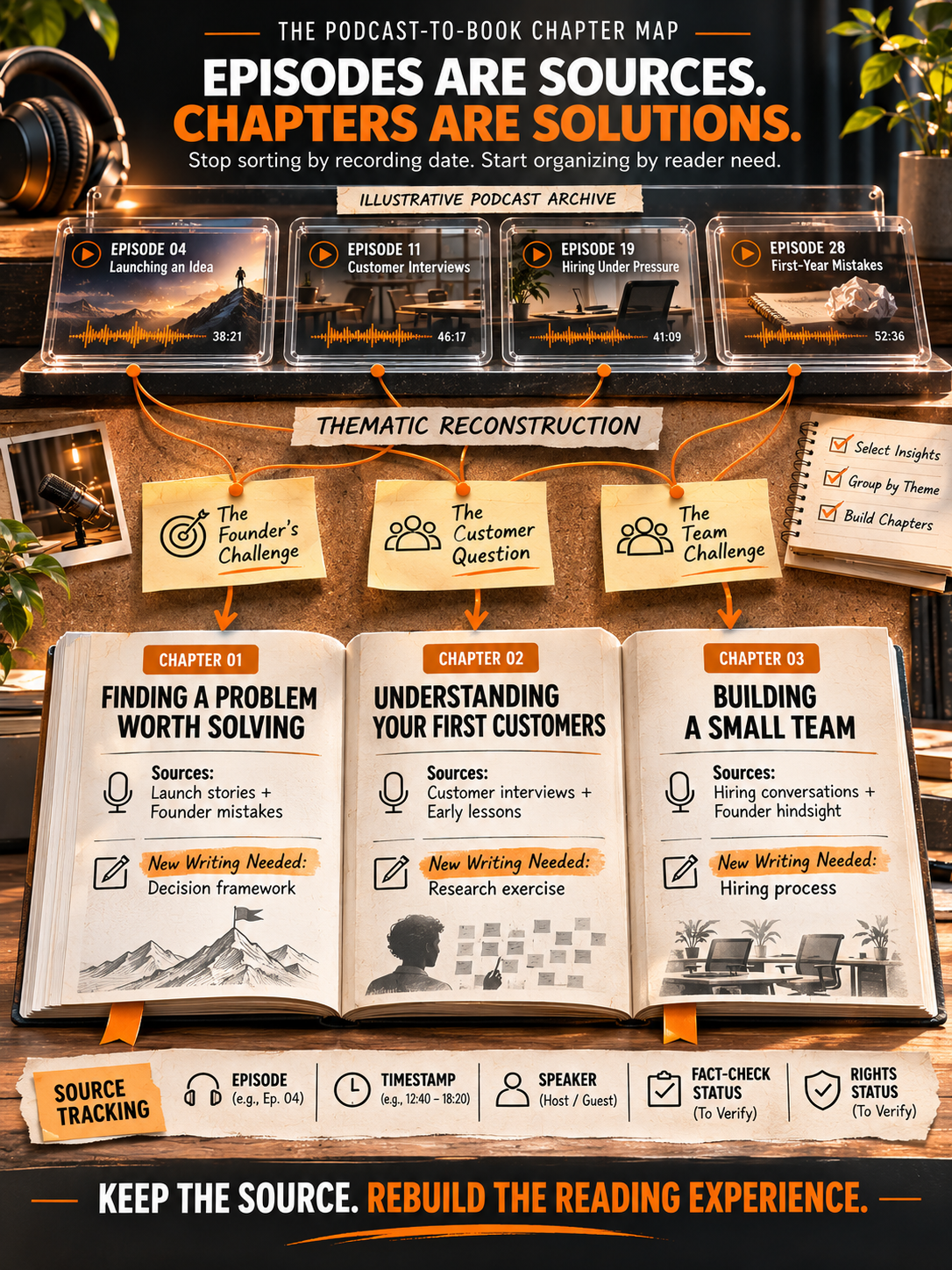
Group by Reader Problems, Not Recording Dates
Suppose your podcast explores creative entrepreneurship.
You could organize the material like this:
| Podcast Material | Possible Book Chapter | Missing Development |
|---|---|---|
| Interviews about starting a business | Finding a Problem Worth Solving | A decision framework for readers |
| Episodes discussing customer research | Understanding Your First Customers | A practical research exercise |
| Founder stories about pricing | Setting Prices With Confidence | Comparisons and current examples |
| Conversations about hiring | Building a Small Team | A step-by-step hiring process |
| Episodes about early mistakes | Knowing When to Change Direction | A diagnostic checklist |
This is an illustrative outline, not a real podcast case study.
Notice that the chapters aren't titled after guests or episode numbers.
They are organized around the reader's learning journey.
That's what gives the book a coherent direction.
Pro Tip: Create a separate document for excellent material that doesn't fit. You can use those stories in future podcast episodes, articles, or another book without weakening the current manuscript.
Step 3: Transcribe the Relevant Episodes and Build an Evidence Ledger
Once you know which episodes matter, gather their transcripts.
Automated transcription can speed up this stage, but it isn't a substitute for checking important passages against the audio.
Names, technical terms, numbers, dates, and interrupted sentences are particularly easy to misunderstand.
Clean Transcripts Without Erasing Their Meaning
Correct transcription errors and remove material that has no editorial value, such as technical interruptions or repeated production announcements.
However, don't silently change a guest's meaning to make their statement cleaner.
When a speaker's words are ambiguous, return to the original recording.
Keep the audio timestamp attached to passages you may use in the book.
Use an Episode Evidence Ledger
A useful way to manage a podcast-based manuscript is to maintain one record showing where each important idea came from.
| Source | Useful Material | Intended Chapter | Editorial Action |
|---|---|---|---|
| Episode A, 12:40 | Host explains a hiring mistake | Hiring With Better Judgment | Rewrite as a narrative example |
| Episode B, 28:15 | Guest discusses interview questions | Interviewing Candidates | Verify permission before quotation |
| Episode C, 09:30 | Host describes onboarding problems | The First Month | Develop into a checklist |
| Episode D, 34:10 | Older claim about hiring practices | Avoiding Costly Assumptions | Recheck accuracy before use |
Illustrative entries showing how to organize source material.
A working ledger should also contain the speaker's name, exact timestamp, supporting documents, fact-check status, and permission status when relevant.
This gives the writer a way to check the manuscript against its source.
It also helps prevent an argument from being attributed to the wrong person or a memorable anecdote from losing an essential detail.
Where Can AI Help?
AI-assisted tools can help identify repeated themes, organize transcript excerpts, summarize source material, and flag possible gaps.
For example, you might ask a tool to:
Group these transcript excerpts by reader problem. Preserve episode references and timestamps. Identify repeated ideas and unsupported claims. Do not create quotations or add information absent from the source.
Always review the output yourself.
AI tools can misidentify speakers, merge conflicting statements, and introduce details that weren't in the recording.
Before uploading guest interviews or unpublished recordings, check the relevant permissions, confidentiality agreements, and tool data-handling terms.
Pro Tip: Keep an untouched source transcript separate from any cleaned or AI-assisted working version. You should always be able to return to what was actually said.
Step 4: Rewrite the Material as Chapters, Not Edited Conversations
This is the stage where the book becomes a new reading experience.
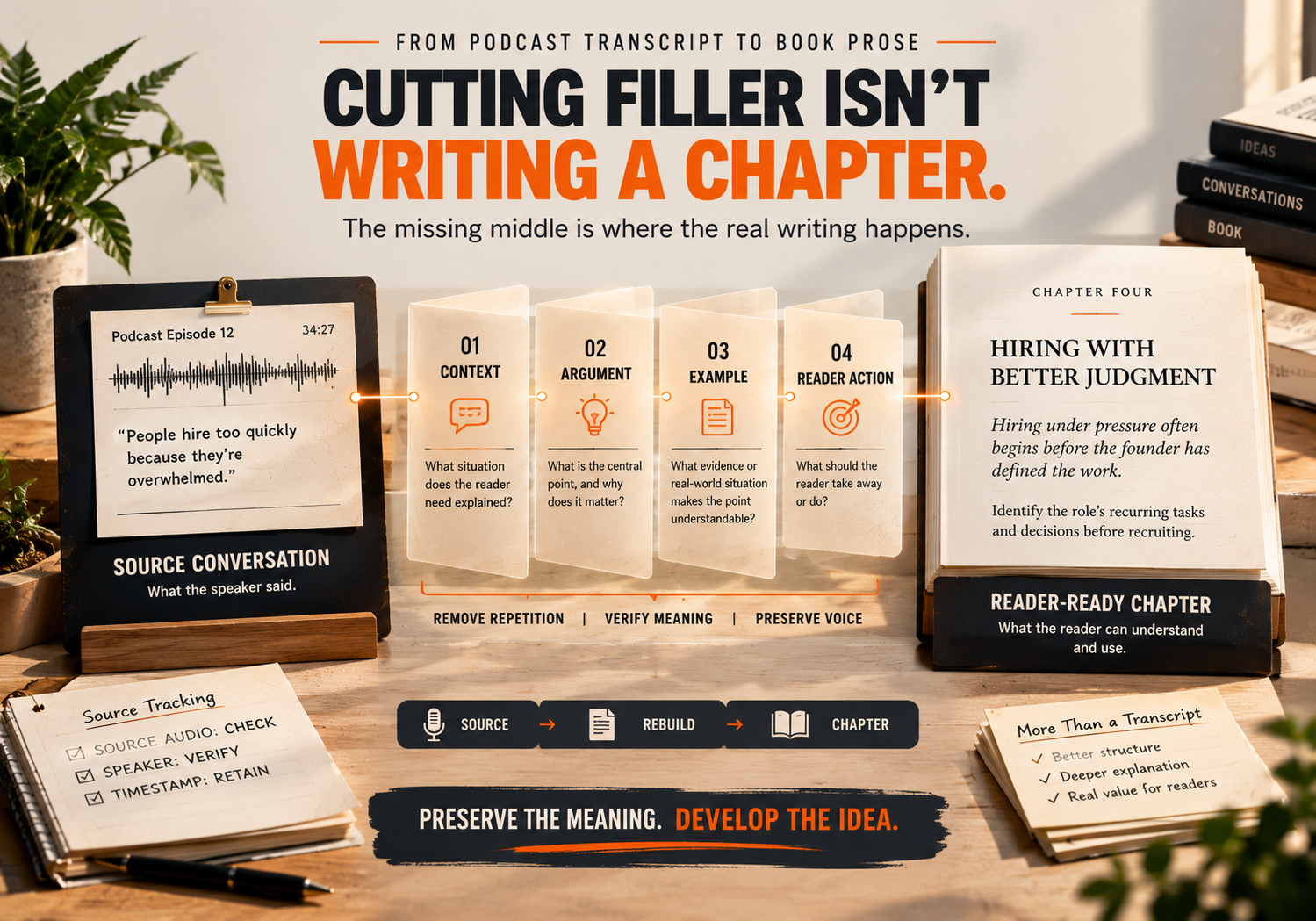
Removing filler words doesn't turn an interview into a chapter.
The writer still needs to identify the argument, establish context, explain the evidence, connect examples, and give the reader a reason to continue.
See the Difference Between Spoken Material and Book Prose
Imagine a podcast host saying:
"I think the biggest thing with hiring, and we've talked about this before, is that people want to hire really quickly because they're overwhelmed. But then they end up spending more time fixing problems because they didn't think about what the person actually needed to do."
That is a fictional example created to illustrate the editing process.
A book-ready adaptation might read:
Hiring under pressure creates a predictable problem: the founder begins searching for relief before defining the work. The new employee arrives, but the responsibilities remain unclear. Instead of reducing the founder's workload, the hire introduces another layer of supervision. A better approach starts by identifying the recurring tasks, required skills, and decisions the role must own.
The second version doesn't simply remove words.
It develops the original insight into a clearer argument with a practical implication.
Build Chapters Around Reader Progression
A strong practical chapter often contains:
- A specific problem or question.
- An explanation of why the problem occurs.
- Relevant evidence, examples, or experiences.
- An actionable method or framework.
- A takeaway that connects to the next chapter.
Not every chapter needs exactly the same arrangement.
However, the reader should understand why each section belongs.
Preserve the Podcast Host's Voice
The goal isn't to make every sentence sound formal.
A host's humor, directness, personal stories, and unusual explanations may be part of the reason people enjoy the show.
Preserve those strengths while removing repetition, incomplete ideas, and references that only make sense when heard.
You may want to create a short voice guide recording preferred vocabulary, sentence rhythm, humor, and examples before drafting the full manuscript.
If the book needs substantial new writing, professional ghostwriting support can help develop a structured manuscript from interviews, recordings, and existing ideas, with the author's direction and review.
A Real Example: Tim Ferriss and Tools of Titans
Author and podcast host Tim Ferriss offers a useful example of adapting recorded conversations into a different reading format.
His book Tools of Titans drew extensively from interviews associated with The Tim Ferriss Show. Rather than simply presenting a chronological sequence of complete podcast transcripts, the book organized useful material into shorter profiles, lessons, and reference-style content.
Discussing his later book Tribe of Mentors, Ferriss wrote:
"I did keep the 'snackable' short-profile format that worked so well in the last book."
Ferriss made that observation in his 2017 explanation of Tribe of Mentors and its relationship to Tools of Titans.
The takeaway isn't that every podcast should become a collection of profiles.
It's that the final book's structure should serve the reading experience, even when most of the source material began as audio.
Step 5: Resolve Guest Permissions, Accuracy, and Editorial Problems
An interview podcast introduces questions that a solo show may not.
You may own the recording or have permission to publish an episode without necessarily having all the rights needed for every possible future use.
Review Guest and Contributor Agreements
Before including identifiable guest material, examine the original agreement and the proposed use in your book.
Direct Quotations and Interview Excerpts
Check whether your agreement covers quotations or adaptations in commercial books, including print, ebook, audiobook, and promotional extracts where relevant.
If the original permission doesn't clearly cover your intended use, obtain appropriate written permission or seek legal advice.
Not every short quotation automatically requires a license under U.S. law; fair use can apply in some circumstances. But fair use is context-dependent, and attribution alone isn't a substitute for required permission.
Co-Hosts, Producers, and Third-Party Material
Review rights relating to co-created scripts, commissioned research, guest contributions, copyrighted readings, photographs, and other third-party material.
Music or sponsored content that appeared in an episode should not automatically be carried into the book.
An interview with someone doesn't give you unrestricted rights to reproduce every creative work they mention or provide.
Fact-Check the Manuscript, Not Just the Transcript
Your book may be published long after some episodes were recorded.
Review dated claims, professional advice, quotations, research findings, company names, and references to products or platforms.
If an expert's position has changed, explain the timeline rather than presenting an old statement as current.
A professional or business book can lose credibility quickly when its examples are outdated or its statements are attributed incorrectly.
Use the Right Editorial Review
A developmental editor can assess whether the chapters form a coherent book, whether ideas repeat, and whether the content is sufficiently developed.
A copyeditor handles sentence-level consistency, clarity, grammar, and style after the larger structural decisions have been made.
These aren't interchangeable tasks.
If you're unsure whether your transcripts require a writer or your draft requires editorial work, our guide to ghostwriter vs. editor explains how to make that decision before paying for the wrong service.
Pro Tip: Don't wait until the manuscript is finished to investigate guest permissions. If a major chapter depends on material you cannot use, discovering that problem late can require substantial rewriting.
Step 6: Prepare the Book for Publication and Give It a Life Beyond the Podcast
Once the manuscript is approved, the project moves into book production.
The next decisions include the title, cover direction, interior formatting, publishing formats, metadata, and distribution plan.
Choose a Title for Readers Who Have Never Heard Your Show
Using your podcast's name as the book title may seem natural, especially if the show has an established audience.
But the book also needs to communicate its value to people unfamiliar with the podcast.
A podcast named The Founder Sessions, for example, might produce a book titled:
The First-Time Founder's Hiring Playbook: Practical Lessons From Real Business Decisions
This is an invented title illustrating the difference between a show identity and a reader-focused book proposition.
Your final title should reflect the actual manuscript, not simply promise a benefit because it sounds marketable.
Prepare the Right Publishing Files
An ebook and a printed paperback require different file preparation.
The book may need an EPUB or other KDP-supported ebook file, a properly designed paperback interior, a separate cover, and accurate publication details.
If the project supports a business, speaking, coaching, or consulting objective, business book publishing services may help connect manuscript development with appropriate production and launch planning.
Avoid making the book an extended sales brochure.
Its first responsibility is to provide an independent reading experience.
Understand AI Disclosure When Publishing Through KDP
Amazon KDP distinguishes AI-assisted content from AI-generated content.
Using an AI tool to improve your own writing, identify errors, or brainstorm an outline is generally treated differently from using AI to generate the actual manuscript text.
KDP requires disclosure of AI-generated content when applicable, even if that content has subsequently been substantially edited.
Authors should review the current KDP content guidelines when submitting their book and remain responsible for accuracy, originality, and rights compliance.
Let the Podcast and Book Support Each Other
A book doesn't need to replace the podcast.
They can serve different purposes.
The podcast gives readers access to ongoing conversations, voices, and discoveries.
The book provides a focused resource they can return to without searching across an episode archive.
Useful launch activities might include:
- Recording an episode explaining why the book needed to exist.
- Discussing one important chapter with a relevant guest.
- Creating an episode around questions raised by early readers.
- Sharing a carefully selected book excerpt with permission where required.
- Inviting guests featured in the book to participate voluntarily in promotion.
Be clear about any promotional arrangements and don't assume that appearing in the book obligates a guest to market it.
How Long Does It Take to Turn a Podcast Into a Book?
There is no reliable universal timeline.
The work depends on how much usable source material exists and how much original writing remains.
A solo educational show with organized notes and a focused subject may be easier to adapt than a long-running interview podcast involving many speakers, incomplete transcripts, changing information, and outstanding permissions.
Think about the workload by production stage rather than treating the process as one large writing assignment.
| Stage | What Determines the Workload |
|---|---|
| Book concept | Clarity of audience, subject and scope |
| Transcript preparation | Audio quality, transcription accuracy, archive organization |
| Outlining | Repetition, gaps, number of themes |
| Drafting | Amount of new prose and research required |
| Guest permissions | Agreements already in place and requested uses |
| Editing | Structural quality, accuracy, revision depth |
| Production | Formats, interior complexity, cover and proof review |
An experienced host may already have most of the ideas needed for the book.
That doesn't mean the chapters have already been written.
If you're commissioning help, request separate milestones for source review, outline approval, sample chapter, complete draft, editing, and final production.
That provides a clearer picture of the work than an unsupported promise to produce a book in a few weeks.
Common Mistakes When Turning Podcast Episodes Into a Book
Mistake 1: Treating Every Episode as a Chapter
An episode sequence follows a publishing schedule.
A book's chapter sequence should follow a reader's needs.
Do this: Organize material around a central argument and the order in which ideas build.
Not that: Import episode transcripts and rename them Chapter One, Chapter Two, and Chapter Three.
Mistake 2: Using Every Good Story
A memorable story may be worth keeping, but several stories making the same point can slow the book.
Choose the strongest example and use the others only when they add a different perspective.
Mistake 3: Mistaking Clean Transcripts for Finished Writing
Removing filler words is transcription cleanup.
Developing an argument, explaining a concept, and building meaningful transitions is manuscript writing.
Don't confuse these stages when budgeting or hiring.
Mistake 4: Assuming Guest Credit Resolves Every Rights Issue
Naming a guest doesn't automatically give you permission for all uses of their material.
Review the specific content, existing agreements, and legal requirements.
Mistake 5: Allowing AI to Invent Missing Context
Automated tools can make material appear polished while introducing unsupported details.
Check names, examples, statements, sources, and speaker attribution against the original recordings.
Mistake 6: Publishing a Book That Offers Nothing New
If readers can receive the same experience by downloading your transcripts, the book may have little reason to exist.
Add structure, context, synthesis, updated information, and practical value that the recordings don't provide in one place.
Should You Write the Book Yourself or Hire a Ghostwriter?
That depends on the condition of your material and how much writing you want to do.
Writing it yourself may be a good choice if you enjoy the process, have a focused outline, and can dedicate time to creating new prose.
A ghostwriter may be appropriate if the material is extensive, you need help organizing your thinking, or your professional commitments make long-form writing difficult.
An editor may be the better investment if you already have complete chapters that need structural or language improvements.
Before commissioning work, clarify ownership, confidentiality, guest permissions, AI use, editorial responsibilities, revision limits, and the source files you will receive.
The right professional should strengthen the book's connection to your ideas—not replace them with generic content.
Final Thoughts: Your Podcast Is the Source, Not the Finished Book
The strongest podcast-based books don't ask readers to relive every episode.
They find the connections between conversations that were recorded weeks, months, or years apart. They organize those ideas around a specific reader. They preserve the host's perspective while adding the structure, explanation, and editorial judgment that a finished book requires.
That's the real skill behind how to turn a podcast into a book.
Choose the subject carefully. Keep a record of where material came from. Resolve rights questions before they become production problems. And write chapters that can stand on their own.
A podcast can capture your thinking as it develops.
A book gives that thinking a deliberate shape.
Make the second format worth experiencing, even for people who already love the first.