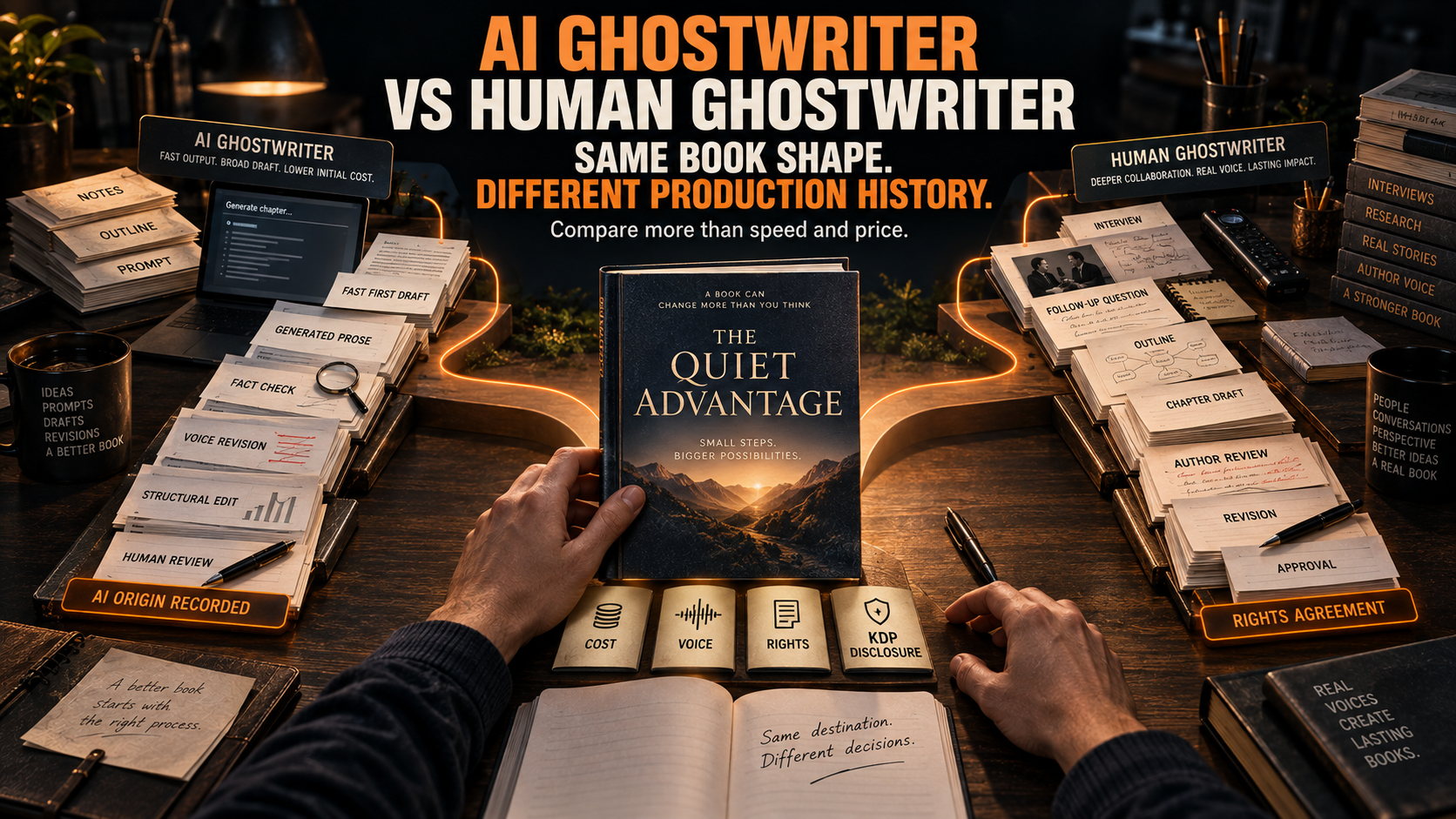
The first draft appears on your screen before you have even had time to make coffee.
It has chapters. Headings. Transitions. The sentences are readable.
That can make the AI ghostwriter vs human ghostwriter decision look simple: why spend more money and wait longer if software can already produce a book-shaped draft?
Then the harder questions arrive.
Does it actually sound like you? Who checks the facts? What happens to the private material you upload? Who owns what comes out? And if AI wrote the prose but a person heavily rewrites it later, what are you supposed to tell Amazon KDP?
Those questions matter more than drafting speed.
Amazon KDP Experts approaches professional ghostwriting as a collaborative process involving discovery, voice development, author material, outlining, chapter review, and milestone feedback. Its current ghostwriting workflow confirms the author's voice early rather than waiting until the full manuscript is complete.
An AI ghostwriter is usually better at producing a fast, inexpensive starting draft. A human ghostwriter is usually better suited to projects that depend on interviews, personal voice, judgment, sensitive material, research, and sustained collaboration. Rights and KDP disclosure depend on how the manuscript was actually created, not simply which option was cheaper.
Key Takeaways
- Compare the finished publishing risk, not only the drafting price.
- AI can reproduce stylistic patterns, but voice also depends on lived context, judgment, and what an author chooses not to say.
- Tool usage rights and U.S. copyright protection are different questions.
- KDP requires disclosure when AI creates actual manuscript text, even if a human later edits it heavily.
What Is the Real Difference Between an AI Ghostwriter and a Human Ghostwriter?
An AI ghostwriter generates manuscript text from instructions, source material, prompts, outlines, or other inputs.
A human ghostwriter develops the manuscript through human authorship. That work may include interviews, research, follow-up questions, outlining, drafting, fact queries, voice calibration, and revisions with the named author.
Both routes can produce paragraphs that read smoothly.
The difference becomes clearer when the book stops being predictable.
A human writer can hear hesitation during an interview and ask why. They can notice that two stories contradict each other. They can ask whether a painful memory should appear at all. They can challenge an argument or recognize that a seemingly minor anecdote is actually the emotional center of a chapter.
AI works from the material and instructions available to it.
That can be very useful.
It is not the same working relationship.
AI Ghostwriter vs Human Ghostwriter: Where Does Cost Really Differ?
AI almost always changes the economics of the drafting stage because software can generate large amounts of text without billing for months of human writing time.
That does not make the software's subscription price the true cost of a publishable book.
A serious comparison should include:
- source preparation
- research
- fact checking
- voice revision
- structural editing
- generated-text review
- plagiarism or similarity concerns
- professional editing
- formatting
- legal review where appropriate
- author time spent fixing the draft
Human ghostwriting starts at a very different cost level because a person is selling professional time, interviews, research, writing skill, judgment, and revision.
For one current benchmark, the Editorial Freelancers Association's 2026 Rate Chart reports $0.33 to $0.50 per word for full-length nonfiction ghostwriting. The EFA describes its figures as reference data rather than prescribed fees.
That is the only external statistic used in this article.
Compare Total Work, Not the Checkout Price
| Question | AI Ghostwriter | Human Ghostwriter |
|---|---|---|
| Initial drafting cost | Usually lower | Usually higher |
| First-draft speed | Usually much faster | Depends on interviews, research, scope and schedule |
| Author time afterward | Can be substantial | Depends on collaboration and draft quality |
| Interviews | Depends on the tool and workflow | Usually part of serious nonfiction or memoir work |
| Fact checking | Author must verify output | Must still be defined in scope |
| Editing | Often still needed | Often still needed |
| Voice development | Based on supplied material and instructions | Built through listening, questions and feedback |
| Confidentiality | Depends on tool terms and settings | Depends on contract and file practices |
Cheap drafting can still become expensive editing.
Expensive drafting can still be poor drafting.
The useful question is: what work remains before you can safely put your name on the manuscript?
Which Option Is Better at Capturing Your Voice?
Voice is more than vocabulary.
It includes what you notice, how you build an argument, when you make a joke, what you consider private, how directly you state emotion, which stories you tell, and which claims you are willing to make.
The Authors Guild puts the value of human authorship plainly:
“As a writer, it is your original voice, thinking, and creativity that make you the writer that you are.”
Its updated 2026 AI Best Practices for Authors advises writers to protect human voice and understand how generative systems are being used in their work.
Where AI Can Help With Voice
AI can analyze material you provide and imitate visible patterns such as:
- sentence length
- level of formality
- vocabulary
- recurring phrases
- chapter structure
- explanatory style
It can also generate several versions quickly, which can help an author discover what does not sound right.
Where a Human Has an Advantage
Human ghostwriting can develop voice through conversation.
The writer can ask:
- “Would you actually say that?”
- “Why did you leave that detail out?”
- “Is that what you believed then, or what you believe now?”
- “Does this story belong in the book?”
Those questions do more than adjust tone.
They develop the material itself.
Amazon KDP Experts' professional ghostwriting process uses Chapter One approval and milestone review specifically so tone, phrasing, perspective, examples, accuracy, and pacing can be corrected before the entire manuscript develops in the wrong direction.
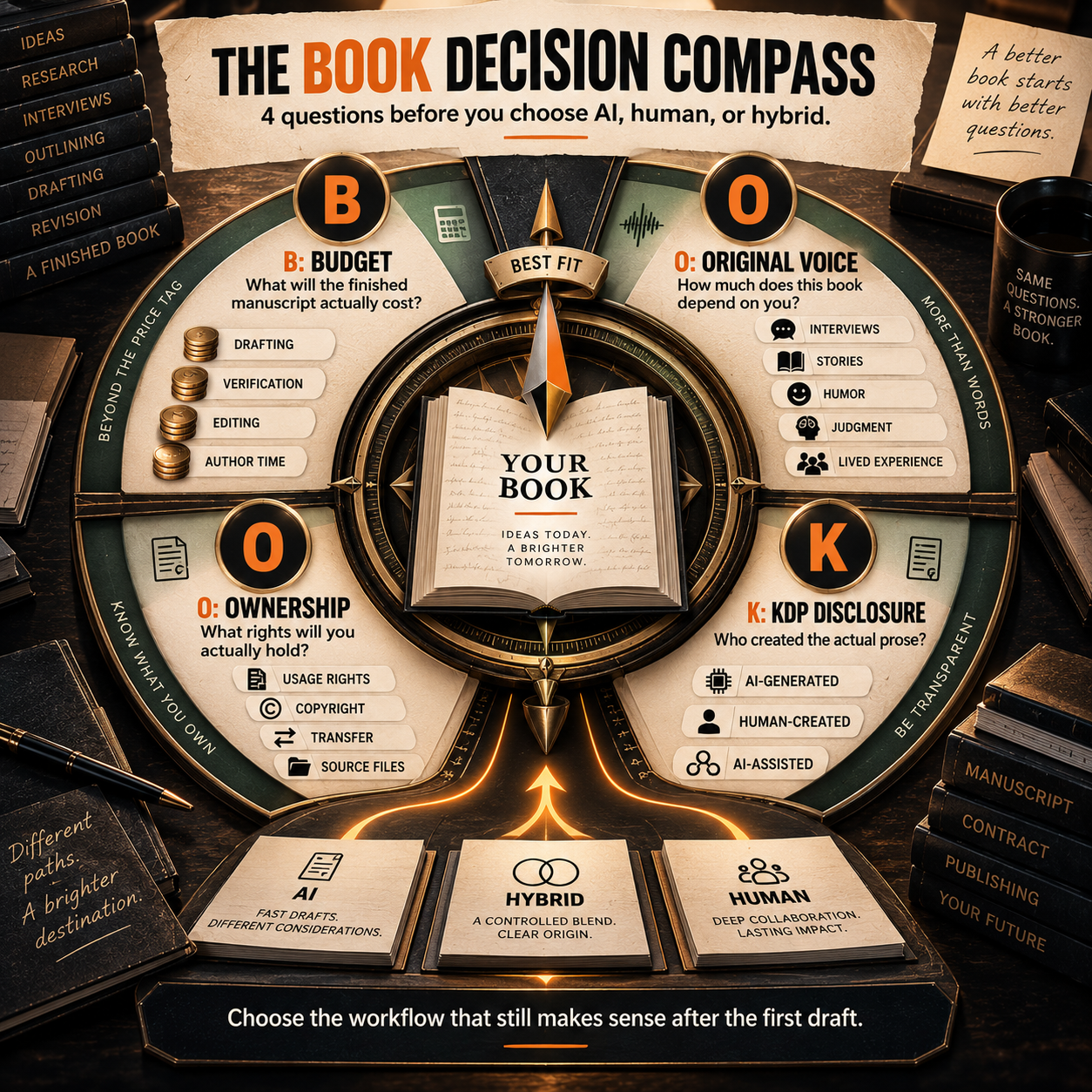
Use the BOOK Test Before Choosing
B: Budget for the Finished Manuscript
Do not compare a software fee with a human project quote as though the deliverables were identical.
Ask what remains after the first draft.
O: Original Voice
Decide how important interviews, personal stories, humor, emotional restraint, professional judgment, and lived experience are to the book.
O: Ownership and Rights
Check both contractual usage rights and copyright protection.
They are not the same.
K: KDP Disclosure
Record how the manuscript was created so you can answer Amazon's AI-content question accurately when publishing.
This four-part check prevents the fastest or cheapest option from deciding the project before the harder questions have been answered.
What Happens to Your Rights With a Human Ghostwriter?
Human-written does not automatically mean the copyright already belongs to the client.
Under U.S. copyright law, copyright generally begins with the author who creates the protected expression. Rights can then transfer under an agreement, and qualifying work-made-for-hire arrangements follow separate rules.
That means a professional ghostwriting agreement should state:
- who owns drafts
- who owns the finished manuscript
- when rights transfer
- whether payment affects transfer
- whether the ghostwriter receives credit
- whether the writer may reuse excerpts
- what happens if the project ends early
- who controls interviews and source files
- what confidentiality obligations survive completion
Do not assume the invoice answers these questions.
If the project has substantial commercial value, sensitive allegations, complicated rights, or an unusual ownership structure, qualified legal review may be sensible.
Are Rights Simpler With an AI Ghostwriter?
Not necessarily.
There are at least two different rights questions.
What Does the Tool Contract Let You Do?
An AI platform may give customers broad commercial usage rights under its terms.
That is a contractual question.
Read the current terms of the specific tool you use.
What Can Copyright Law Protect?
That is a different question.
The U.S. Copyright Office's AI copyrightability report says copyright protects human-created expression, while purely AI-generated material does not receive copyright protection. Human-authored selection, arrangement, modification, and other qualifying contributions may still be protected.
So a platform telling you that you may commercially use its output does not automatically mean every AI-generated sentence receives U.S. copyright protection.
That distinction matters for books intended to become valuable intellectual property.
What Does Amazon KDP Require You to Disclose?
This is where many AI-versus-human comparisons become misleading.
Under Amazon KDP's current Content Guidelines, KDP requires disclosure of AI-generated text, images, or translations. It does not require disclosure of AI-assisted content.
KDP's definitions are particularly important:
- AI-generated: AI created the actual content.
- AI-assisted: a human created the content and AI helped edit, refine, check, improve, or brainstorm it.
Here is the part authors should not miss:
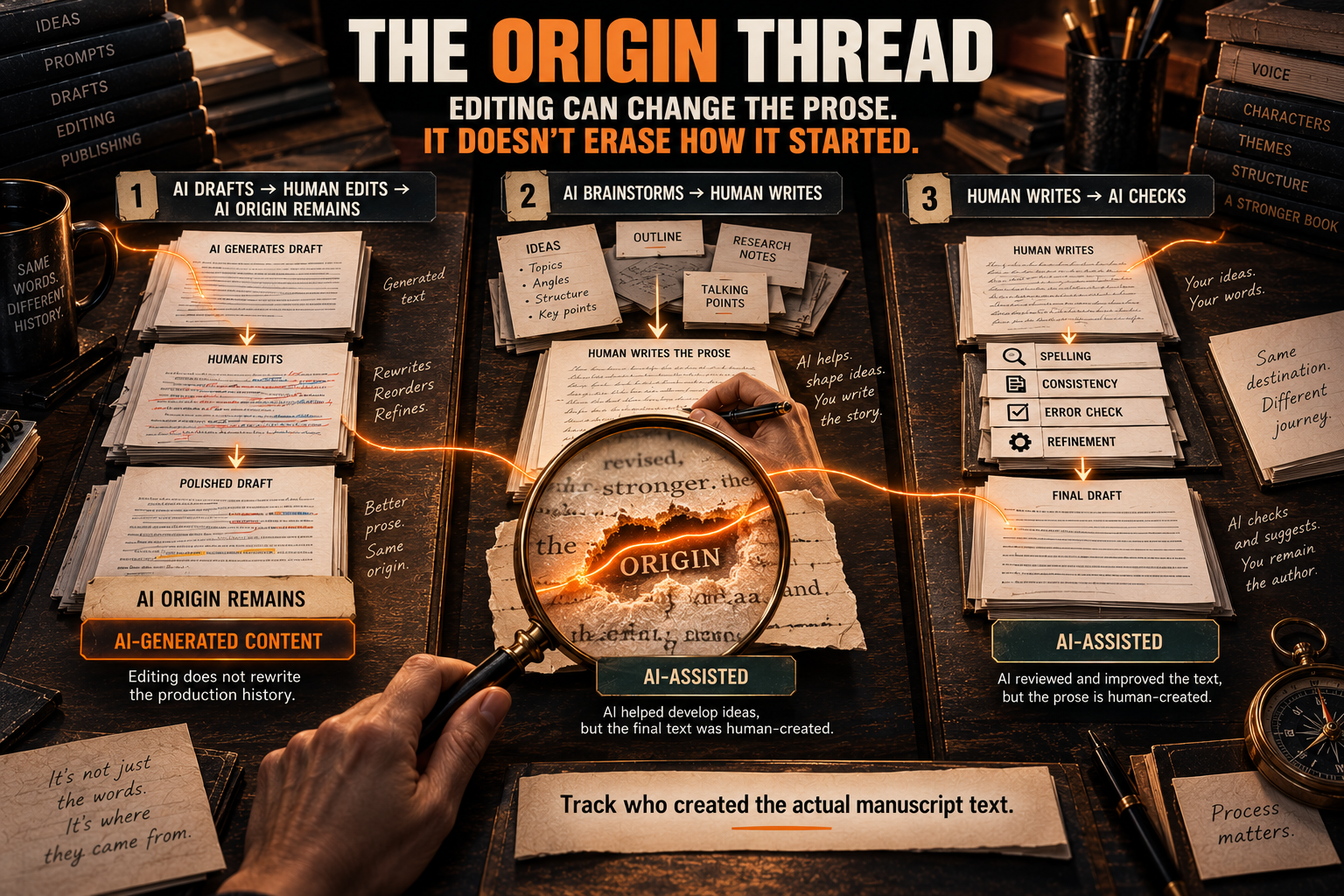
If AI created the actual prose, KDP still treats that content as AI-generated even after substantial human editing.
So this workflow:
AI writes chapter → human “humanizes” chapter → publish
does not automatically turn the chapter into AI-assisted content under KDP's definition.
The origin still matters.
A Safer Hybrid Workflow
Compare that with:
AI helps brainstorm → human ghostwriter interviews author → human writes final prose
KDP explicitly treats AI brainstorming followed by human-created final content as AI-assisted rather than AI-generated.
That difference can affect the disclosure answer.
Why “Humanized AI” Needs Careful Language
Some AI services and marketplaces describe a workflow in which software drafts the manuscript and a freelancer later edits it to sound more human.
That may improve readability.
It may improve voice.
It may correct obvious factual or stylistic problems.
What it does not do is rewrite the production history.
If AI created text that remains in the manuscript, KDP's classification does not disappear because a freelancer polished it afterward.
Authors therefore need a clear record of:
- what the AI created
- what a person created
- what was rewritten
- which AI material remains
- which tools touched the manuscript
- what the final publisher requires them to disclose
“Humanized” is a quality description.
It is not a KDP disclosure category.
What About Manuscript Privacy and Confidentiality?
This issue applies to both options.
With a human ghostwriter, your contract should identify who can access:
- interviews
- recordings
- drafts
- private documents
- business information
- research
- unpublished stories
With an AI platform, you should check the platform's current policies concerning input retention, training, access, deletion, and confidential material.
The Authors Guild's 2026 guidance specifically warns about manuscript material or personal information being placed into consumer-facing AI systems without the author's permission or adequate safeguards.
If you hire a writer, editor, coach, or other manuscript professional, the Guild also recommends written AI terms covering disclosure and approval.
When Does AI Ghostwriting Make More Sense?
AI can be a practical drafting aid when:
- the book is straightforward and informational
- you already know exactly what each chapter must say
- you have strong subject expertise
- you are willing to rewrite heavily
- you can verify every factual claim
- personal voice is less central to the project
- you understand the platform's data terms
- you can track generated content for KDP disclosure
Think of the AI output as material to work on rather than automatic publication copy.
When Does a Human Ghostwriter Make More Sense?
Human ghostwriting becomes more valuable when the manuscript depends heavily on:
- interviews
- memoir
- emotional nuance
- sensitive experiences
- complex research
- expert judgment
- conflicting sources
- narrative structure
- personal humor
- difficult factual decisions
- confidential information
- a voice readers already recognize
A human professional can still make mistakes.
That is why process matters.
Authors comparing providers should review the related guide on ghostwriting agency vs freelancer, which focuses on direct writer access, files, rights, AI use, approvals, and project continuity.
What Does a Good Hybrid Model Look Like?
“Hybrid” can mean several very different things.
That word alone tells you almost nothing.
Model 1: AI Brainstorms, Human Writes
AI helps organize ideas or test outlines.
The author or human ghostwriter creates the final manuscript language.
This keeps human authorship at the center and fits KDP's description of AI-assisted content when the final text is human-created.
Model 2: AI Drafts, Human Edits
AI creates substantial manuscript text.
A writer or editor then revises it.
This can produce stronger prose than untouched AI output, but KDP still considers retained AI-created text AI-generated.
Model 3: Human Ghostwriter Writes, AI Checks
The human writer creates the manuscript, while AI assists with defined tasks such as brainstorming or error checking.
Provided the human creates the final content, this fits more closely with KDP's AI-assisted category.
The safest hybrid model is the one whose workflow you can explain clearly.
An Illustrative Example
Picture a consultant who wants to turn ten years of workshops into a business book.
An AI ghostwriter can take the workshop notes and generate a structured draft quickly.
That may solve the blank-page problem.
But the book's strongest material may never have appeared in the slides: the failed client engagement that changed the consultant's method, the objection they hear in every sales meeting, the story behind a counterintuitive decision, or the phrase they use every time someone misunderstands the framework.
A human ghostwriter can ask for those missing stories.
A sensible hybrid may use AI to sort source material and test possible structures while a human conducts interviews and creates the actual manuscript prose.
The technology handles organization.
The author and writer remain responsible for the thinking that gives the book its identity.
Common Mistakes in the AI Ghostwriter vs Human Ghostwriter Decision
Mistake 1: Comparing Only Price
Do this: compare everything required to reach an approved manuscript.
Not that: compare a software subscription with a full-service human writing proposal.
Mistake 2: Treating Fast Output as a Finished Book
A draft becomes valuable when its facts, structure, voice, examples, reasoning, and reader experience hold up.
Speed answers only one question.
Mistake 3: Assuming Human Editing Removes AI Disclosure
It does not automatically do so under KDP's current definition.
Mistake 4: Treating “Commercial Rights” as the Same as Copyright
Tool permissions and copyrightability are separate legal questions.
Mistake 5: Hiding AI Use From Your Human Writer or Editor
The person responsible for reviewing the manuscript needs to understand its production history.
Mistake 6: Choosing “Human” Without Checking the Contract
A human ghostwriter still needs clear terms for copyright, confidentiality, revisions, files, AI use, payments, and termination.
Five Steps Before You Choose
1. Define What the Book Depends On
Is the value primarily information, personal voice, lived experience, storytelling, research, or professional authority?
2. Decide Who Must Create the Actual Prose
This decision affects voice, copyright questions, and KDP disclosure.
3. Compare Complete Workflows
Compare research, interviews, drafting, revision, fact checking, editing, files, confidentiality, and publishing preparation.
4. Document AI Use and Rights
Keep records of the tools used, contract terms, generated material, human contributions, and rights transfers.
5. Review the Manuscript Before Publishing
Whether AI or a person created the first draft, the named author remains responsible for what is ultimately published through KDP. Amazon explicitly places responsibility for compliance with its content guidelines on authors and publishers.
Final Thoughts: Choose the Writing Process You Can Defend
The AI ghostwriter vs human ghostwriter decision is not a contest between old publishing and new technology.
It is a project decision.
AI can cut the cost and time required to produce an initial draft. Human ghostwriting can bring interviewing, contextual judgment, sustained collaboration, and a more direct path to human-authored prose.
Neither label tells you whether the finished manuscript is good.
Before choosing, ask four things: What will the finished book really cost? Who will protect the voice? What rights will you actually hold? What will you need to disclose when you publish?
The right option is the one whose answers still make sense after the first draft is finished.
Discuss the Manuscript Before Choosing the Tool
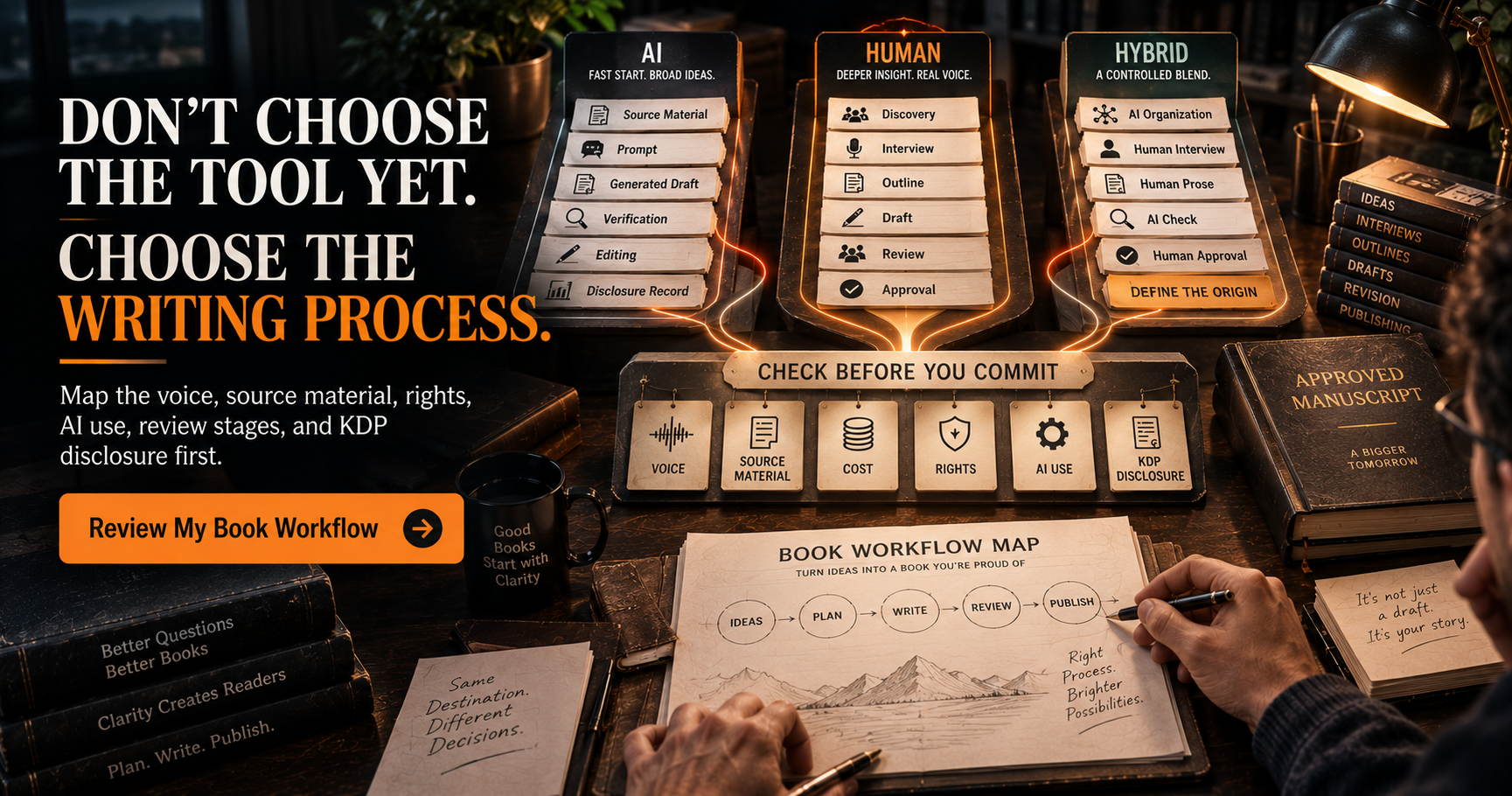
If you know you need help writing the book but are still deciding between AI, a human ghostwriter, or a controlled hybrid process, start with the manuscript rather than the package.
Review Amazon KDP Experts' ghostwriting support or discuss the project's voice, source material, rights, review stages, and publishing route before substantial drafting begins.
If the manuscript already exists and mainly needs refinement, professional book editing may be the more appropriate next step. Once the text is approved, KDP publishing preparation belongs to a separate stage.