Home / Blog / AI Book Cover Copyright
Book Cover Design
August 1, 2026
The cover is finished. The title reads clearly. The artwork fits the story. It even looks good as a small Amazon thumbnail.
Then a harder question appears:
If an AI tool created the main image, what do you actually own?
Paying for the generator does not automatically give you copyright. Paying a designer does not automatically transfer the designer’s rights. Amazon accepting the cover does not confirm that every image, font, likeness, or design element is legally clear.
That is why AI book cover copyright needs to be treated as more than a yes-or-no question. Authors must separate copyright ownership, commercial-use permission, designer rights, third-party licenses, and Amazon KDP disclosure.
Under current U.S. rules, a purely AI-generated cover image generally cannot receive copyright protection on its own because copyright requires human authorship. A finished cover may still contain protected human work, including original illustration, substantial editing, custom lettering, composition, and creative arrangement.
This article provides general information about U.S. copyright and Amazon KDP requirements. It is not legal advice.
Key Takeaways
- Writing a detailed prompt does not usually make you the copyright owner of the output.
- Human-created artwork, edits, typography, and composition may receive protection.
- Commercial permission from an AI platform is not the same as copyright ownership.
- KDP requires disclosure when AI created the actual cover image, even if a person later edited it.
Why AI Cover Ownership Matters More in 2026
AI use is no longer a side issue in publishing.
A North American publishing survey released by BookNet Canada and the Book Industry Study Group in April 2026 received 559 responses from book-industry professionals. Eighty-six percent identified inadequate controls around copyrighted material as their main concern about AI.
That concern reaches beyond the manuscript. It affects:
- Cover artwork
- Interior illustrations
- Audiobook voices
- Marketing graphics
- Author photographs
- Translations
- Manuscript files uploaded to AI platforms
The legal position also became more settled in one important respect during 2026.
On March 2, 2026, the U.S. Supreme Court declined to review Thaler v. Perlmutter, a case involving artwork claimed to have been created autonomously by an AI system. The denial left the lower court’s human-authorship ruling in place. It did not decide every question involving mixed human and AI work, but it confirmed that a machine cannot be named as the author of a U.S. copyrighted work under the current framework.
For authors, the practical question is now clearer:
What visible creative expression came from a person, and who owns that human contribution?
Can an AI-Generated Book Cover Be Copyrighted?
A cover that includes AI-generated material may receive copyright protection, but copyright normally covers only the original human-authored parts.
The U.S. Copyright Office’s AI copyrightability report says that prompts alone do not provide enough human control under generally available AI technology. It also states that human-created modifications, selection, coordination, and arrangement may qualify for protection.
That creates three common situations.
1. The cover consists mainly of raw AI output
You type a prompt, generate several images, choose one, add basic title text, and publish it.
The AI-generated artwork itself may not receive U.S. copyright protection. The ordinary act of selecting one output from several results will not necessarily create enough human authorship.
You may still have permission to use the image under the generator’s contract, but permission and copyright are different rights.
2. A designer substantially develops the AI output
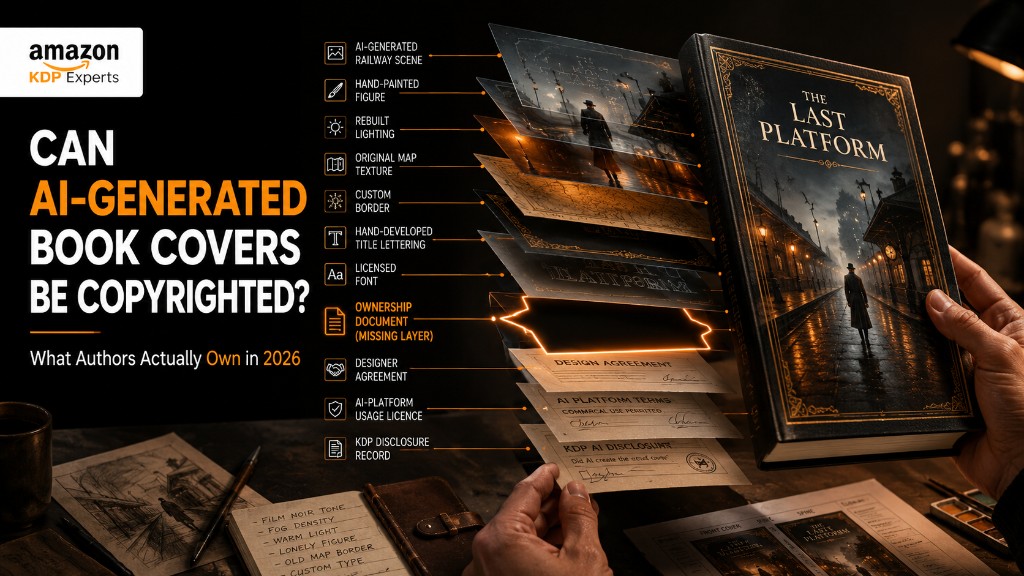
A designer combines several generated images, paints new elements, removes objects, rebuilds the lighting, changes facial features, creates original textures, and designs the complete front, spine, and back cover.
The designer’s original human work may qualify for copyright protection. The underlying AI-generated material may remain outside the claim.
3. AI assists a mainly human-created cover
An illustrator draws the artwork and uses an AI feature only to remove dust, test a background variation, resize an element, or correct a minor production issue.
The human-created artwork can remain protected. The tool acted as an aid rather than the creator of the expressive content.
As the Copyright Office stated:
“Where that creativity is expressed through the use of AI systems, it continues to enjoy protection.”
The Office’s focus remains on the human contribution, not simply whether an AI tool appeared somewhere in the workflow. Read the Copyright Office announcement.
Does a Detailed Prompt Count as Human Authorship?
A prompt can carry considerable thought.
You may specify:
- The setting
- Character appearance
- Lighting
- Color palette
- Historical period
- Camera perspective
- Genre mood
- Symbolic objects
- Emotional tone
That effort still does not automatically give you authorship of the resulting image.
The legal issue is not how long the prompt took to write. It is whether you controlled the final expressive details that appear in the image.
An AI system may ignore part of the prompt, add unrequested details, alter proportions, choose a different visual arrangement, or produce an unexpected interpretation. The user supplies instructions, but the system decides how many of those instructions appear in fixed visual form.
The Copyright Office compares this to giving directions to another creator. Asking for “a lonely lighthouse under a red moon” communicates an idea. It does not necessarily make you the artist who determined the exact brushwork, clouds, shadows, waves, structure, and perspective.
Repeated prompting does not automatically change this result.
Generating 200 versions may demonstrate time and persistence, but copyright depends on human expression and control, not the number of attempts.
What Parts of an AI-Assisted Cover Might You Own?
A book cover should be reviewed as a group of separate assets rather than one flat image.
| Cover element |
Possible rights position |
| Raw AI-generated image |
Commercial-use permission may come from the tool’s terms, but U.S. copyright may not protect the image itself |
| Human illustration |
The illustrator normally owns copyright unless the rights were validly transferred |
| Human retouching and painting |
Original additions may receive protection if they contain enough creative expression |
| Overall composition |
Human selection and arrangement may qualify when the choices show sufficient originality |
| Custom title lettering |
Original illustrated lettering may receive protection as artwork |
| Standard title text |
The words of a book title do not receive copyright protection by themselves |
| Licensed typeface or font file |
Use depends on the font license |
| Stock photograph or texture |
The author receives the rights stated in the stock license, not ownership of the original asset |
| Author photograph |
Rights depend on the photographer’s agreement and any applicable release |
| Finished PDF or JPG |
Possessing the file does not automatically transfer the copyright inside it |
The Copyright Act treats ownership of a file or physical object separately from ownership of copyright. Receiving the final cover file therefore does not, by itself, give an author the designer’s copyright.
Commercial Rights and Copyright Are Not the Same
This distinction causes many author disputes. An AI company may state that paid subscribers can use generated images commercially. That may permit you to place the image on a book, website, advertisement, or social media graphic.
It does not necessarily mean:
- The company guarantees the image does not resemble existing work.
- You have exclusive rights to the image.
- Another user cannot generate a similar image.
- The image qualifies for federal copyright.
- You can stop others from copying the raw AI output.
- Every third-party platform will accept the image.
- A publisher, retailer, contest, or awards body must accept it.
Consider commercial-use terms as one part of the rights file, not the complete answer.
Before using any generator, save a dated copy of the terms that applied when the image was created. Platform terms can change, and the version available six months later may not match the contract you originally accepted.
What Changed After the 2026 Supreme Court Decision?
The Supreme Court did not publish a new opinion creating a detailed AI copyright test.
It simply declined to hear the appeal in Thaler v. Perlmutter.
That distinction matters.
The case involved a work presented as autonomously generated by a machine. It did not decide precisely how much editing, compositing, prompting, masking, painting, or human-directed control makes a mixed AI cover copyrightable.
The practical position remains:
- Pure machine authorship does not qualify.
- Human-authored expression can qualify.
- Protection covers the human contribution, not automatically every AI-generated element.
- Mixed works require a case-by-case review.
- Registration applications must describe the human contribution accurately.
The Copyright Office’s registration guidance for works containing AI-generated material requires applicants to disclose AI-generated content and explain what a human created.
How Much Human Editing Is Enough?
There is no official editing percentage.
You will not find a rule stating that 20%, 40%, or 60% human alteration automatically creates copyright.
The Office looks at the character of the contribution.
Changes that may be too limited
- One-click sharpening
- Automatic upscaling
- Minor color correction
- Removing a small visual defect
- Cropping the image
- Adding standard title text
- Choosing one output from a group
- Applying a basic filter
Changes that may support a stronger human-authorship claim
- Painting substantial new visual elements
- Rebuilding characters or settings
- Combining several source elements into an original scene
- Creating an original foreground and background relationship
- Drawing custom symbols or borders
- Developing custom lettering
- Making detailed spatial and compositional choices
- Incorporating original photographs or illustrations
- Creating a coordinated full-wrap print design
The focus stays on creative expression.
A technically difficult task may still lack protectable authorship if it does not add original expression. A visually simple change may qualify when it reflects a distinctive creative decision.
Who Owns the Cover When You Hire a Designer?
Many authors believe payment settles ownership.
It does not.
Under U.S. copyright law, copyright normally begins with the human creator. If a freelance designer creates original cover artwork, the designer may initially own copyright in that work.
You may have permission to use the design for the book, but that does not necessarily give you:
- The right to alter it
- The right to reuse it for another title
- The right to sell merchandise
- The right to license it to another publisher
- The right to transfer it during a rights deal
- The right to receive the layered source files
A copyright transfer generally needs a written document signed by the owner of the rights being transferred. Section 204 of the U.S. Copyright Act sets out that writing requirement.
Be careful with “work made for hire”
A contract should not rely on this phrase without checking whether the legal requirements actually apply.
Independent-contractor work qualifies as work made for hire only in limited circumstances and when the written agreement meets the statutory conditions. A direct copyright assignment often provides clearer language for a commissioned cover.
A practical agreement should address:
- Human-created artwork
- Human edits to AI-generated material
- Typography and layout
- Front, spine, and back-cover design
- Source files
- Promotional versions
- Audiobook and large-print adaptations
- Translation editions
- Merchandise rights
- Revision rights
- Portfolio use by the designer
- Third-party assets and licenses
- AI disclosure
- Final copyright assignment or license
The Authors Guild’s 2026 model AI clauses also provide a useful current benchmark. Its model cover clause calls for the author’s approval before a publisher uses AI-generated artwork and distinguishes that from human-controlled AI assistance. The clause is guidance, not law, but it shows how publishing contracts are beginning to address the issue.
What Does Amazon KDP Require for AI-Generated Covers?
Amazon KDP requires publishers to inform it when AI created cover or interior images.
KDP uses two separate classifications.
| Classification |
KDP’s description |
Disclosure required? |
| AI-generated |
An AI tool created the actual text, image, or translation |
Yes |
| AI-assisted |
A person created the content and used AI to edit, refine, check, or improve it |
No |
A crucial point often gets missed:
KDP still treats an image as AI-generated when AI created the original content and a person later made substantial edits.
By contrast, if a human created the artwork and used AI only to help edit it, KDP classifies the work as AI-assisted.
KDP also places responsibility on the publisher to check copyright, trademark, brand, privacy, publicity, and other rights. Amazon may reject or remove content that breaches its guidelines and may ask for more information before making the book available. Read Amazon KDP’s current content guidelines.
KDP disclosure and copyright protection answer different questions:
- KDP asks: Did AI create the actual content?
- Copyright law asks: What original expression did a human create?
- Your contract asks: Who owns or may use each human-created element?
- The AI platform asks: What uses does its license permit?
Passing one test does not automatically satisfy the others.
An Illustrative Cover Example
Imagine an author generates an image of a deserted railway station at night.
The raw output contains the station, fog, tracks, and a distant figure.
A human designer then:
- Combines the station from one output with the sky from another
- Paints a new figure by hand
- Rebuilds the lighting
- Replaces the signs
- Creates an original map texture
- Draws a custom border
- Develops the title lettering
- Arranges the complete paperback wrap
- Prepares separate ebook and print files
The rights position might look like this:
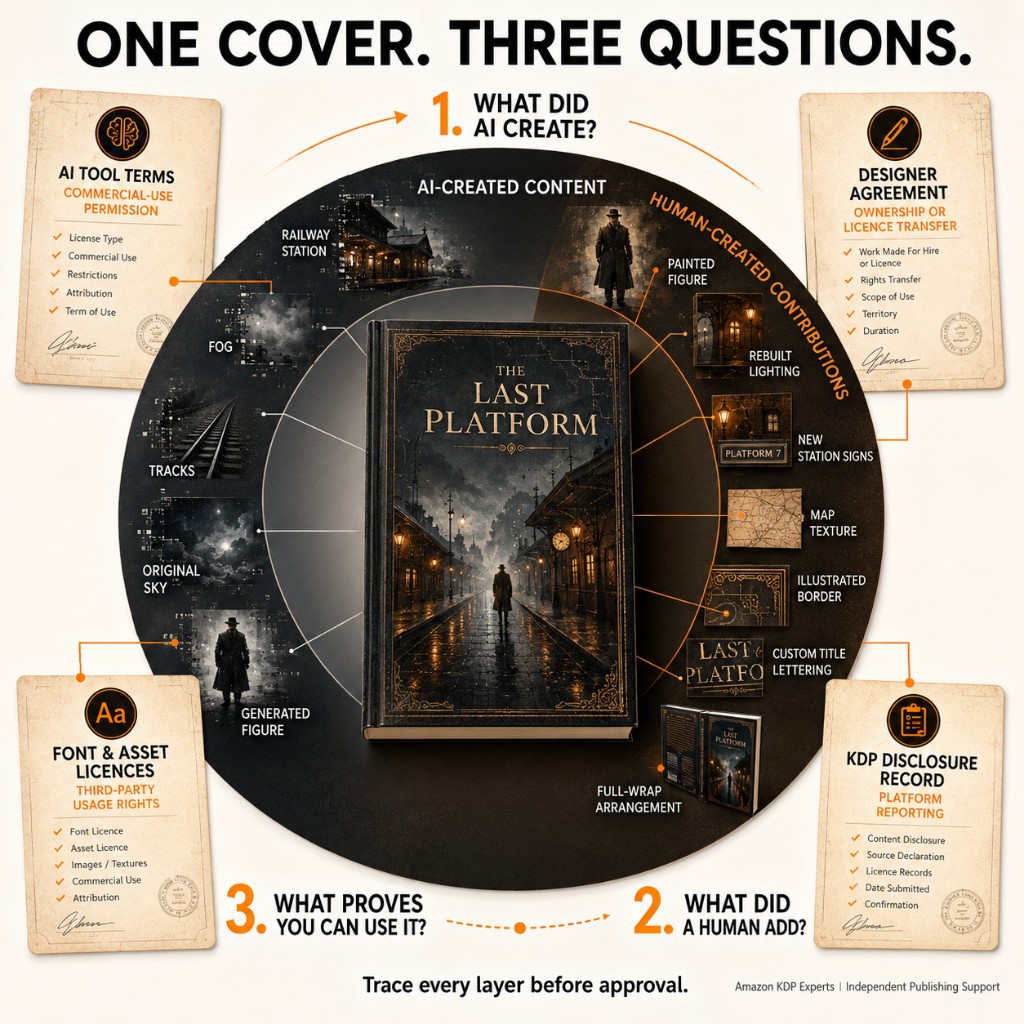
- The raw AI station may not receive copyright protection.
- The painted figure may be protected.
- The new lighting and map texture may be protected.
- The custom border and lettering may be protected.
- The complete human arrangement may receive limited protection.
- The author owns those human-created rights only if the designer’s agreement transfers them.
- KDP disclosure remains required because AI created part of the actual image content.
This is why asking, “Do I own the cover?” is too broad.
Ask instead:
Which layers exist, who created each layer, and what document gives me the right to use or own it?
Use the COVER Rights Check Before Approval
A practical rights review does not need to begin with legal terminology. Use the COVER check.
C: Creation
Who created every visible element?
Record whether each part came from:
- A human illustrator
- An AI generator
- A stock library
- A photographer
- A font provider
- A template
- A previous edition
- The author
O: Ownership
Who currently owns the human-created material?
Do not assume the person paying the invoice owns the rights.
V: Vendor Terms
What do the AI tool, font provider, stock platform, template marketplace, and designer agreement permit?
Check commercial use, exclusivity, modification, resale, and sublicensing.
E: Evidence
Can you prove how the cover was created?
Keep:
- Drafts
- Sketches
- Layered files
- Prompt history
- Edit history
- Invoices
- Licenses
- Releases
- Approval emails
- Signed agreements
R: Reporting
What must you disclose?
Check both:
- Amazon KDP’s AI-content question
- The U.S. Copyright Office registration application
The COVER check turns a vague ownership concern into five records an author can verify.
Five Steps to Protect an AI-Assisted Cover Before Publishing
1. Build an asset list
Write down every image, texture, font, photograph, icon, illustration, and AI output used in the final design.
Do not limit the review to the main artwork. A small stock texture or font file can still carry a separate license.
2. Separate AI work from human work
Mark which parts came directly from the generator and which parts a person created or changed.
Ask the designer for a plain-English description of the workflow.
3. Read the current licenses
Check the AI platform terms, stock license, font agreement, and any template restrictions.
Save copies with the project files.
4. Put the designer’s rights in writing
State whether you receive:
- Ownership
- An exclusive license
- A nonexclusive license
- Source files
- Adaptation rights
- Promotional rights
- Rights for future editions
Avoid relying on “full rights included” without defining what that phrase covers.
5. Complete KDP disclosure accurately
Tell KDP when AI created actual cover content.
If you later apply for copyright registration, describe the human authorship and exclude AI-generated material from the claim where required.
Before starting the upload, authors may also find it useful to review these self-publishing mistakes that commonly delay first-time KDP projects.
Common AI Cover Mistakes Authors Should Avoid
Assuming a paid plan gives exclusive ownership
A paid account may give commercial permission while allowing other users to create similar material.
Do this: Save the relevant license and check whether the rights are exclusive.
Not that: Treat the subscription invoice as a copyright certificate.
Uploading without asking the designer about AI
A designer may use generative tools without mentioning them unless the project brief or contract asks.
Require written disclosure of AI-generated content before approving the design.
Treating KDP approval as legal clearance
Amazon reviews the book under its platform rules. It does not act as your copyright lawyer.
Registering the whole cover without disclosing AI material
The Copyright Office requires applicants to explain human contributions and disclose AI-generated content included in the submitted work.
Accepting only a flat JPG
A flat image may be enough to upload, but it provides little evidence of the human design process.
Request the layered source file where the project scope allows it.
Copying a living artist’s recognizable style
A style request may create ethical, contractual, publicity, or infringement concerns even when “style” itself is not protected in the same way as a specific copyrighted work.
Avoid prompts that ask for a close imitation of a named working artist.
When Can You Handle the Cover Yourself?
A self-managed workflow may be reasonable when:
- The design uses your own photography or illustration.
- Every third-party asset has a clear commercial license.
- The cover uses simple typography.
- You understand ebook and print-cover requirements.
- You do not need exclusive control over the AI artwork.
- The project does not involve recognizable people, brands, characters, or protected properties.
- You have documented the creation process.
When Does the Cover Need Professional Review?
Consider professional design or publishing support when:
- Several AI and stock assets have been combined.
- A designer’s ownership terms remain unclear.
- The book will have multiple formats or editions.
- The cover supports a business, course, speaking career, or valuable intellectual property.
- You plan to license translation, audio, film, or foreign rights.
- The artwork includes a recognizable person.
- KDP has rejected or questioned the cover.
- You plan to register the cover with the Copyright Office.
- You cannot identify where every visual element came from.
A complex cover can involve design, licensing, file preparation, and platform disclosure at the same time. That is where coordinated KDP publishing support for completed or near-complete books can help authors review the production path before the files reach the upload stage.
What Professional Cover Support Should Include
A useful cover service should provide more than an attractive front image.
Ask for:
- A written creative brief
- Genre and audience direction
- AI-use disclosure
- Asset and font records
- Commercial-use checks
- Human design and retouching
- Ebook cover export
- Full paperback or hardcover wrap
- Spine and bleed calculations
- Barcode-safe placement
- Layered source files where included
- Revision limits
- Final approval rights
- Written ownership or license terms
- A list of final deliverables
The author should retain control over the book concept, approval, KDP account, publishing decisions, and final files.
Final Thoughts: Know the Rights Behind the Image
An AI-generated book cover may look complete long before its ownership record is complete.
The strongest position does not come from writing the longest prompt or purchasing the most expensive AI plan. It comes from knowing which parts a human created, checking every third-party license, obtaining clear written rights from the designer, preserving the project records, and answering KDP’s disclosure question accurately.
AI book cover copyright is therefore not one right attached to one file. It is a set of rights, permissions, and responsibilities connected to different parts of the design.
Before approving the cover, ask one final question:
Could you explain where every important element came from and why you have the right to publish it?
When the answer is clear, the cover is much closer to being ready.
Need Help Reviewing the Cover Before Upload?
A finished cover should come with clear files, clear permissions, and clear approval rights.
Amazon KDP Experts provides independent book-production and publishing preparation support for authors who need help reviewing their cover, formatting, and KDP-ready files. Discuss your book and current cover stage before beginning the upload.
Amazon KDP Experts is an independent publishing-services company and is not affiliated with, endorsed by, or sponsored by Amazon.com, Inc. or Kindle Direct Publishing.